
Peer Reviewed
Disinformation in practice: Threats, actors, mechanisms, and constraints according to practitioners
Article Metrics

0
CrossRef Citations
PDF Downloads
Page Views
How do the practitioners charged with fighting disinformation understand the problem they are meant to solve? We surveyed 106 French practitioners across military, government, regulatory, civil-society, and media organizations. These practitioners converge on an upstream, supply-side diagnosis (platforms and amplification structures, rather than public demand, drive the spread of disinformation) but describe a field blocked by weak coordination, scarce resources, and fear of censorship accusations. Their relationship to science adds to these constraints: while most practitioners trust peer-reviewed research, few engage with it directly. Nearly all expect disinformation to become a greater threat, and only 13% believe institutions will be able to contain it.

Research Questions
- How do counter-disinformation practitioners perceive the threat of disinformation, its trajectory, and those responsible for it?
- In the practitioners’ view, why do people believe disinformation, and what makes it spread?
- What operational, legal, and ethical constraints hinder practitioners’ actions?
- How do practitioners access and use scientific research, and how do their views compare with scientists’?
Essay Summary
- Practitioners broadly share an upstream, supply-side diagnosis of disinformation, identifying platforms, algorithms, and organized actors as more important drivers of the problem than citizens’ demand for false content.
- This shared diagnosis does not translate into effective action: practitioners report that governments call the fight against disinformation a priority but withhold the coordination, resources, clear mandates, and shared indicators an effective response requires.
- Practitioners rank the fear of being accused of censorship among their top obstacles, yet most say they rarely or never face ethical dilemmas: what inhibits them is not moral conflict but the accusation they anticipate.
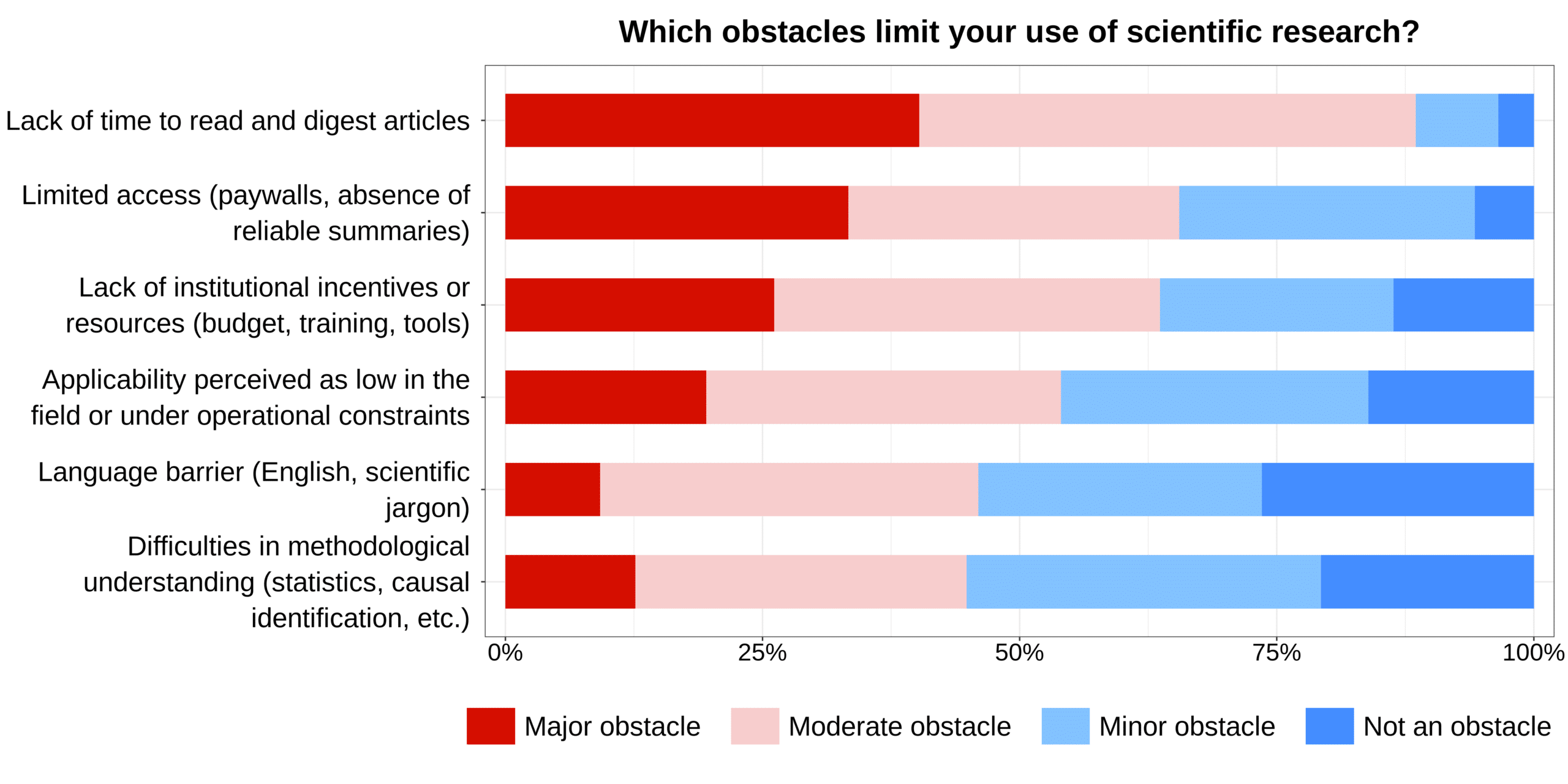
- Scientific research is trusted but rarely read firsthand. Most practitioners rely on press coverage and gray literature, leaving practice largely dependent on secondhand interpretations of the evidence base. The barriers they report are mainly organizational (lack of time, paywalled access, weak institutional incentives), and most read about disinformation in French while the literature is largely in English.
- Set against academics surveyed in 2022 (Altay, Berriche, Heuer, et al., 2023), practitioners agree on well-established drivers of belief in disinformation, such as confirmation bias and repetition, but judge its electoral impact larger and give less weight to institutional distrust. This comparison is descriptive, as the two surveys differ in instruments and timing.
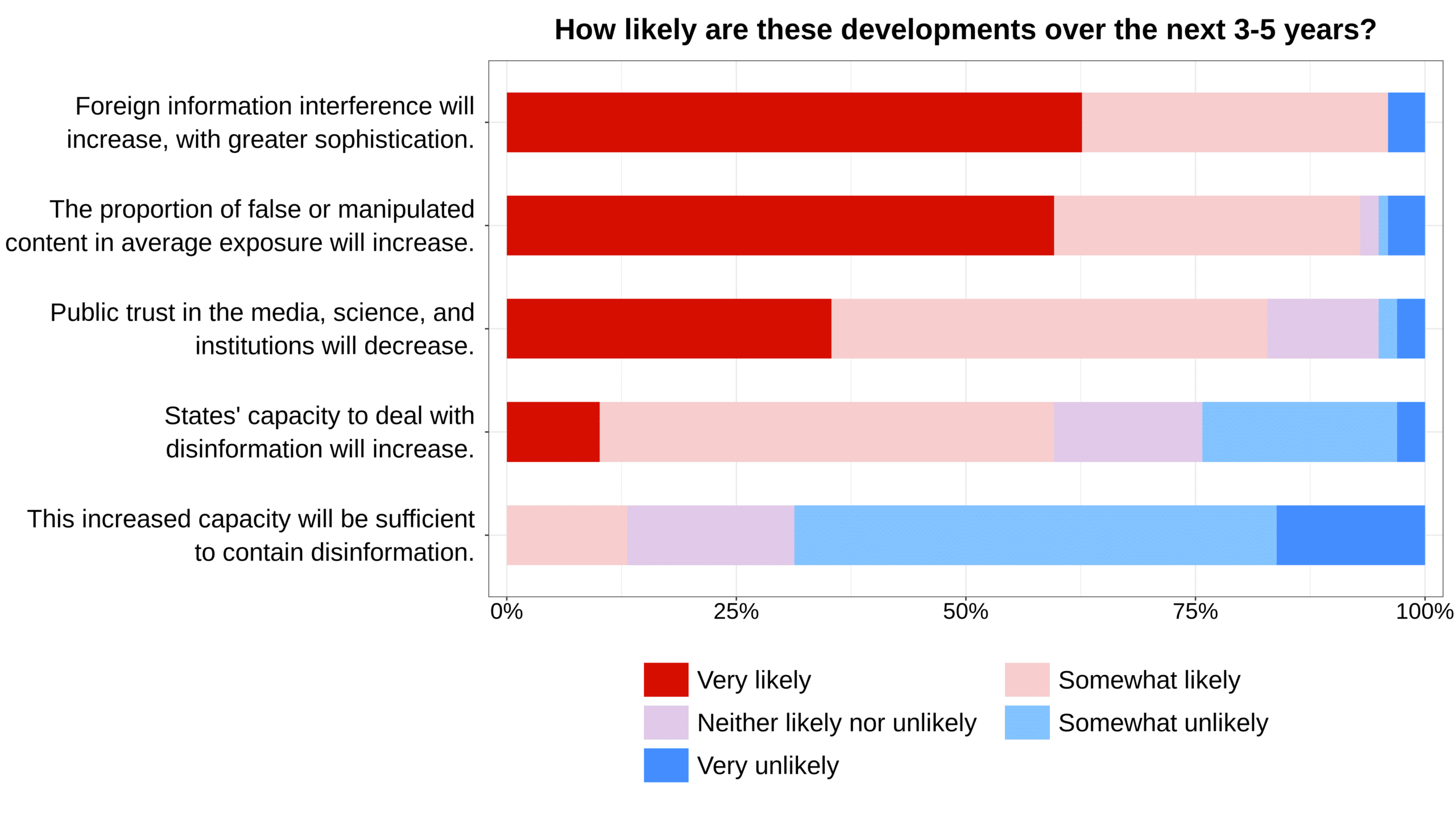
- Nearly all practitioners expect disinformation to become a greater threat, and only 13% believe institutions will be able to contain it.
- Practitioners need research translated into their working language, shared measures of exposure and effects rather than activity counts, clearer coordination, and transparent safeguards that make legitimate intervention defensible.
Implications
The people who shape and carry out democracies’ responses to disinformation are not scientists. They are civil servants, military officers, and regulators. Yet these practitioners remain largely unstudied. Recent surveys have mapped what scientists and experts think about misinformation (Altay, Berriche, Heuer, et al., 2023; Altay et al., 2025; Kruger et al., 2024), but not the practitioners who act on that knowledge.
We surveyed 106 French practitioners engaged in counter-disinformation work: senior figures such as members of the offices of the President and Prime Minister, officials in the ministries of Foreign Affairs and Health, military and intelligence officers, executives of independent regulators (such as the audiovisual regulator ARCOM and the telecommunications regulator ARCEP), and journalists specialized in fighting disinformation (see Appendix A for sampling and inclusion criteria). This study documents how counter-disinformation practitioners in a national setting understand the threat and identifies where institutional responses risk falling short of the evidence they claim to rely on.
This article uses “disinformation” as French practitioners and institutions do: as an umbrella term, broader and more heterogeneous than researchers’ usage (Wardle & Derakhshan, 2017), routinely extended to misinformation, malinformation, and information manipulation at large (Darcy, 2026a, pp. 7–10; Appendix H). Even within the French field, the term’s meaning follows each institution’s mandate: security institutions (the armed forces, the Foreign Affairs Ministry, and VIGINUM, the government service against foreign digital interference) work with the narrower lens of foreign information manipulation and interference (FIMI), while journalists and educators confront the broader spectrum. We therefore imposed no definition on respondents.
By “counter-disinformation practitioners” we mean people who, by virtue of their position, hold responsibility for preventing, monitoring, analyzing, regulating, or responding to disinformation in this broad sense (see Methods). What unites them is functional rather than conceptual—a mandate within the response system, exercised under institutional or organizational constraints, not a shared profession, toolkit, or definition of the problem. Whether their understandings converge is therefore an empirical question, and the findings show that there is convergence on the diagnosis but divergence on obstacles and research use.
Research and practice form two communities, with distinct incentives, vocabularies, and timelines (Caplan, 1979; Weiss, 1979). In neighboring fields such as advertising and crisis communication, practitioners act on implicit theories that develop largely independently of academic findings (Claeys & Opgenhaffen, 2016; Kover, 1995; Nyilasy & Reid, 2009). Because knowledge translation must be tailored to the receiving community’s beliefs and constraints (Oliver et al., 2014; Ward et al., 2009), documenting what practitioners believe, read, and face is a prerequisite for any research-to-practice effort.
Most of the practitioners we surveyed were trained in the social sciences and communication studies and report little formal research training, a sample profile oriented toward institutional analysis and operational response rather than research production or consumption (see Methods and Appendix A). This background plausibly leads them to frame the problem in terms of cases, discourse, and institutions more than quantitative data.
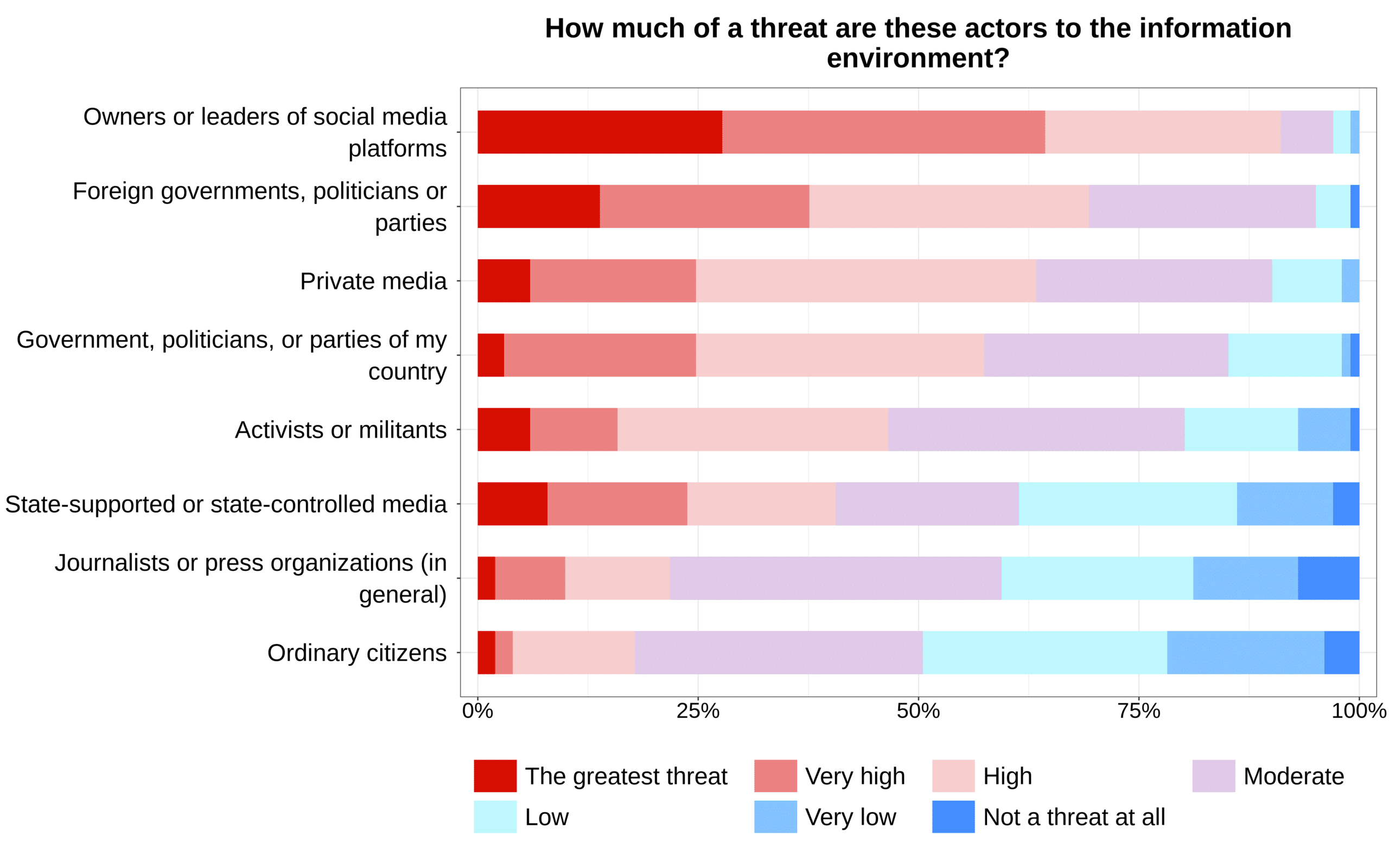
Practitioners share an upstream, supply-side understanding of the disinformation problem: they trace the problem to the production and amplification of false content and give little weight to the public’s demand for such content (see Finding 2 below). Nine in ten rate social media platform owners as a major threat to the information environment, while ordinary citizens come last by a wide margin. The same supply-side logic shapes how they explain the spread of disinformation: large majorities attribute that spread to platform algorithms and to mass distribution by producers and platforms, whereas the idea that the public actively seeks out such content divides them.
In a descriptive comparison with about 150 academic scientists surveyed by Altay, Berriche, Heuer, et al. (2023), practitioners agree on well-established drivers of belief in disinformation but differ on contested questions. They rate the electoral impact of misinformation far higher and give less weight to institutional distrust, which scientists treat as central to vulnerability (see Finding 6 and Appendix C). This points to a selective diagnosis. By overweighting supply-side factors and individual credulity while underweighting the social and institutional conditions that make misleading claims persuasive, the field risks designing interventions that miss the deeper drivers of the problem.
This common diagnosis is not matched by a shared capacity to act. Practitioners report facing numerous concrete obstacles (Finding 3). The leading obstacle, which three in four respondents rate as serious, is a gap between rhetoric and action, and the complaint comes from inside the state. Officials, officers, and regulators report that counter-disinformation is proclaimed a priority without the resources, coordination, and indicators it requires. Most of these obstacles are structural. Institutions are asked to respond to a politically sensitive threat under fragmented authority, ambiguous mandates, and uncertain legitimacy, conditions under which even a shared diagnosis fails to produce action.
A further obstacle concerns knowledge itself. The research that could broaden this selective diagnosis rarely reaches practitioners directly (Finding 4). The issue is engagement, not trust in science. Seven in ten respondents trust peer-reviewed research to guide their decisions, yet only about a third keep up with it, relying instead on the press and gray literature. Language sustains the pattern, since nearly all read about disinformation primarily in French, a language in which far less of the literature is available.
The main barriers to scientific engagement are organizational. Lack of time, limited access to publications, and weak institutional incentives all rank above low perceived applicability, the language barrier, and methodological difficulty, though self-reports may understate the last two (Finding 4). Perceived applicability and the language barrier both vary sharply by role (Appendix D). Research is trusted in principle but consumed through intermediaries, which could create gaps between what practitioners believe the evidence shows and what it actually supports.
Whether this selective, supply-side diagnosis reflects incomplete uptake of the evidence or limits in the evidence itself can be partly answered item by item. The first reading, incomplete uptake, holds on the two divergences noted above, where current evidence does not support the practitioner position. On elections, the best available evidence finds little sign that misinformation decides outcomes (Allcott & Gentzkow, 2017; Budak et al., 2024; Eady et al., 2023). On trust, comparative research treats institutional trust as central to vulnerability (Ejaz et al., 2025; Humprecht et al., 2020), and low institutional trust is widely recognized as making people more receptive to misinformation, even by researchers who disagree about misinformation’s societal effects (Altay & Mercier, 2026; Tay et al., 2026). This makes practitioners’ low ranking of institutional distrust all the more notable. The second reading, limits in the evidence, is also plausible: a literature that is largely Anglophone, platform-centric, and focused on average population effects may say less about the targeted foreign operations many respondents confront. Exploratory analyses do not settle the question: respondents who engage most with research find it neither more nor less applicable than those who rarely do (all |ρ| ≤ .18; Appendix I).
A third reading ties the other two together and may help explain the supply-side diagnosis (Finding 2), though our data cannot test it. Institutions tend to diagnose the problem in terms of what they can measure. Disinformation’s effects are hard to measure, and prevention that works leaves no trace, since success means the expected harm never happens. So, institutions count what they can see instead—the attempts they detect, mostly online. That focus on the digital, upstream side steers action toward the reactive policies whose results they can show. Acting at this level makes the technology-centered diagnosis look right, so it confirms itself. This dynamic is well documented in public administration. When measurable objectives stand in for hard-to-measure goals, indicators come to define the activity they monitor (Bevan & Hood, 2006; Campbell, 1979), and counter-disinformation is unusually exposed: its ultimate goal (an information environment citizens can trust) is among the hardest outcomes to measure, while its operational objectives (campaigns detected, content removed) are easier to count. Even impact metrics sit upstream of the harms that justify the policy, since institutions reach for engagement counts and declared beliefs, yet likes are not beliefs, and beliefs are not actions (Altay, Berriche, & Acerbi, 2023; Budak et al., 2024). Research faces the same constraint, since its evidence concentrates where data are accessible. The supply-side convergence of practitioners and scientists may therefore partly reflect shared observability limits rather than independent assessments.
None of this is inevitable, and each reading points to its own remedy. Incomplete uptake calls for translating what already exists more than for new studies: rapid briefs, short syntheses, and permanent brokerage roles that connect existing research to training, doctrine, and operational decisions in practitioners’ working language. Limits in the evidence call for the reverse flow, carrying practitioners’ operational questions back into research agendas. The measurement loop calls for measuring the outcomes that matter rather than the activity that is easiest to count.
Respondents do not experience these challenges uniformly. Educational background is the most consistent source of variation, especially in perceived obstacles to action (Appendix D). Research engagement and censorship fear also vary by role, with fear of censorship accusations highest among normative, regulatory, and public-protection roles and lowest among cybersecurity practitioners. Mandates and objectives diverge, too. Practitioners face different threats, use different tools, and define success differently.
Our findings have implications for institutions, researchers, and the infrastructure between them. We focus on how the response system could work better (its coordination, its evidence base, and the links between them) rather than on which interventions work, a question that existing reviews and guides already cover (Appendix J).
For institutions, coordination should accommodate the diversity across roles rather than flatten it. A single framework that assumes all practitioners see the problem alike would serve some roles and be distrusted by others. A limited set of common indicators (exposure, incident response, coordination quality, effects), embedded in clear mandates and auditable safeguards, would be a way out of this measurement loop.
For researchers, this diversity of mandates means there is no single standard for “fighting disinformation.” Success for an educator (accurate beliefs) may mean nothing for a regulator (compliance) or an officer (attribution). The evidence base is just as fragmented. Psychology and communication study corrections, literacy, and inoculation (Ecker et al., 2022); security, intelligence, and computer science study attribution and deterrence; some problems, like evaluating institutional responses, fall to no field at all.
The infrastructure between them could translate research into different products for different professions (a legal memo, a threat report, a classroom resource) rather than one brief for all. One speculative arrangement would combine measurement and knowledge translation in a standing observatory of the information environment, building the indicators current instruments miss and deploying the knowledge translation mechanisms the evidence-use literature has tested; its precedents, mechanisms, and design risks are in Appendix J.
This is pressing because practitioners expect deterioration (Finding 5). Nearly all foresee more foreign interference and more false content in users’ feeds over the next three to five years, and most expect declining trust in media, science, and institutions. Yet, only one in eight believes the response will be sufficient, and practitioners see no trajectory that closes the gap under current arrangements.
These findings have limitations. The sample is non-random, France-centered, state-weighted, and thin in some sectors; a dedicated comparison found no public–private differences on the substantive questions, though low precision means this is not evidence of equivalence (Appendix D). Recruitment ran partly through defense and security networks, possibly tilting the sample toward foreign-threat and supply-side framings. All measures are self-reports of what practitioners believe, read, and face, not what they do, and with no imposed definition, answers may reflect heterogeneous understandings of “disinformation,” which we treat as part of the object of study but which limit comparability. Subgroup analyses are exploratory, resting on uneven group sizes and variable response rates (Appendix A). The scientist comparison is likewise descriptive rather than confirmatory, because it sets side by side two surveys with different designs (different instruments, response scales, languages, populations, and fielding periods), so item-level contrasts should be read as indicative only (Appendix C). Respondents mandated to counter disinformation may overstate its prevalence or severity. Yet, because they select detection instruments, draft regulations, and decide when to intervene, their perceptions are consequential.
The French setting, however, is not only a limitation. As a European Union (EU) and North Atlantic Treaty Organization (NATO) member, France is covered by the Digital Services Act (DSA), into which the Code of Practice on Disinformation was integrated in 2025, and has built one of Europe’s most institutionalized counter-disinformation apparatuses (e.g., VIGINUM and a national strategy adopted in 2026), making it both a leading case and, increasingly, a reference point for partners (Darcy, 2026a, pp. 101–106; Appendix H). At the same time, it concentrates features common to many democracies—fragmented responsibility, strong security salience, and uneven access to an overwhelmingly Anglophone literature—so its lessons are unlikely to be France’s alone. Replication across national settings would clarify which patterns are specific to France and which reflect structural features of democratic counter-disinformation more broadly.
Findings
Finding 1: Practitioners treat disinformation as a first-order societal threat, on par with democratic decline and climate change, and attribute broad macro-political effects to it.
Nearly all respondents (96%) rate disinformation as an important or very important societal problem. Most place it at roughly the same level as democratic decline (69%), climate change (62%), and armed conflict (57%), rather than clearly above them (Figure G1). Practitioners also attribute broad consequences to disinformation: large majorities view foreign campaigns as a major threat to democracy (90%) and believe disinformation sustains Russian support for the war in Ukraine (87%), fuels vaccine hesitancy (81%), enables voter manipulation (80%), and erodes trust in the state (78%; Figure G2). Although existing research has found limited and context-dependent evidence for misinformation effects on voting behavior (Allcott & Gentzkow, 2017; Budak et al., 2024; Eady et al., 2023), 83% agree that a disinformation campaign can decisively change an election result. Agreement is somewhat lower on the specific case of Trump’s 2016 election (71%), which suggests that practitioners see disinformation as a greater threat in the abstract than in a concrete case. This threat assessment is anchored in direct experience: a majority of respondents (57%) report that their institution has already been directly targeted by disinformation, while 21% do not know, suggesting that even organizations engaged in counter-disinformation cannot always tell whether they have been targeted (Figure A1).
Finding 2: Practitioners share an upstream, supply-side diagnosis: they locate responsibility in platforms and amplification structures, explain belief through cognitive and algorithmic mechanisms, and give less weight to institutional distrust than scientists do.
Threat attribution is concentrated on actors who shape the information environment. Nine in ten practitioners rate social media platform owners as a major threat, and nearly three in ten name them the single greatest threat (Figure 1). Foreign governments rank next (69%), followed by private media (63%) and domestic politicians (57%). Ordinary citizens are rarely treated as major drivers (18%). As in the International Panel on the Information Environment’s survey of 412 researchers (IPIE, 2024), which used the same actor list and scale, platform owners rank first and ordinary citizens and journalists last. Practitioners, however, are more alarmed about platform owners (91% vs. 64%) and private media, and they rank foreign actors above domestic politicians (69% vs. 57%), whereas researchers did the reverse (50% vs. 56%).
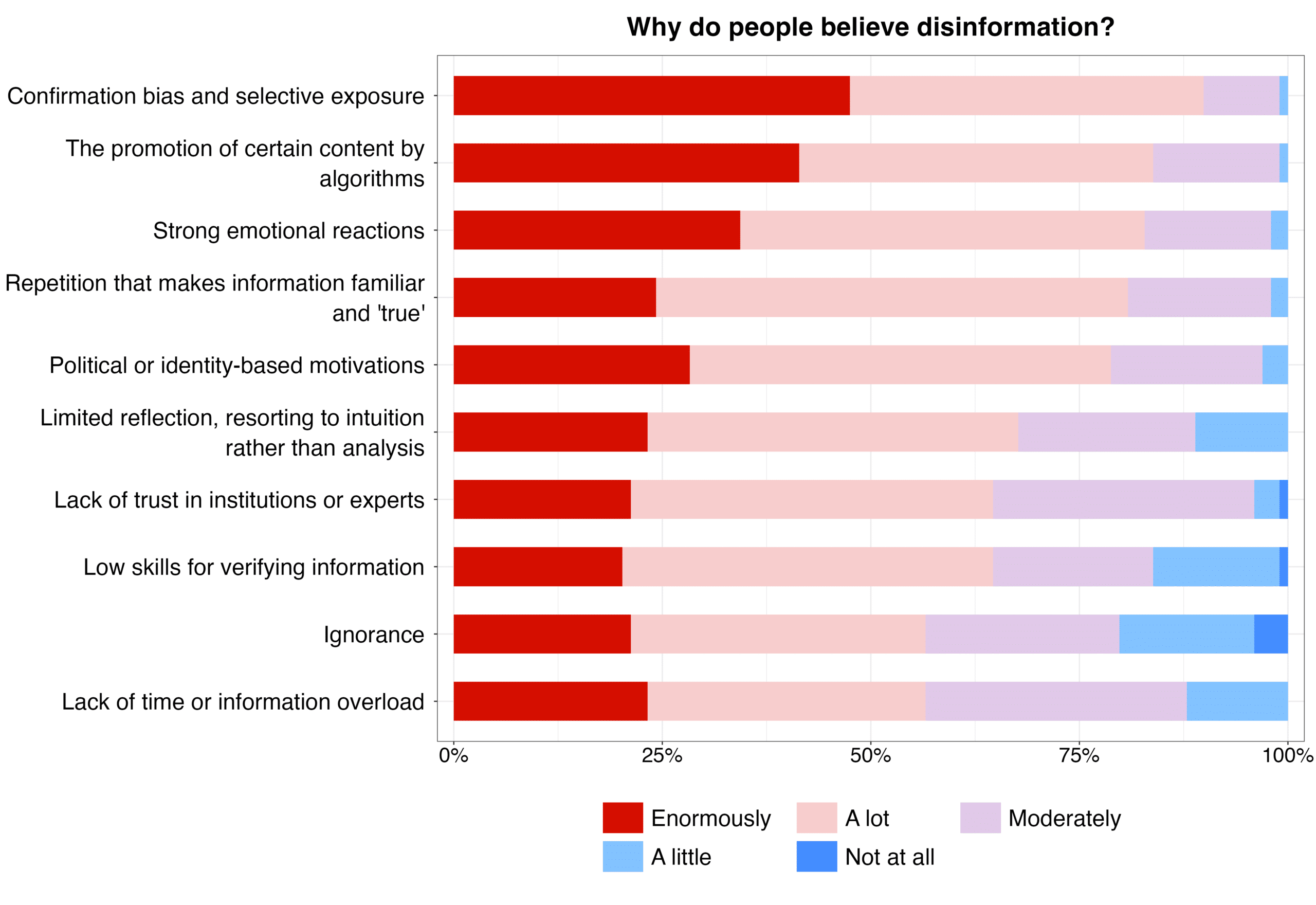
Beliefs about how disinformation spreads follow the same logic. Large majorities agree that platform algorithms strongly influence political opinions (85%) and that producers and platforms distribute misleading content on a massive scale (76%; Figure G3). The idea that the public actively seeks out such content divides the sample nearly in half (39% agree, 43% disagree). On belief drivers, the most prominent explanations are confirmation bias and selective exposure (90%) and algorithmic promotion (84%), followed by emotional reactions, repetition, and identity-based motivations (Figure 2).1As worded in the survey, confirmation bias and selective exposure is a way of handling information (“one avoids contrary information and prefers information favorable to oneself”) that can serve any prior belief. Political or identity-based motivation is a reason for wanting a conclusion (“one believes what reinforces one’s side or one’s identity”), which may or may not work through that mechanism. Altay, Berriche, Heuer, et al. (2023) also keep them separate, and here the two ratings correlate only moderately (Spearman ρ = .47, n = 99). Both were closed lists with a limited set of options, so neither covers every possible explanation.
A notable result is the relatively modest place of institutional distrust, which the academic literature often treats as a central condition of vulnerability (Ejaz et al., 2025; Humprecht et al., 2020). In short, practitioners frame disinformation as a supply-side problem, driven by infrastructure and amplification acting on cognitive vulnerabilities, and give less weight to audience demand.
Finding 3: The top obstacles to fighting disinformation are a rhetoric-action gap, reactive policies, and platform power, compounded by anticipatory fear of censorship accusations.
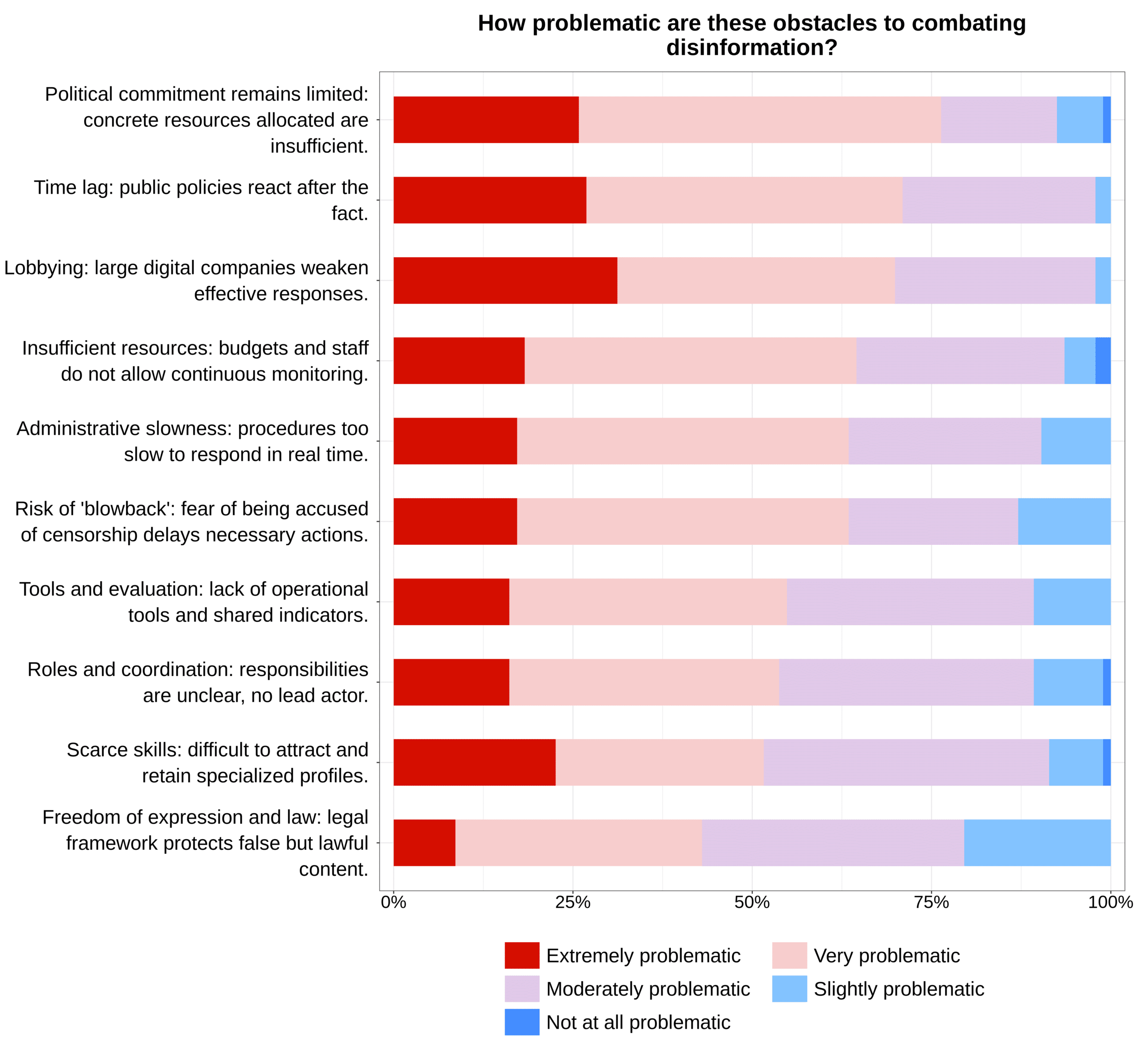
The most important obstacle, rated very or extremely important by three in four practitioners (76%), is that counter-disinformation is proclaimed a political priority while concrete action remains insufficient (Figure 3). The next most cited obstacles are reactive policies that lag behind new tactics (71%) and the influence strategies of large digital companies (70%). Structural constraints compound the picture, each cited by a majority of respondents (52–65%): insufficient budgets and staff, administrative slowness, the lack of operational tools and shared indicators, unclear roles and coordination with no lead actor, and difficulty attracting and retaining specialists. Fear of censorship accusations also ranks high (63%), yet only one in five practitioners (21%) reports encountering actual ethical dilemmas often in daily work, while more than six in ten (62%) encounter them rarely or never. The constraint appears largely anticipatory. What inhibits practitioners is mainly the prospect of being accused of overreach.
Finding 4: Practitioners trust scientific research but rarely engage with it directly.
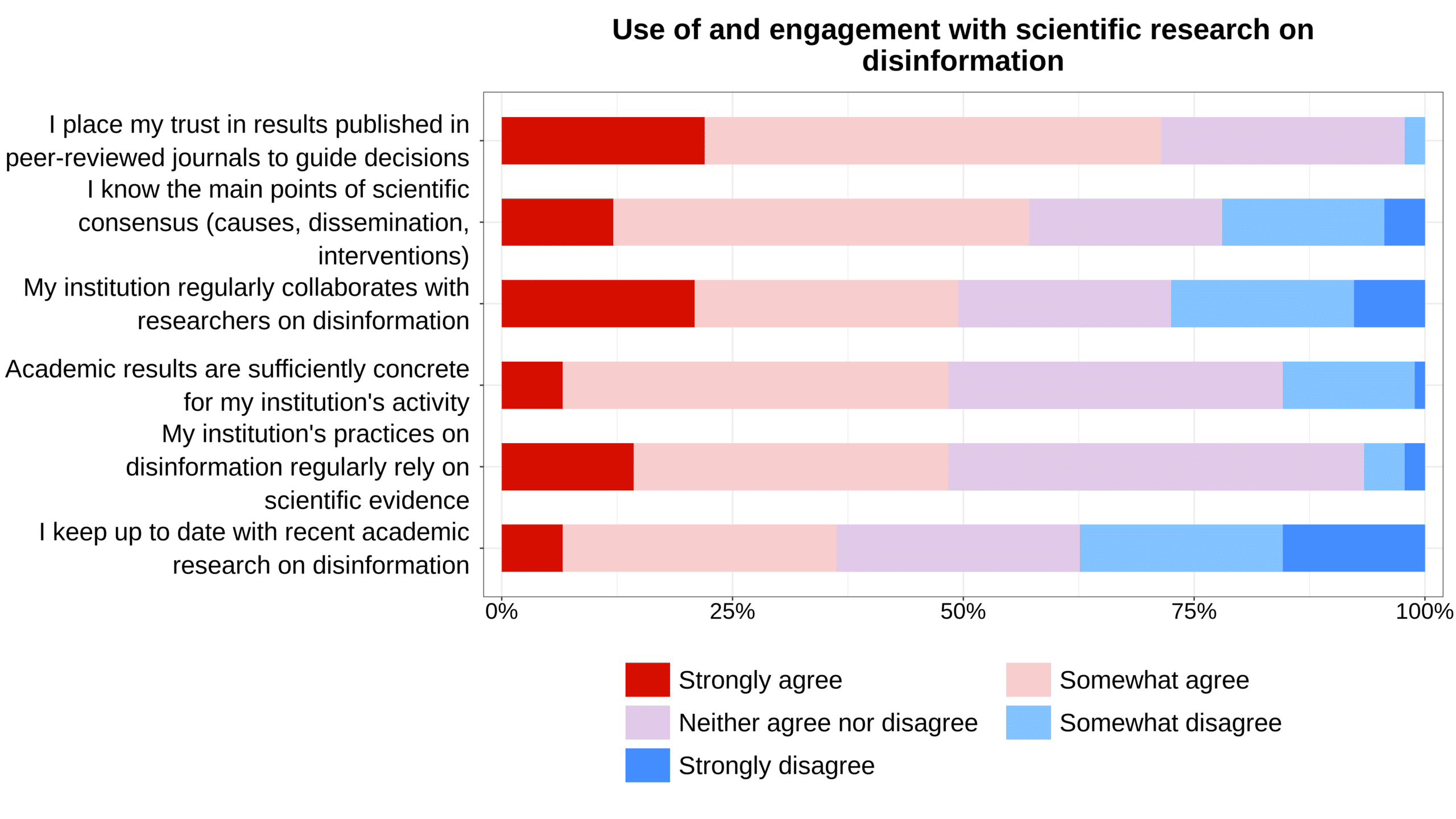
Nearly three in four practitioners (71%) say they trust peer-reviewed research to guide their decisions, but only about a third (36%) report keeping up with recent academic work (Figure 4). Nearly all (88%) read about disinformation primarily in French, a language in which far less of the scientific literature is available. The most frequent sources are the press and gray literature, with scientific articles secondary (Appendix G, Figure G4). The barriers are organizational: lack of time, limited access to publications, and weak institutional incentives all rank above methodological difficulty or skepticism (Figure 5).
Because these items ask respondents to judge their own competence, they may be affected by social desirability: admitting difficulty with methods or scientific English is more face-threatening than citing lack of time or access. The ranking should therefore be read with caution, and the 45% reporting methodological difficulty as a likely lower bound. The French setting may reinforce this under-reporting. French administrative elites are selected and legitimized through extensive, formalized general knowledge rather than specialized expertise (Mangset, 2017), and only 4% of our respondents have a research background (they hold or are preparing a doctorate, or work in higher education or research), so many may not recognize what they miss when reading a study. Two features temper this concern, however: answers were anonymous, and respondents readily gave other potentially face-threatening answers, admitting low engagement with research and reliance on French-language sources.
Finding 5: Practitioners expect the threat to worsen and do not believe institutional capacity will keep pace.
Nearly all respondents anticipate increases in foreign interference (96%) and in false or manipulated content in ordinary users’ feeds (93%) over the next three to five years (Figure 6). Large majorities also expect declining trust in media, science, and institutions (83%). On the response side, six in ten (60%) think state capacity will increase, but only one in eight (13%) believes future capacity will be sufficient, while more than two in three (69%) judge that outcome unlikely.
Finding 6: Respondents converge on the diagnosis but diverge on obstacles and research use, with educational background the most consistent source of variation, and their views sometimes differ from scientists’.
Variation within the sample was assessed with linear mixed-effects models across three grouping variables (organizational type, educational background, and practitioner role; 60 omnibus tests, Appendix D). One effect survived multiple-testing correction: perceived obstacles to action varied by educational background (raw p < .001, adjusted p = .007, η²p = .23). Respondents trained in computer and data sciences (n = 11) rated obstacles as less severe overall (block mean 3.19 vs. 3.71–3.95 in the other fields; lower on nine of the ten items), while the ranking of obstacles did not differ detectably (group × item interaction, p = .587). Ranked by the variance of subgroup means, variation was strongest for obstacles to action and barriers to using scientific research, and weakest for perceived impact and expected future developments. The subgroup patterns are exploratory, given the study’s precision limits (Appendix B). A dedicated comparison of public-sector and private respondents found no detectable difference in the substantive diagnosis (Appendix D).
We also compared respondents’ answers with those of about 150 academic scientists surveyed by Altay, Berriche, Heuer, et al. (2023), on six closely matched items (see Appendix C). Because the two surveys differed in instruments, response scales, language, populations, and timing (fielded in 2022 and in 2025–2026, on either side of the 2024 U.S. election), the comparison is descriptive. The two groups give similar ratings to well-established mechanisms (confirmation bias, repetition) and diverge sharply on the role of disinformation in the 2016 U.S. election, which practitioners rate far higher (d = 0.89), and on lack of trust in institutions, which scientists rate higher (d = −0.46). Convergence thus concentrates on well-established psychological mechanisms. On contested items, practitioners favor explanations centered on individual credulity and campaign power, while scientists give more weight to the structural conditions that make audiences receptive, such as eroded institutional trust. The full item-by-item comparison and its caveats are in Appendix C.
Methods
The target population comprised practitioners holding official responsibility for preventing, monitoring, analyzing, regulating, or responding to misleading, manipulated, or hostile informational content. Academic researchers were excluded by design; their beliefs have been documented elsewhere (Altay, Berriche, Heuer, et al., 2023). No sampling frame exists for “disinformation practitioners” in France, so we maximized coverage through organizational charts, conferences, interagency initiatives, practitioner networks, and snowball referrals. The sample should not be interpreted as a random draw. Consistent with the institutional usage described above, the questionnaire did not impose a definition of disinformation; items used the term as it circulates among French practitioners.
Recruitment proceeded in two waves (September 2025–February 2026). Wave 1 contacted practitioners directly within state institutions and major non-governmental organizations (n = 85, 80%); Wave 2 disseminated an anonymous Qualtrics link through practitioner association channels (n = 21, 20%; see Appendix E for wave composition). Of 123 consented responses, 106 met inclusion criteria (see Appendix A for full details).
The resulting sample is skewed toward state institutions: one third of respondents work in military or intelligence services, 29% in regulatory or normative bodies, and 21% in senior government or political offices, while private-sector and media actors are comparatively limited (7% from private for-profit organizations, 6% from private non-profits, and 4% from journalism or media; Appendix A, Figure A1). Educational backgrounds are mostly (61%) in the social sciences and communication or media studies, with smaller shares from computer and data sciences, the humanities, and the natural sciences (Figure A1). Only 4% are doctoral students, doctorate holders, academics, or researchers, and only 16% report formal training drawing on research on disinformation. This profile describes a sample oriented toward institutional analysis, communication, and operational response rather than toward research production, and should be kept in mind when interpreting the findings.
The questionnaire (92 items, in French) was closed-ended, apart from optional “Other (please specify)” fields in some blocks and one open question on ethical dilemmas. Respondents rated each statement in a predefined list separately on a labeled scale. Several blocks reuse, in French translation, items from existing expert surveys whose results serve as benchmarks for comparison. The threat block (Figure 1) reproduces the actor list and seven-point scale of the 2024 IPIE expert survey (IPIE, 2024). The belief drivers (Figure 2) take up the list of Altay, Berriche, Heuer, et al. (2023) to allow comparison with scientists; to shorten the survey, their identity, partisanship, and motivated-reasoning items were merged into one. Items on the 2016 U.S. election, opposing views online, fact-checking, and algorithms are adapted from the same survey (Appendix C). The research obstacles (Figure 5), which have no equivalent in these surveys, cover the barriers to evidence use most often reported for policymakers (time, access, skills, relevance, and institutional resources; Oliver et al., 2014), plus language. Full wording in French and English is in the codebook provided with the replication materials.
To maximize available information given heterogeneous missingness patterns, analyses rely on pairwise deletion, using all available data for each analysis rather than excluding participants with any missing value (Enders, 2010; Little & Rubin, 2019). Full methodology is detailed in Appendix A. Throughout the findings, percentages aggregate the highest response categories; item-level means and standard deviations on the original response scales are reported in Appendix F.
Topics
Bibliography
Algan, Y., & Cahuc, P. (2007). La société de défiance: Comment le modèle social français s’autodétruit [The society of distrust: How the French social model destroys itself]. Éditions Rue d’Ulm.
Algan, Y., Renault, T., & Subtil, H. (2025). La fièvre parlementaire: Ce monde où l’on catche ! Colère, polarisation et politique TikTok à l’Assemblée nationale [Parliamentary fever: A world of wrestling! Anger, polarization, and TikTok politics in the National Assembly] (Observatoire du bien-être du CEPREMAP Note No. 2025-01). Centre pour la recherche économique et ses applications (CEPREMAP). https://www.cepremap.fr/depot/2025/01/2025-01-Fievre-Parlementaire.pdf
Allcott, H., & Gentzkow, M. (2017). Social media and fake news in the 2016 election. Journal of Economic Perspectives, 31(2), 211–236. https://doi.org/10.1257/jep.31.2.211
Altay, S. (2026). Rethinking the problem of misinformation and its solutions. New Media & Society. https://doi.org/10.1177/14614448261428635
Altay, S., Berriche, M., & Acerbi, A. (2023). Misinformation on misinformation: Conceptual and methodological challenges. Social Media + Society, 9(1). https://doi.org/10.1177/20563051221150412
Altay, S., Berriche, M., Heuer, H., Farkas, J., & Rathje, S. (2023). A survey of expert views on misinformation: Definitions, determinants, solutions, and future of the field. Harvard Kennedy School (HKS) Misinformation Review, 4(4). https://doi.org/10.37016/mr-2020-119
Altay, S., & Mercier, H. (2026). Misinformation is a symptom: Commentary on Ecker et al. (2025). American Psychologist, 81(2), 287–289. https://doi.org/10.1037/amp0001550
Altay, S., Valenzuela, S., & Howard, P. N. (Eds.). (2025). Trends in the information environment: 2025 expert survey results (Synthesis Report No. SR2025.2). International Panel on the Information Environment. https://doi.org/10.61452/GZNW1970
Antheaume, A. (2026). France. In J. Egan, C. T. Robertson, A. Ross Arguedas, N. Newman, R. K. Nielsen, M. Mukherjee, & R. Fletcher (Eds.), Reuters Institute digital news report 2026. Reuters Institute for the Study of Journalism. https://reutersinstitute.politics.ox.ac.uk/digital-news-report/2026/france
Assemblée nationale. (2025). L’opérationnalisation de la nouvelle fonction stratégique influence [Operationalizing the new strategic function of influence] (Information report No. 1661, National Defence and Armed Forces Committee). https://www.assemblee-nationale.fr/dyn/17/rapports/cion_def/l17b1661_rapport-information
Bateman, J., & Jackson, D. (2024). Countering disinformation effectively: An evidence-based policy guide. Carnegie Endowment for International Peace. https://carnegieendowment.org/research/2024/01/countering-disinformation-effectively-an-evidence-based-policy-guide
Bates, D., Mächler, M., Bolker, B., & Walker, S. (2015). Fitting linear mixed-effects models using lme4. Journal of Statistical Software, 67(1), 1–48. https://doi.org/10.18637/jss.v067.i01
Benjamini, Y., & Hochberg, Y. (1995). Controlling the false discovery rate: A practical and powerful approach to multiple testing. Journal of the Royal Statistical Society: Series B (Methodological), 57(1), 289–300. https://doi.org/10.1111/j.2517-6161.1995.tb02031.x
Bevan, G., & Hood, C. (2006). What’s measured is what matters: Targets and gaming in the English public health care system. Public Administration, 84(3), 517–538. https://doi.org/10.1111/j.1467-9299.2006.00600.x
Bond, S. (2024, June 14). A major disinformation research team’s future is uncertain after political attacks. NPR. https://www.npr.org/2024/06/14/g-s1-4570/a-major-disinformation-research-teams-future-is-uncertain-after-political-attacks
Budak, C., Nyhan, B., Rothschild, D. M., Thorson, E., & Watts, D. J. (2024). Misunderstanding the harms of online misinformation. Nature, 630(8015), 45–53. https://doi.org/10.1038/s41586-024-07417-w
Burnham, A. (2026, September 22). PM speech at UNGA: 22 September 2026 [Speech transcript]. Prime Minister’s Office, 10 Downing Street. https://www.gov.uk/government/speeches/pm-speech-at-unga-22-september-2026
Campbell, D. T. (1979). Assessing the impact of planned social change. Evaluation and Program Planning, 2(1), 67–90. https://doi.org/10.1016/0149-7189(79)90048-X
Caplan, N. (1979). The two-communities theory and knowledge utilization. American Behavioral Scientist, 22(3), 459–470. https://doi.org/10.1177/000276427902200308
Centre de recherches politiques de Sciences Po (CEVIPOF). (2026). En quoi les Français ont-ils confiance aujourd’hui ? Le baromètre de la confiance politique, vague 17 [What do the French trust today? The political trust barometer, wave 17] (Survey by OpinionWay). https://www.sciencespo.fr/cevipof/sites/sciencespo.fr.cevipof/files/Barometre_confiance_CEVIPOFVague17_fev2026_vd1.pdf
Claeys, A.-S., & Opgenhaffen, M. (2016). Why practitioners do (not) apply crisis communication theory in practice. Journal of Public Relations Research, 28(5–6), 232–247. https://doi.org/10.1080/1062726X.2016.1261703
Colman, A. M., Norris, C. E., & Preston, C. C. (1997). Comparing rating scales of different lengths: Equivalence of scores from 5-point and 7-point scales. Psychological Reports, 80(2), 355–362. https://doi.org/10.2466/pr0.1997.80.2.355
Darcy, G. (2026a). La désinformation [Disinformation]. La Découverte. https://doi.org/10.3917/dec.darcy.2026.01
Darcy, G. (2026b). Désinformation en France: Sortir de la spirale de la défiance [Disinformation in France: Breaking out of the spiral of distrust]. Futuribles, (474), 21–44. https://doi.org/10.3917/futur.474.0021
Darcy, G., Fitouchi, L., Thouzeau, V., André, J.-B., & Chevallier, C. (2026). Trust miscalibration across cultures and social classes. PsyArXiv. https://doi.org/10.31234/osf.io/wb7am_v1
Darcy, G., Mercier, H., Mari, A., Origgi, G., Yahia, L., & Casati, R. (2025). Lutter contre la désinformation: Penser autrement l’action publique à l’aune des sciences cognitives [Fighting disinformation: Rethinking public action in light of the cognitive sciences] [Policy brief]. Institut Jean Nicod. https://doi.org/10.31219/osf.io/fu9cz_v1
Direction interministérielle de la transformation publique [DITP], & VIGINUM. (2026). Lutter efficacement contre les manipulations de l’information: Revue de la littérature académique et des interventions probantes [Countering information manipulation effectively: A review of the academic literature and evidence-based interventions]. https://www.modernisation.gouv.fr/publications/lutter-efficacement-contre-les-manipulations-de-linformation
Dobbins, M., Hanna, S. E., Ciliska, D., Manske, S., Cameron, R., Mercer, S. L., O’Mara, L., DeCorby, K., & Robeson, P. (2009). A randomized controlled trial evaluating the impact of knowledge translation and exchange strategies. Implementation Science, 4, Article 61. https://doi.org/10.1186/1748-5908-4-61
Eady, G., Paskhalis, T., Zilinsky, J., Bonneau, R., Nagler, J., & Tucker, J. A. (2023). Exposure to the Russian Internet Research Agency foreign influence campaign on Twitter in the 2016 US election and its relationship to attitudes and voting behavior. Nature Communications, 14, Article 62. https://doi.org/10.1038/s41467-022-35576-9
Ecker, U. K. H., Lewandowsky, S., Cook, J., Schmid, P., Fazio, L. K., Brashier, N., Kendeou, P., Vraga, E. K., & Amazeen, M. A. (2022). The psychological drivers of misinformation belief and its resistance to correction. Nature Reviews Psychology, 1(1), 13–29. https://doi.org/10.1038/s44159-021-00006-y
Ejaz, W., Altay, S., Fletcher, R., & Nielsen, R. K. (2025). Trust is key: Determinants of false beliefs about climate change in eight countries. New Media & Society, 27(9), 5281–5300. https://doi.org/10.1177/14614448241250302
Enders, C. K. (2010). Applied missing data analysis. Guilford Press.
Humprecht, E., Esser, F., & Van Aelst, P. (2020). Resilience to online disinformation: A framework for cross-national comparative research. The International Journal of Press/Politics, 25(3), 493–516. https://doi.org/10.1177/1940161219900126
International Panel on the Information Environment. (2024). Trends in the global information environment: 2024 expert survey results (Synthesis Report No. SR2024.2). https://doi.org/10.61452/QDLY4609
Ivers, N., Yogasingam, S., Lacroix, M., Brown, K. A., Antony, J., Soobiah, C., Simeoni, M., Willis, T. A., Crawshaw, J., Antonopoulou, V., Meyer, C., Solbak, N. M., Murray, B. J., Butler, E.-A., Lepage, S., Giltenane, M., Carter, M. D., Fontaine, G., Sykes, M., … Grimshaw, J. M. (2026). Audit and feedback: Effects on professional practice. Cochrane Database of Systematic Reviews, 2026(6), Article CD000259. https://doi.org/10.1002/14651858.CD000259.pub5
Kover, A. J. (1995). Copywriters’ implicit theories of communication: An exploration. Journal of Consumer Research, 21(4), 596–611. https://doi.org/10.1086/209421
Kozyreva, A., Lorenz-Spreen, P., Herzog, S. M., Ecker, U. K. H., Lewandowsky, S., Hertwig, R., Ali, A., Bak-Coleman, J., Barzilai, S., Basol, M., Berinsky, A. J., Betsch, C., Cook, J., Fazio, L. K., Geers, M., Guess, A. M., Huang, H., Larreguy, H., Maertens, R., … Wineburg, S. (2024). Toolbox of individual-level interventions against online misinformation. Nature Human Behaviour, 8(6), 1044–1052. https://doi.org/10.1038/s41562-024-01881-0
Kruger, A., Saletta, M., Ahmad, A., & Howe, P. (2024). Structured expert elicitation on disinformation, misinformation, and malign influence: Barriers, strategies, and opportunities. Harvard Kennedy School (HKS) Misinformation Review, 5(7). https://doi.org/10.37016/mr-2020-169
Kuznetsova, A., Brockhoff, P. B., & Christensen, R. H. B. (2017). lmerTest package: Tests in linear mixed effects models. Journal of Statistical Software, 82(13), 1–26. https://doi.org/10.18637/jss.v082.i13
Langer, L., Tripney, J., & Gough, D. (2016). The science of using science: Researching the use of research evidence in decision-making. EPPI-Centre, Social Science Research Unit, UCL Institute of Education, University College London. https://eppi.ioe.ac.uk/cms/Default.aspx?tabid=3504
Lewandowsky, S., Cook, J., Ecker, U. K. H., Albarracín, D., Amazeen, M. A., Kendeou, P., Lombardi, D., Newman, E. J., Pennycook, G., Porter, E., Rand, D. G., Rapp, D. N., Reifler, J., Roozenbeek, J., Schmid, P., Seifert, C. M., Sinatra, G. M., Swire-Thompson, B., van der Linden, S., … Zaragoza, M. S. (2020). The debunking handbook 2020. Databrary. https://doi.org/10.17910/b7.1182
Little, R. J. A., & Rubin, D. B. (2019). Statistical analysis with missing data (3rd ed.). Wiley. https://doi.org/10.1002/9781119482260
Lord, P., Rabiasz, A., Roy, P., Harland, J., Styles, B., & Fowler, K. (2017). Evidence-based literacy support: The ‘Literacy Octopus’ trial. Education Endowment Foundation. https://www.nfer.ac.uk/media/0ublrbci/evidence_based_literacy_support_the_literacy_octopus_trial.pdf
Mangset, M. (2017). Elite circulation and the convertibility of knowledge: Comparing different types and forms of knowledge and degrees of elite circulation in Europe. Journal of Education and Work, 30(2), 129–144. https://doi.org/10.1080/13639080.2017.1278903
Norman, G. (2010). Likert scales, levels of measurement and the “laws” of statistics. Advances in Health Sciences Education, 15(5), 625–632. https://doi.org/10.1007/s10459-010-9222-y
Nyilasy, G., & Reid, L. N. (2009). Agency practitioner theories of how advertising works. Journal of Advertising, 38(3), 81–96. https://doi.org/10.2753/JOA0091-3367380306
Oliver, K., Hopkins, A., Boaz, A., Guillot-Wright, S., & Cairney, P. (2022). What works to promote research-policy engagement? Evidence & Policy, 18(4), 691–713. https://doi.org/10.1332/174426421X16420918447616
Oliver, K., Innvar, S., Lorenc, T., Woodman, J., & Thomas, J. (2014). A systematic review of barriers to and facilitators of the use of evidence by policymakers. BMC Health Services Research, 14, Article 2. https://doi.org/10.1186/1472-6963-14-2
Secrétariat général de la défense et de la sécurité nationale (SGDSN). (2026). Stratégie nationale de lutte contre les manipulations de l’information 2026–2030 [National strategy to counter information manipulation 2026–2030].https://www.sgdsn.gouv.fr/publications/strategie-nationale-de-lutte-contre-les-manipulations-de-linformation-2026-2030
Sénat. (2024). Lutte contre les influences étrangères malveillantes: Pour une mobilisation de toute la Nation face à la néo-guerre froide [Countering malicious foreign influence: Mobilizing the whole nation against the neo-Cold War] (Report No. 739, 2023–2024, Vol. 1). https://www.senat.fr/rap/r23-739-1/r23-739-1.html
Tay, L. Q., van der Linden, S., Roozenbeek, J., Cook, J., Oreskes, N., Lewandowsky, S., & Ecker, U. K. H. (2026). Misinformation is both a symptom and a cause: Reply to Altay and Mercier (2026). American Psychologist, 81(2), 290–292. https://doi.org/10.1037/amp0001622
Transparency International. (2026). Corruption Perceptions Index 2025. https://www.transparency.org/en/cpi/2025
Ward, V., House, A., & Hamer, S. (2009). Knowledge brokering: The missing link in the evidence to action chain? Evidence & Policy, 5(3), 267–279. https://doi.org/10.1332/174426409X463811
Wardle, C., & Derakhshan, H. (2017). Information disorder: Toward an interdisciplinary framework for research and policymaking [Report No. DGI(2017)09]. Council of Europe. https://rm.coe.int/information-disorder-toward-an-interdisciplinary-framework-for-researc/168076277c
Weiss, C. H. (1979). The many meanings of research utilization. Public Administration Review, 39(5), 426–431. https://doi.org/10.2307/3109916
Funding
This study was supported by the Agence Nationale de la Recherche (ANR), grant ANR-17-EURE-0017 (EUR FrontCog) and ANR-10-IDEX-0001-02 to PSL.
Competing Interests
The authors declare no competing interests.
Ethics
This study received ethical approval from the University of Zurich PhF Ethics Committee (ethics approval No. 24.02.13). All participants provided informed consent before taking part in the study. No demographic variables were collected beyond current professional role, institutional affiliation, and educational background. No personal identifiers, gender, age, or ethnicity data were recorded.
Copyright
This is an open access article distributed under the terms of the Creative Commons Attribution License, which permits unrestricted use, distribution, and reproduction in any medium, provided that the original author and source are properly credited.
Data Availability
All materials needed to replicate this study are available via the Harvard Dataverse: https://doi.org/10.7910/DVN/2HDLCA
Acknowledgements
The authors thank the anonymous reviewers and the editorial team for the constructive and detailed feedback.
Authorship
G. D. and S. A. designed the study and wrote the paper. G. D. collected and analyzed the data. G. D. is the corresponding author (gregoire.darcy@protonmail.com).