
Commentary
How can approaches from physical ecology help research and policy on the information environment?
Article Metrics

0
CrossRef Citations
PDF Downloads
Page Views
Scholars and policymakers increasingly use ecological metaphors such as “information environment” and “information ecosystem” to describe contemporary informational spaces. Ecology offers more than loanwords. Its concepts and frameworks can help researchers understand relationships among people, technology, content, and society. We leverage natural science definitions and Pickett and Cadenasso’s six parameters of physical ecosystems to develop concrete models for studying complex informational systems. By moving beyond amorphous ecological analogies, we show how ecological frameworks can clarify key concepts, structure research across disciplines, and inform policy. We also propose research questions to facilitate transdisciplinary collaboration and advance the study of information ecosystems.

Introduction
Ecological metaphors abound in research and policy documents on technology and information.1The National Bureau of Economic Research used them in its 2025 white paper, “The Impact of AI and Digital Platforms on the Information Ecosystem” (Stiglitz & Ventura-Bolet, 2025), as did the United Nations (UN) in “Positioning the Future Geospatial Information Ecosystem” (United Nations Committee of Experts on Global Geospatial Information Management [UN-GGIM], 2025). Researchers in finance and education use ecological terms and principles to describe how organizational information systems affect financial decision-making (Mitra & Cready, 2005) or student learning (Morze et al., 2013). The most prominent are ecosystem and environment, terms routinely used interchangeably to describe the complexity of contemporary information flows. In this commentary, we argue that scholars and policymakers should move beyond using ecology as a metaphor and instead use ecological frameworks as models to help researchers facilitate a shared understanding across disciplines.
Decades ago, pioneering media scholars McLuhan (1964), Postman (2000), Ong (2012 [1977]), and later Scolari (2012) advanced concepts of media ecology to better understand how different means of communication affect messaging and society. Building on this foundation, some researchers referring to digital and news media ecosystems have borrowed concepts on processes, like feedback loops, or policies, such as sustainability (Márton, 2022). Others have turned to the concept of information ecology (e.g., Davenport & Prusak, 1997; Nardi & O’Day, 1999). Davenport and Prusak (1997) invoke ecology to argue against an engineering mindset, observing that information ecosystems are much less bounded than such an approach assumes, whereas Nardi and O’Day (1999) borrow specific concepts from ecology, such as keystone species, diversity, and coevolution. Both of these works draw on ecology to encourage greater humility about controlling the information environment and recognizing its complexity through interdependence. However, we would argue this use has been largely metaphorical, rather than a substantive borrowing of the analytical methods from its scientific namesake.
A major challenge in the use of ecological metaphors is a lack of consistency across applications and, often, a lack of a clear definition. This lack of clarity invites criticism. For example, the United States Surgeon General’s 2021 report on health misinformation used an analogy to information pollution (“Because it pollutes our information environment, misinformation is harmful to individual and public health,” Murthy, 2021, p. 5) that has been critiqued for implying that the information environment can simply be regulated into good health (Phillips & Milner, 2021; Simon & Camargo, 2023). Similarly, for Norris and Suomela (2017), the term “information ecosystem” denotes something natural, and thus “greenwashes” the potentially harmful roles of technology in them. Likewise, Nadler (2019) argues that framing “the dynamics of news ecosystems as expressions of competing and symbiotic relations among news producers” completely ignores the “social, political, and economic decisions and norms that set the stage of the digital media landscape” (p. 1). Essentially, quick metaphors are insufficient to translate the complexity of one system to another, and without greater depth in definition, characteristics of one system may be inadvertently attributed to the other.
The imprecise use of ecological terms also hinders the analysis across disciplines needed to make sense of complex systems. With each field using slightly different terms, be it definitions of information ecosystems or other concepts like media ecology or digital ecosystem, connecting research across disciplines is challenging (McMahan & Evans, 2018). To facilitate transdisciplinary research—that which transcends disciplinary boundaries (Rosenfield, 1992)—shared terminology should be developed to connect fields already exploring aspects of the information environment, including earth sciences, ecology, computer science, information science, business, sociology, media studies, political science, psychology, and computational social science (Wanless, 2025).
We draw inspiration from physical ecology, which studies “the relationships between living organisms, including humans, and their physical environment” (Ecological Society of America, n.d.). Different branches of research within this field connect to provide an understanding of the biological world: taxonomists classify organisms to provide structure, for example, creating a hierarchy of living things; molecular biologists study proteins in living organisms; and population ecologists study groups of the same species living together over time. Ecology also draws from botany and zoology, among other fields, to understand plants’ and animals’ roles in ecosystems. This interdisciplinary approach can provide inspiration for connecting the different fields that are currently studying aspects of the information environment but are not necessarily collaborating.
This work draws on physical ecology in three ways: 1) reviewing core definitions to distinguish between environment and ecosystem; 2) applying the biological hierarchical framework to structure complexity within the information environment; and 3) applying Pickett and Cadenasso’s (2002) six parameters of physical ecosystems as a model to delineate what constitutes an information ecosystem. By model, we mean a “simplified or idealized description or conception of a particular system, situation, or process… put forward as a basis for theoretical or empirical understanding, or for calculations, predictions, etc.” (Oxford, n.d.). There are currently multiple definitions of information used in scholarship and policy. Here we define information as anything humans process to provide meaning, a definition drawn from an extensive literature review of the contested term (Wanless, 2025). We hope this framework will help generate different kinds of research questions and will lead to structured transdisciplinary work between researchers, practitioners, and policymakers.
Structure of this kind is not a retreat from the dynamics that make information ecosystems complex—the feedback loops, cascades, and tipping points that many ecological metaphors evoke. Structure is both a precondition and a partner for understanding dynamics. For example, a variable cannot be said to have crossed a threshold until it has been defined, its system bounded, and its unit of analysis fixed; two studies cannot compare their “feedback loops” or build on one another until both are indexed to a shared structure. The reason ecological metaphors have so often disappointed is not that they reached for ways to explain complex dynamics, but that they reached for such explanations without this foundation. The history of ecology supports this thinking: population dynamics were unthinkable before biology defined what a population was in relation to other biological units of analysis. Taxonomy and structure lay the foundation that enables the study of dynamics and the comparative analysis of complex systems, and, cumulatively, a scientific approach.
To demonstrate how these ecological parameters can be applied to information, we use Myanmar as a throughline, identifying how each ecological category and parameter can be understood in an informational context. Myanmar between 2016–17 is a particularly instructive case. Zero-rating data access (i.e., Facebook’s controversial Free Basics program that provided free internet access to select websites including Facebook itself) made Facebook effectively synonymous with the internet (Nothias, 2020). The independent media landscape in Myanmar was still fledgling, slowly emerging after the end of the military dictatorship half a decade earlier. The divisions within the country between the Bamar-Buddhist majority and Muslim minority Rohingya communities remained deeply fractious after the 1982 Citizenship Law made the Rohingya stateless. In late summer 2017, in response to Rohingya militants, the Myanmar military launched operations to clear the Rohingya, including mass killings, rape, and village burnings. After 700,000 Rohingya fled to Bangladesh, charges of genocide were brought against the country, though Myanmar continues to deny it.
The complexity of these contexts is undeniable, yet explanations for the genocide often reduce the cause of the violence solely to Facebook’s stoking of ethnic tensions (Prasse-Freeman, 2021; Schissler, 2025). This commentary does not attempt to answer that causal question; instead, drawing on research questions about the role of Facebook in the Rohingya genocide, we illustrate how a structured ecological approach forces researchers and policymakers to grapple with the full complexity of information ecosystems, rather than falling back on limited, technologically determinist framings.
Applying core definitions
Ecologists define the environment as the total set of factors, both biotic (living) and abiotic (non-living, such as climate, soil, water, light, nutrients), that influence an organism’s survival, behavior, growth, and reproduction. They define an ecosystem as an integrated system in which organisms interact with each other and their physical surroundings. Invoking the ecosystem concept emphasizes energy flows, nutrient cycles, and the dynamic relationships that link organisms to each other and to their surroundings. Ecosystems are not closed or isolated: they exchange energy, materials, and organisms with adjacent systems. The importance of the ecosystem concept lies in the way living things interact with one another and with their environment.
To stimulate a transdisciplinary approach to the study of informational phenomena, the concepts of information ecosystems and information environments should be clearly delineated. For science and policy to advance, shared definitions used across contexts would be helpful, yet the North Atlantic Treaty Organization (NATO; Giordano, 2023), United Nations High Commissioner for Refugees (UNHCR, 2024), World Health Organization (WHO, 2025), and United Nations Development Programme (UNDP; Hanafin, 2022) have all recently invoked the terms, and, where they define them at all, do so differently. An information ecosystem is a dynamic network of interactions among people, tools (technologies), and the outputs they generate within boundaries imposed by language and norms. These interactions, whether procedurally structured or ad hoc, produce, transform, circulate, and use information within a specific context—an institution or a country—and they can change rapidly as behaviors, incentives, or technologies shift.
In contrast, the information environment is the higher-level, semi-structured domain of durable conditions and rules that cut across and shape ecosystems. These conditions include, for example, physical infrastructure (e.g., energy, transport), institutional and legal frameworks, education, and economy. These environmental features change more slowly and constrain or enable how ecosystems operate. Ecosystems and their environment shape each other, but not equally. Environments provide persistent constraints as well as possibilities for action; ecosystems operate within environments and, through aggregated choices, investments, standards, and institutional change, gradually reshape those environments over longer timescales. Because the environment and ecosystem are deeply interdependent constructs, they resist neat analytical separation. This conceptual entanglement frequently generates confusion when scholars in other fields borrow these terms as metaphors without making clear which aspects of the concept they intend to apply and which they hope to leave behind.
The information environment provides the conditions for information to exist. Historically, geography enabled proximity to foster communication via gestures. Humans formed information ecosystems through the interrelationships between people, tools, information, and their surrounding environment. As new means of generating, sharing, and storing information expanded, those information ecosystems became increasingly complex. Humans gained the capacity to alter surrounding environmental conditions (through electricity, governance, the economy, and education), much like the climate does in the physical world. Put simply, the information environment provides elements for the structure, whereas information ecosystems emerge through a series of processes, much like concepts drawn from the natural sciences (see Table 1).
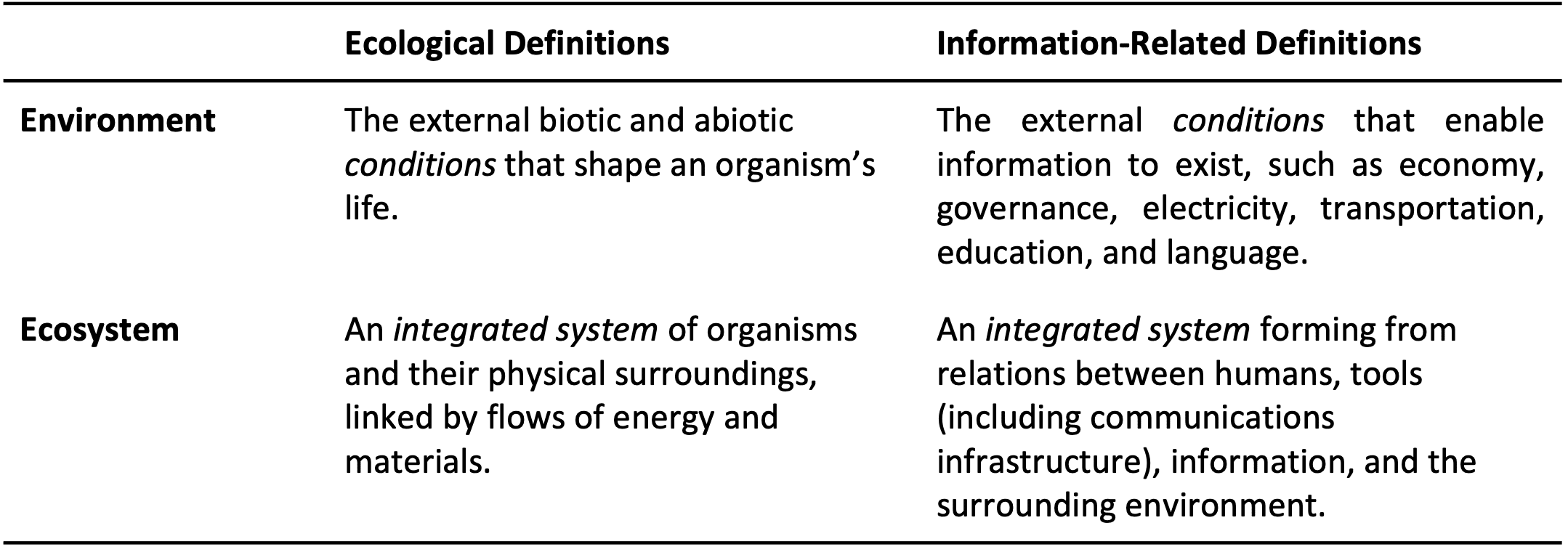
What is at play is a series of coupled systems, each consisting of two or more distinct, interacting parts, where a change in one directly influences the behavior of another. Consider an information ecosystem: the laws and economy that enable and shape it were created beforehand, likely within that same ecosystem. The information environment provides the conditions for ecosystems to emerge, but once they do, those ecosystems can reshape the surrounding environment in turn. This is a level of complexity that physical ecology has long grappled with.
Consider the relationship between the environment, climate, and ecosystems—separate but interrelated things. Climate is one part of the environment, and the two shape each other continuously. Climate is the long-term pattern of temperature, precipitation, wind, and related conditions in a place. The environment is broader: it is everything in a place, including the living things (e.g., plants, animals, microbes) and the non-living physical parts (e.g., soil, water, rock, mountains, air).
Climate shapes the environment by setting the conditions that determine what can exist somewhere: tundra emerges because the climate allows it. It influences which species live where, how soil forms, how water moves, and how ecosystems function. But the environment also shapes climate in return: forests absorb carbon dioxide and release water vapor, and soils store or release carbon. Change one of these, and the climate responds. So, climate sets the conditions for tundra to exist, warming disrupts it, and the disrupted tundra releases stored carbon that drives further warming. The two are not acting on each other as external forces separate and distinct from each other. Climate is embedded in the environment, and together they form a coupled system where each continuously influences the other.
Just as climate scientists measure factors like temperature and water levels to understand physical environment dynamics, equivalents are required for the information environment. These measurements might include how many people globally have access to the internet and how that is changing over time. Research could measure things like literacy levels, what mobile services are available, whether data is unlimited, or how many libraries exist and how they differ in operations. Changes in the physical environment can also affect factors in information ecosystems, raising questions like how solar flares affect communication infrastructure.
Applying a hierarchical framework
Making sense of complexity requires structure. In ecology, a hierarchical framework helps researchers study complex systems and better understand how various elements interrelate. The scale often begins at an individual organism, moving upward to the biosphere. While scholars and policymakers have begun borrowing hierarchies from physical ecology, they have been limited in application (e.g., individuals, community, society) or to function (e.g., producer, consumer, decomposer) (Sell et al., 2023). However, their use of these ecological structures suggests that the information environment can similarly be conceptualized as beginning at the individual level, moving up to information ecosystems and beyond (see Table 2). In this sense, ecosystems sit within the environment.
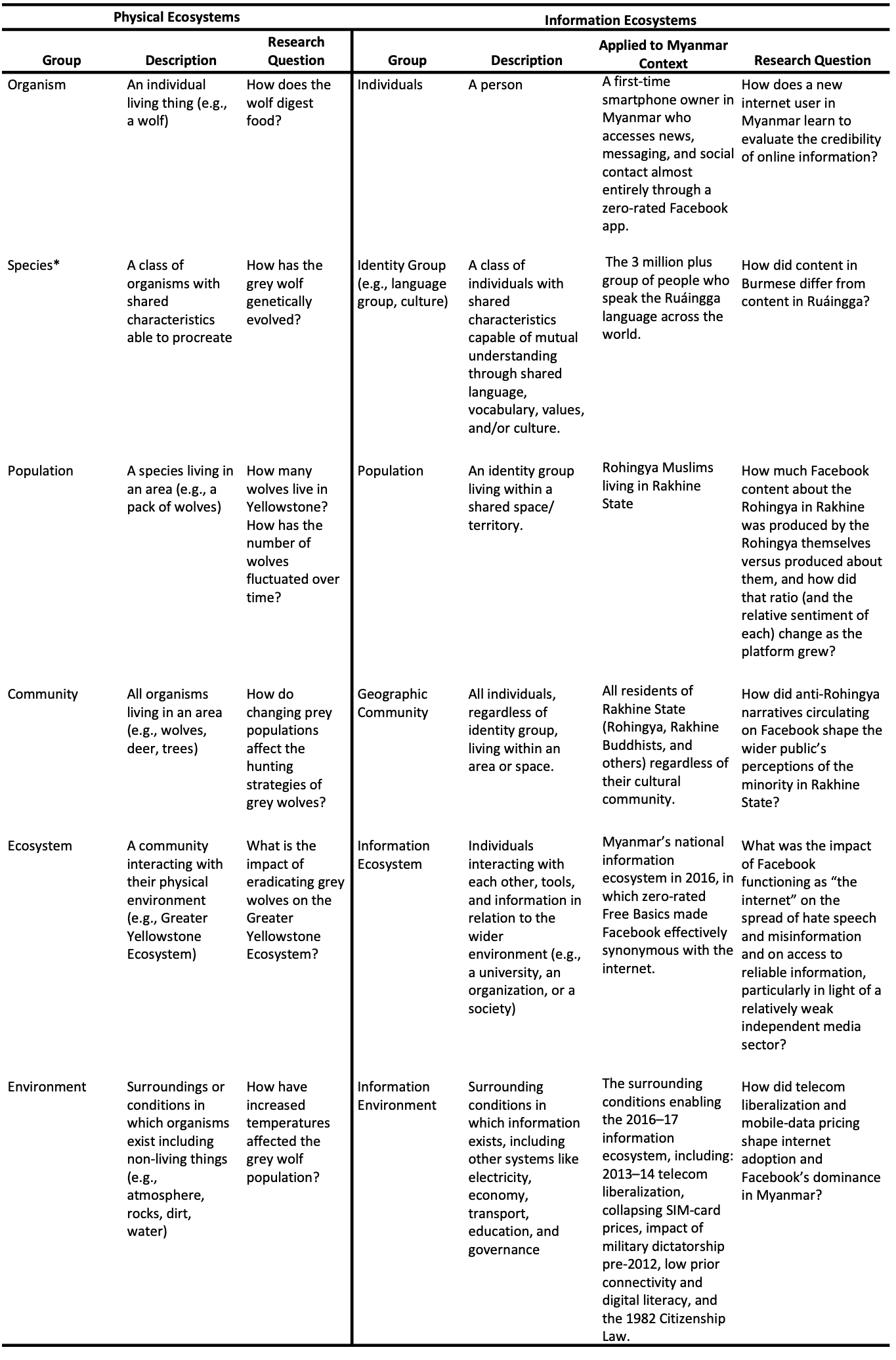
More than analogies or metaphors, physical ecosystems can provide models to understand how information ecosystems are built, function, and change over time (Pickett & Cadenasso, 2002), clarifying shared and divergent assumptions and structures as researchers seek to work across disciplines. Both types of ecosystems come in many shapes and sizes. Physical ecosystems are where organisms and their surroundings collectively form a sphere of life. In the information environment, ecosystems are where humans, tools, and outputs collectively form a sphere around a shared idea, be it a religion, a shared illness, or a nation-state.
Ecosystems can be large and sprawling, like Canada; small, like an emergency room; or virtual, like a subreddit. Because they both change over time, temporal demarcations help define context and allow comparison of like with like. Physical ecosystems can be as fleeting as tidal eddies or can be measured in geological time, like eras. In the informational world, comparing Twitter discourse circa 2011 to discussions on X (formerly Twitter) after Elon Musk’s 2022 purchase must also account for the dramatic shift in social context and platform affordances. The physical boundaries, spatial resolution (i.e., unit of analysis), and temporal scale then help define what components can be found within.
Borrowing from physical ecology, however, is not seamless. The frame of ecosystems in ecology, for example, is a specific physical space. Other fields have conceptualized ecosystems beyond location to group characteristics such as language, profession, culture, and ethnicity, among others. This creates some mismatches in an analogous hierarchy for information ecosystems, as the terms population and community are inverted in social science, with community typically referring to a smaller group of people sharing characteristics, and population to a larger group, such as a country.
Applying parameters to information ecosystems
Classifying these characteristics is necessary but not sufficient to describe either physical or information ecosystems. Both physical and information ecosystems are inherently input-output oriented; therefore, specifying the relationships between components and constraints within the system is necessary to understand how ecosystems function and change. Physical inputs such as sunlight, water, and nutrients produce plants and animals as organisms compete for these resources. In information ecosystems, culture, identities, economies, and democracy can emerge in contexts where attention (Falkinger, 2008) or sleep may be key constraints, as Netflix’s then-CEO, Reed Hastings, famously declared sleep its greatest competitor in 2017 (Hern, 2017). Both types of ecosystems are complex, meaning that causality can be multidirectional and dynamic, as it is constantly in flux. Physical ecosystems are highly interconnected through a web of life or food chain, whereas information ecosystems are highly interconnected through technological interdependencies and information accumulation and transfer, as well as the often complex and messy relationships between people who belong to multiple identity groups and communities.
We draw on Pickett and Cadenasso (2002) to offer six parameters of physical ecosystems that can help clarify models for studying information ecosystems: 1) boundaries, 2) spatial resolution, 3) temporal scale, 4) ecosystem components, 5) the nature of relationships among components, and 6) any constraints within the ecosystem (see Table 3). In our view, these parameters can also be used to structure questions about policy on information ecosystems, with the parameters providing a template for what policymakers should consider when anticipating potential unintended consequences of new policies or for generating evidence as an evaluation framework for existing ones.
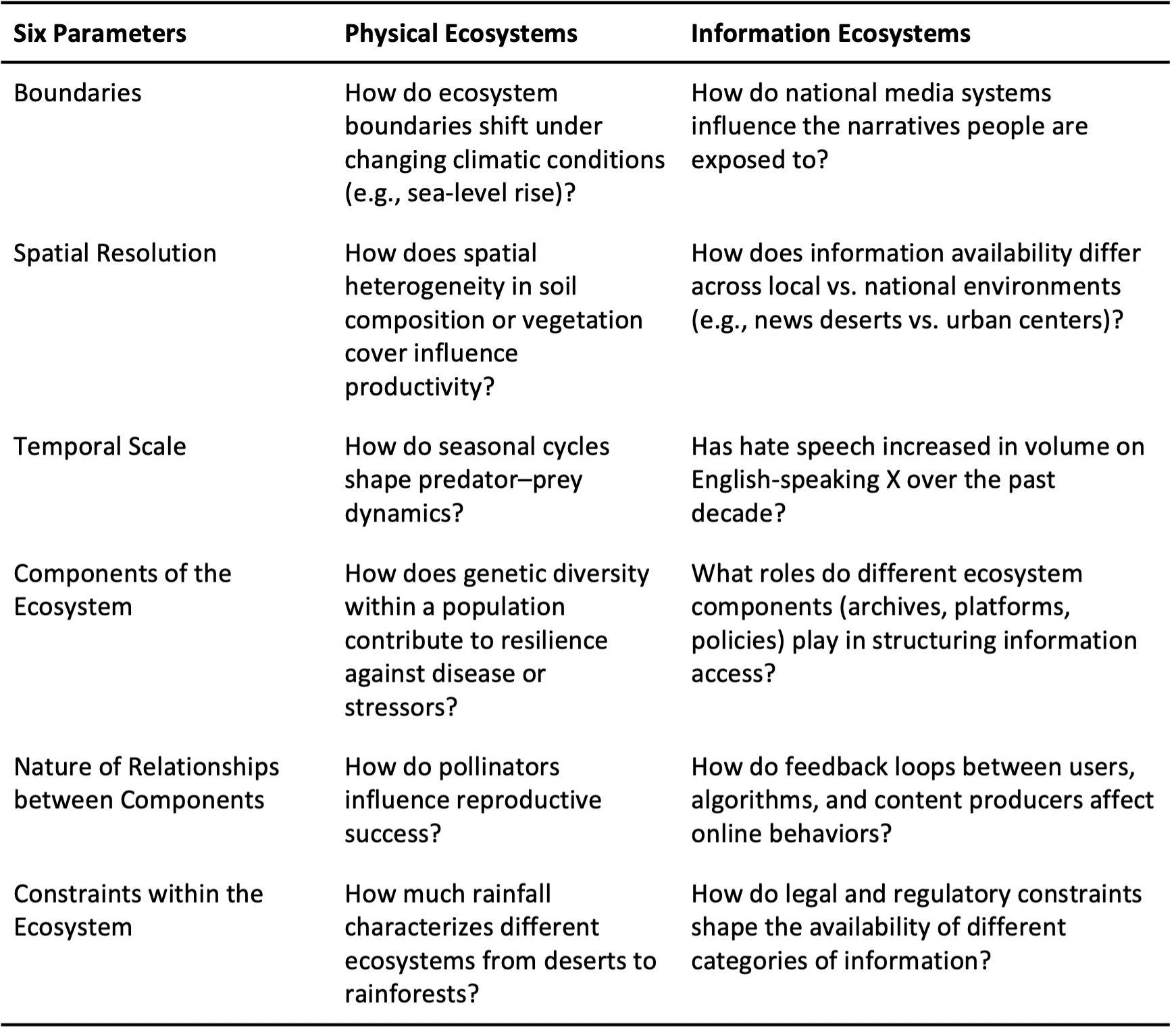
Modern devices offer resources and conditions where an individual encounters information (e.g., a laptop, cell phone), shaping how people engage with that content. This experience is affected by conditions both within the ecosystem and the surrounding environment. Using Myanmar between 2016–17 as a context, the six parameters provide a range of research questions (see Table 4).
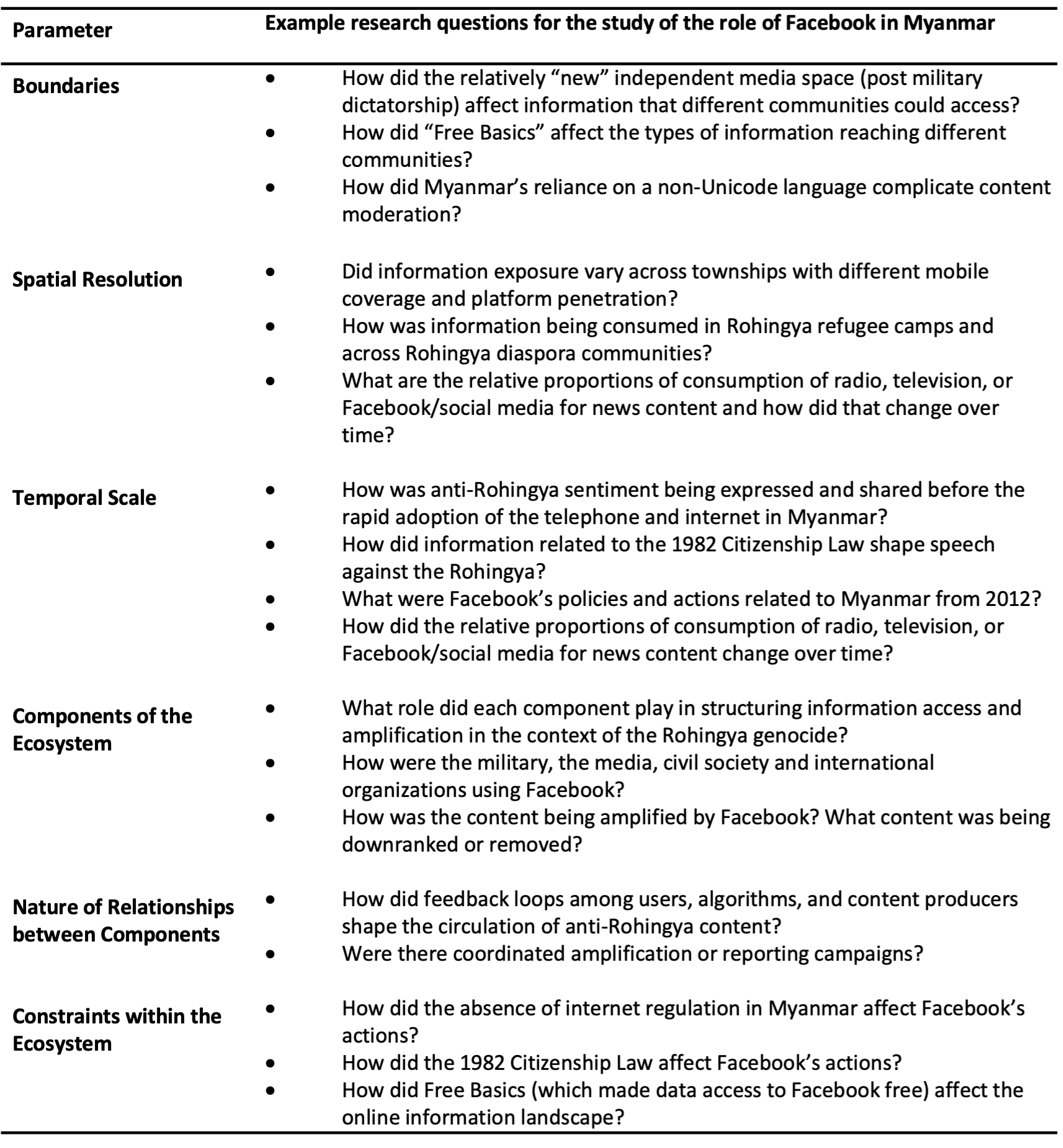
Promising research that considers the information ecosystem as a model has been limited by access to proprietary platform data and by challenges in connecting off- and online information ecosystems (Zuckerman, 2021). Studying information ecosystems is a large undertaking that requires a body of research from many researchers across time, rather than a single empirical work by an individual researcher. However, researchers can better situate where their work fits within the conceptual model of an information ecosystem.
Nonetheless, systemic approaches are emerging; for example, research connecting how economics and a lack of regulations enable the recruitment of highly skilled professionals to manipulate information ecosystems in the Philippines (Ong & Cabañes, 2019). Work that connects decades-long socio-political shifts with media coverage and social media sheds light on processes like feedback loops (Benkler et al., 2018). Attempts to model information ecosystems in Wisconsin through mixed-methods, including surveys, news analysis, and interviews, provide insight into the differences in local and national-level politics (Friedland et al., 2022). Humans’ relationship to technology and information is a system-level problem. Understanding information ecosystems requires not just assessing people, but also the dynamic interrelationships between people, the available means for processing information, and the outputs created.
Discussion
Environmental and ecological metaphors have become default rhetorical shortcuts to nod to complexity and interdependence in research and policymaking without sufficiently defining terms or acknowledging additional, unintended metaphorical allusions. As Sontag (1978) argued, metaphors are unavoidable when thinking about complex, interdependent phenomena, but such invocations can be made more responsible and useful.
Of course, there are limitations to using any of the approaches we suggest here. Definitions may require adjustment over time. Metaphors and analogies bring additional, often unintended baggage or shape perceptions in unintended (or devious) ways. Models are simplifications of complex systems for theoretical and empirical purposes, not true representations of them. Following our suggestions does not absolve researchers or policymakers from being reflective about what their approach is illuminating or obscuring. Our hope is that a more conscientious approach to research on information ecosystems will make reflection and transparency about these limitations easier.
Across several scientific fields, there is now a greater understanding that static, reductionistic, or retrospective depictions of processes or systems can be misleading, and that there is a need for a concerted shift toward describing and understanding the evolving interplay of different components across various units of analysis (Byrne & Callahaghan, 2022; Greenhalgh & Papoutsi, 2018). Schoolchildren are taught at a young age (often through images of ponds, mountains, and rainclouds in textbooks) that ecosystems are complex and dynamic, so it is perhaps unsurprising to employ ecological metaphors to emphasize the complexity that researchers now want to highlight.
For those studying the role of information in societies, we suggest mapping research questions, key variables, and existing literature against the natural science definitions, biological hierarchy, and the six parameters outlined here. We hope that if more researchers consistently use clearly specified terms like those found here as foundations for their work, we will see a broader methodological shift in the field away from isolated, reductionist studies and toward research designs that embrace the interdependence, scale, and dynamism inherent to the ecosystems they seek to study.
Topics
Bibliography
Benkler, Y., Faris, R., & Roberts, H. (2018). Network propaganda: Manipulation, disinformation, and radicalization in American politics. Oxford University Press. https://doi.org/10.1093/oso/9780190923624.001.0001
Byrne, D., & Callaghan, G. (2022). Complexity theory and the social sciences: The state of the art. Routledge. https://doi.org/10.4324/9781003213574
Davenport, T. H., & Prusak, L. (1997). Information ecology: Mastering the information and knowledge environment. Oxford University Press. https://doi.org/10.1093/oso/9780195111682.001.0001
Ecological Society of America. (n.d.). What is ecology? https://esa.org/about/what-does-ecology-have-to-do-with-me/
Falkinger, J. (2008). Limited attention as a scarce resource in information‐rich economies. The Economic Journal, 118(532), 1596–1620. https://doi.org/10.1111/j.1468-0297.2008.02182.x
Friedland, L. A., Shah, D. V., Wagner, M. W., Cramer, K. J., Wells, C., & Pevehouse, J. (2022). Battleground: Asymmetric communication ecologies and the erosion of civil society in Wisconsin. Cambridge University Press. https://doi.org/10.1017/9781108946780
Greenhalgh, T., & Papoutsi, C. (2018). Studying complexity in health services research: Desperately seeking an overdue paradigm shift. BMC Medicine, 16(1), Article 95. https://doi.org/10.1186/s12916-018-1089-4
Giordano, P. (2023, April 3). Information environment assessment capability programme plan initiated. NATO Allied Command Transformation. https://www.act.nato.int/article/information-environment-assessment-capability-programme-plan-initiated/
Hanafin, N. (2022). Information integrity: Forging a pathway to truth, resilience and trust. United Nations Development Program. https://www.undp.org/sites/g/files/zskgke326/files/2022-02/UNDP-Information-Integrity-Forging-a-Pathway-to-Truth-Resilience-and-Trust.pdf
Hern, A. (2017, April 18). Netflix’s biggest competitor? Sleep. The Guardian. https://www.theguardian.com/technology/2017/apr/18/netflix-competitor-sleep-uber-facebook
Márton, A. (2022). Steps toward a digital ecology: Ecological principles for the study of digital ecosystems. Journal of Information Technology, 37(3), 250–265. https://doi.org/10.1177/02683962211043222
McLuhan, M. (1964). Understanding media (2nd ed.). Routledge.
McMahan, P., & Evans, J. (2018). Ambiguity and engagement. American Journal of Sociology, 124(3), 860–912. https://doi.org/10.1086/701298
Mitra, S., & Cready, W. M. (2005). Institutional stock ownership, accrual management, and information environment. Journal of Accounting Auditing & Finance, 20(3), 257–286. https://doi.org/10.1177/0148558×0502000304
Morze, N., Kuzminska, O., & Protsenko, G. (2013). Public information environment of a modern university. In V. Ermolayev, H. C. Mayr, M. Nikitchenko, A. Spivakovsky, & G. Zholtkevych (Eds.), ICTERI 2013: Proceedings of the 9th International Conference on ICT in Education, Research and Industrial Applications: Integration, Harmonization and Knowledge Transfer (pp. 264–272). CEUR-WS. https://ceur-ws.org/Vol-1000/ICTERI-2013-p-264-272.pdf
Murthy, V. H. (2021). Confronting health misinformation: The U.S. Surgeon General’s advisory on building a healthy information environment. Office of the United States Surgeon General. https://www.hhs.gov/surgeongeneral/reports-and-publications/health-misinformation/index.html
Nadler, A. (2019). Nature’s economy and news ecology: Scrutinizing the news ecosystem metaphor. Journalism Studies, 20(6), 823–839. https://doi.org/10.1080/1461670X.2018.1427000
Nardi, B. A., & O’Day, V. (1999). Information ecologies: Using technology with heart. MIT Press. https://doi.org/10.7551/mitpress/3767.001.0001
Norris, T. B., & Suomela, T. (2017). Information in the ecosystem: Against the “information ecosystem.” First Monday, 22(9). https://doi.org/10.5210/fm.v22i9.6847
Nothias, T. (2020). Access granted: Facebook’s free basics in Africa. Media, Culture & Society, 42(3), 329–348. https://doi.org/10.1177/0163443719890530
Ong, J. C., & Cabañes, J. V. (2019). When disinformation studies meets production studies: Social identities and moral justifications in the political trolling industry. International Journal of Communication, 13, 5771–5790. https://ijoc.org/index.php/ijoc/article/view/11417
Ong, W. J. (2012). Interfaces of the word: Studies in the evolution of consciousness and culture. Cornell University Press. (Original work published 1977)
Oxford University Press. (n.d.). Model. In Oxford English Dictionary. Retrieved July 7, 2026, from https://www.oed.com/dictionary/model_n
Phillips, W., & Milner, R. M. (2021). You are here: A field guide for navigating polarized speech, conspiracy theories, and our polluted media landscape. MIT Press. https://doi.org/10.7551/mitpress/12436.001.0001
Pickett, S. T. A., & Cadenasso, M. L. (2002). The ecosystem as a multidimensional concept: Meaning, model, and metaphor. Ecosystems, 5(1), 1–10. https://doi.org/10.1007/s10021-001-0051-y
Postman, N. (2000). The humanism of media ecology. Proceedings of the Media Ecology Association, 1, 10–16. https://www.media-ecology.net/publications/MEA_proceedings/v1/postman01.pdf
Prasse-Freeman, E. (2021). Hate bait, micro-publics, and national(ist) conversations on Burmese Facebook. Independent Journal of Burmese Scholarship, 1, 144–204. https://ijbs.online/?page_id=2824
Rosenfield, P. L. (1992). The potential of transdisciplinary research for sustaining and extending linkages between the health and social sciences. Social Science & Medicine, 35(11), 1343–1357. https://doi.org/10.1016/0277-9536(92)90038-R
Schissler, M. (2025). Beyond hate speech and misinformation: Facebook and the Rohingya genocide in Myanmar. Journal of Genocide Research, 27(3), 445–470. https://doi.org/10.1080/14623528.2024.2375122
Scolari, C. A. (2012). Media ecology: Exploring the metaphor to expand the theory. Communication Theory, 22(2), 204–225. https://doi.org/10.1111/j.1468-2885.2012.01404.x
Sell, A., Jeansson, J., Helmefalk, M., Allmér, H., & Marcusson, L. (2023). Conceptualizing information systems as biological ecosystems: A “new” vocabulary for speaking of information systems. In Proceedings of the 36th Bled eConference – Digital Economy and Society: The Balancing Act for Digital Innovation in Times of Instability (pp. 647–662). University of Maribor Press. https://doi.org/10.18690/um.fov.6.2023.39
Simon, F. M., & Camargo, C. Q. (2023). Autopsy of a metaphor: The origins, use and blind spots of the ‘Infodemic’. New Media & Society, 25(8), 2219–2240. https://doi.org/10.1177/14614448211031908
Sontag, S. (1978). Illness as metaphor. Farrar, Straus and Giroux.
Stiglitz, J., & Ventura-Bolet, M. (2025). The impact of AI and digital platforms on the information ecosystem (NBER Working Paper No. w34318). National Bureau of Economic Research. https://doi.org/10.3386/w34318
United Nations Committee of Experts on Global Geospatial Information Management. (2025). Positioning the future geospatial information ecosystem. United Nations Department of Economic and Social Affairs, Statistics Division. https://ggim.un.org/meetings/GGIM-committee/15th-session/documents/2025-07_UN-GGIM_FutureGeospatialEcosystem.pdf
United Nations High Commissioner for Refugees. (2024). Information ecosystem assessment. UNHCR Information Integrity Toolkit. https://www.unhcr.org/handbooks/informationintegrity/practical-tools/situation-analysis/information-communication-needs-and-ecosystem-assessments/information-ecosystem-assessment
Wanless, A. (2025). The information animal: Humans, technology and the competition for reality. Oxford University Press. https://doi.org/10.1093/oso/9780197835319.001.0001
World Health Organization (2026). Conducting information environment assessments for health emergencies: An implementation toolkit. https://iris.who.int/handle/10665/387691
Zuckerman, E. (2021). Why study media ecosystems? Information, Communication & Society, 24(10), 1495–1513. https://doi.org/10.1080/1369118X.2021.1942513
Funding
No funding has been received to conduct this research.
Competing Interests
The authors declare no competing interests.
Copyright
This is an open access article distributed under the terms of the Creative Commons Attribution License, which permits unrestricted use, distribution, and reproduction in any medium, provided that the original author and source are properly credited.
Acknowledgements
We are grateful for thoughtful reviews and comments from Michael Berk, Jacqueline Gerson, Lindsey Russo, Heidi Tworek, and an anonymous reviewer. Of course, all errors remain our own.
Authorship
The first two authors contributed to this work equally.