
Peer Reviewed
Accountability in name only: Fact-checking under the EU’s Code of Practice on Disinformation
Article Metrics

0
CrossRef Citations
PDF Downloads
Page Views
Major platforms constantly claim to fight disinformation and support the fact checking community, but their transparency reports and the empirical evidence from a survey of expert fact checkers across 21 EU countries show a different reality. This study finds that despite commitments made under EU regulations, expert fact checkers remain largely peripheral actors within the existing platform governance framework, with limited insight into how their work influences platform decisions. As Brussels rolls out its new Democracy Shield (European Parliament, 2025), our study exposes that the promise of algorithmic transparency remains largely unfulfilled, leaving frontline fact checkers locked out of the very governance systems they are meant to support.
Research Questions
- How do major online platforms (Meta, Google, Microsoft, and TikTok) operationalize their commitments to cooperate with fact-checking organizations under the CoPD? (RQ1)
- To what extent do fact checkers have access to relevant data, tools, and feedback mechanisms so that they can perform their role attributed within the broader European Union’s (EU) disinformation governance framework? (RQ2)
- What structural conditions shape the effectiveness and sustainability of partnerships between fact-checking organizations and platforms? (RQ3)
- How do fact checkers perceive their role and influence within the EU’s multi-stakeholder governance of disinformation, and what barriers prevent them from having true policy impact? (RQ4)
Essay Summary
- Online disinformation has become a persistent challenge for democracies; in response, the European Union (EU) has developed an anti-disinformation regulatory architecture, central to which is the Code of Practice on Disinformation (CoPD). The CoPD was strengthened in 2022 and transitioned to a Code of Conduct in 2025 to include more granular commitments for online platforms to mitigate systemic risks related to disinformation. The Code recognizes that trusted third parties, such as fact checkers, play a vital role in the ecosystem by identifying and contextualizing misleading content (Bélair-Gagnon et al., 2023; Bleyer-Simon, 2025; Cazzamatta, 2025). Specifically, fact checkers fulfill three distinct functions within the governance framework: operational detection, public contextualization, and systemic accountability. While their primary tasks involve fragging misinformation, their accountability role is equally critical, as they provide empirical evidence to policymakers to inform future regulations (Lauer & Graves, 2024; Mündges & Park, 2024).
- However, the stability of these partnerships is increasingly precarious. As noted by Rone (2021, p. 173), platform governance often oscillates between preemptive and conflictual cooperation, where platforms integrate civil society at a symbolic level to send a political signal or suggest compliance while in effect maintaining a strict control over governance processes. Meta’s 2025 decision to withdraw from its Third-Party Fact-Checking Program exemplifies the shift from a supportive, at least in theory, partnership to a more conflictual modus operandi, in which platforms prioritize their own moderation interest over the fact-checking ecosystem.
- Despite formal agreements, this study finds that platform cooperation is more performative than substantive. By juxtaposing platform transparency reports with survey data from professional fact checkers across EU countries, the analysis reveals discrepancies between the commitments agreed upon by platforms and actual practice. The performative nature of these partnerships represents more than a breach of promise and suggests a potential gap in DSA compliance and the broader EU Democracy Shield.
Implications
Our findings reveal a significant gap between the EU’s normative ambitions as formulated in the CoPD and the operational realities experienced by fact checkers across Europe in their day-to-day partnership with platforms. At the heart of this gap lies a tension that is increasingly visible across EU’s digital governance: while non-platform/civil-society actors are formally integrated into multi-stakeholder arrangements (Meyer & Vetulani‐Cęgiel, 2024; Urman & Makhortykh, 2023), the conditions under which they function prevent them from having a meaningful impact (Graves & Amazeen, 2019). The implications of this tension extend beyond fact-checking alone and raise broader questions about how co-regulatory approaches could be recalibrated in order to be more effective (Borz et al., 2024; Gorwa, 2019; Marsden et al., 2020).
A central implication of the findings is that fact checkers occupy a peripheral position within the disinformation ecosystem. This peripheral status is not a consequence of exclusion—fact checkers are formally acknowledged, there are existing contractual arrangements, which are prominently referenced in platforms’ self-reports—but of structural marginalization. They are included without being empowered. In response to RQ1, the findings show that major online platforms operationalize their commitments in uneven and often minimal ways. While formal cooperations exist, as indicated in both transparency reports and the expert survey, they don’t translate into meaningful transparency. Platform practices tend to prioritize symbolic compliance—such as the application of labels, which is rarely presented in a disaggregated manner—over technical access to tools or mechanisms that would allow fact checkers to understand how their outputs influence moderation, ranking, or algorithmic visibility.
Addressing RQ2, the study finds that fact checkers’ access to relevant data, tools, and feedback mechanisms is insufficient. The lack of reliable, granular (ideally at national-level) impact data—such as information on misleading information reach reduction, user exposure to disinformation, or platform decisions based on verified content—prevents fact checkers from evaluating how effective their work is or from verifying platform claims related to content moderation decisions. As a result, even when fact-checking outputs are incorporated into platform systems—the extent of which cannot be quantified due to opacity—this integration is done without any evaluative insight offered to fact checkers.
With respect to RQ3, the analysis indicates several structural conditions that shape the effectiveness and sustainability of partnerships with fact checkers, which include asymmetries in access to data and, in general, discussers that are controlled and attentively curated by platforms. These empirical findings suggest that fixing technical shortcomings, ensuring clear data protocols, and minimum impact metrics would be minimal conditions for functional cooperation with fact checkers.
Fact checkers perceive their role in the anti-disinformation governance model as peripheral rather than influential, which directly answers RQ4. This research identifies multiple barriers that prevent these practitioners from having a policy impact. Specifically, platforms reduce insight into the decision-making, omit formalized feedback loops formalized from contractual agreements, and exclude fact-checkers from data governance models. Because the cooperation framework lacks a clear institutional embedding for fact checkers, they remain mere implementers of platform-defined processes. Consequently, they cannot inform policy recommendations or conduct independent risk assessments in an effective manner.
The combined findings suggest several ways in which platforms could move beyond symbolic disclosures and informal ad hoc interactions with fact-checking organizations. In countries where fact-checking agreements are very limited (e.g., in Greece and Hungary), expanding the coverage of these local agreements should be a priority. Taking this step recognizes the importance of fact checkers in strengthening local resilience against disinformation. The findings also point to a strong need for platforms to make better use of fact checks by integrating them more visibly into platform services. This includes improving the visibility of fact-checked content to inform algorithms, as well as clearly communicating corrections and contextual information to users.
More broadly, the results point to the need for a recalibration of how fact checkers are integrated into EU disinformation governance. While assessing specific enforcement mechanisms falls beyond the scope of this research, the findings suggest that empowerment needs more than recognition. A gradual shift toward co-enforcement is necessary to address the persistent power and information asymmetries this study documented. This means moving away from a voluntary basis toward mandatory rules under the DSA. In this context, measures that support the fact-checking community while intersecting with enforcement mechanisms under the DSA—such as standardized data access protocols for fact checkers, technical API specifications so that they can see how disinformation spreads, minimum impact metrics (e.g., how much a fact check reduced the reach of a false post), and transparent feedback loops (how much did fact checks influence moderation decision)—could solve the limitations identified.
These implications should be read not as direct policy prescriptions, but rather as analytically grounded observations about the structural conditions necessary for the current Code of Conduct to function as originally intended: a true partnership in which fact checkers contribute not only to verifying content but also to shaping better policy through evidence (European Commission, 2024).
Furthermore, as an addendum to the study, this study’s findings must be re-evaluated in light of recent developments, such as Meta’s withdrawal from third-party fact-checking arrangements, predominately in the United States but with global implications. The reduced institutional support for fact checkers and the trend toward “community notes”—a crowdsourced model that relies on user-driven, algorithmic consensus rather than professional fact checkers or journalists to flag misleading content—suggest a shift in platform governance. Consequently, in Europe, the Digital Services Act (DSA) and the Code of Conduct on Disinformation (CoCD) (used as a benchmark for compliance) now serve as the primary legal safeguards for the regional fact-checking ecosystem. In this context, independent audits, a requirement under the DSA, are more critical than ever to verify that platforms’ European operations and stated partnerships remain functional and effective.
Findings
Finding 1: Cooperations with fact-checking organizations (Commitment 30).
Drawing on both platform transparency reports and survey responses from fact-checking experts, the analyses show a clear gap between platforms’ formal promises and their day-to-day operations. While platforms use symbolic compliance, making high-profile public statements that look good on paper, they fail in the majority of cases to deliver meaningful results. This represents a form of structural marginalization where fact checkers are officially invited into the accountability system but are kept on the sidelines without the power or data they need to have an impact.
An assessment of Commitment 30 (Table 1) shows a fragmented cooperation landscape (for more details, see Botan & Meyer, 2025). All major platforms claim to support fact-checking, but their reports lack details on the nature of the fact-checking partnerships, the countries they cover, and their potential impact on reducing disinformation. This lack of detail makes it quasi-impossible to evaluate the actual impact of this cooperation.
Meta (Facebook & Instagram) reports various initiatives such as We Think Digital, News Integrity Initiative, and fact-checking partnerships with 29 organizations in 23 languages, without mentioning what the organizations are or where they are based. The reports also reference tools such as warning labels, fact-check panels, and the Meta Content Library via the Inter-university Consortium for Political and Social Research (ICPSR). Microsoft (Bing & LinkedIn) mentions NewsGuard, Page Insights, and general partnerships with the News Literacy Project and the Trust Project. Despite claims of access to beta research programs and access to open datasets like Microsoft Machine Reading Comprehension (MS MARCO), reports provide no documentation on their operational scope or researcher uptake. TikTok reports existing collaborations with fact checkers without detailed information on the scope or geography of these collaborations. Google (Search & YouTube) refers to its own Google News Initiative and offers a more detailed reporting on how information panels and labels are integrated into its YouTube service but provides no granular data on their financial contribution to fact-checking organizations.
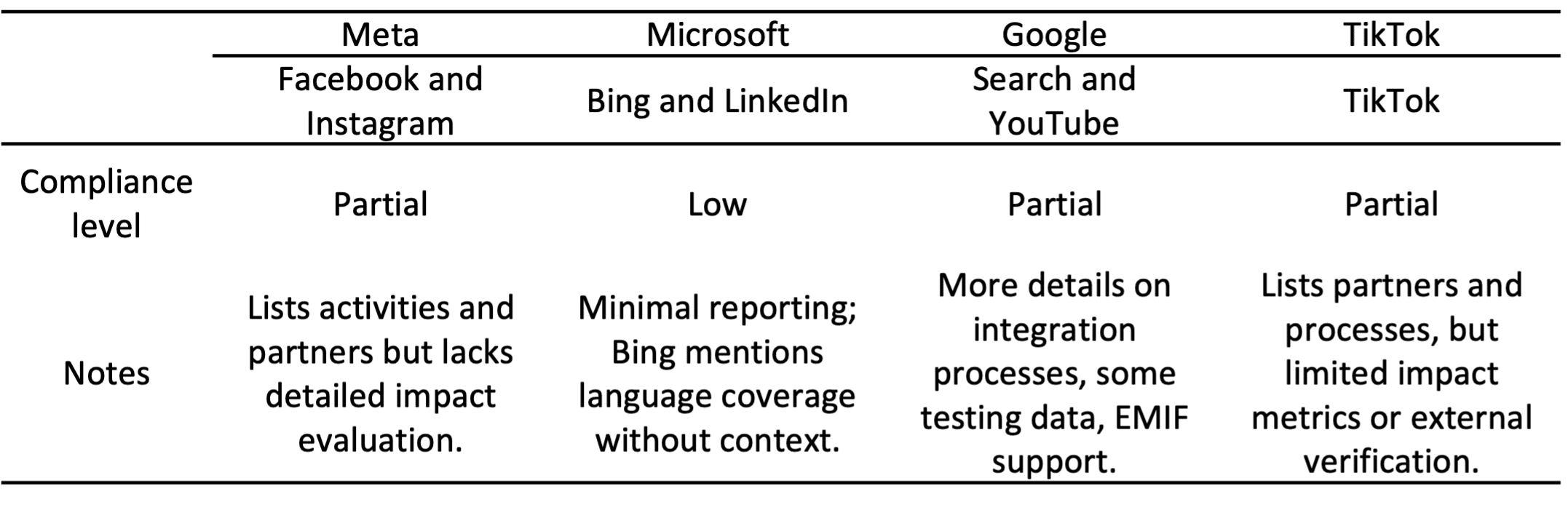
The survey insights show a mixed experience with platform fact-checking programmes. While participation in such programmes is generally viewed as positive, the quality of collaboration is often rated slightly lower than the overall experience, reflecting persistent shortcomings, usually structural. Respondents acknowledge the value of existing cooperation frameworks, but point to platform-driven arrangements, in which they have limited control over terms, processes, and outcomes.
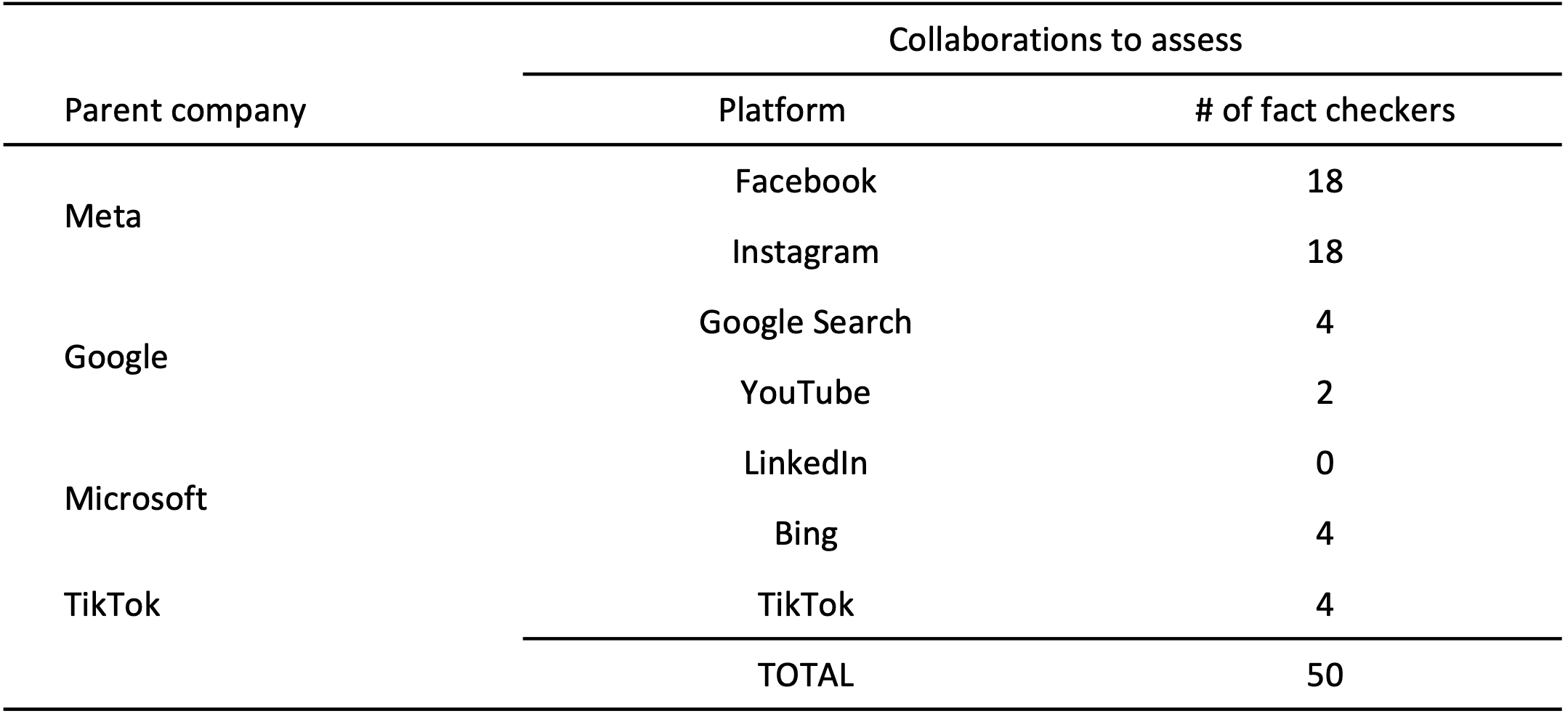
The second analytical layer comes from the expert survey and offers a more fine-grained image of how fact checkers perceive existing partnerships. In terms of collaboration, the experts who took part in the survey reported 50 fact-checking agreements. Respondents had fact-checking agreements with Facebook (18) and Instagram (18), Google Search (4), YouTube (2), TikTok (4), and Microsoft Bing (4) (see Table 2). LinkedIn was not engaged in any partnerships with the European Digital Media Observatory’s (EDMO) community of fact checkers.
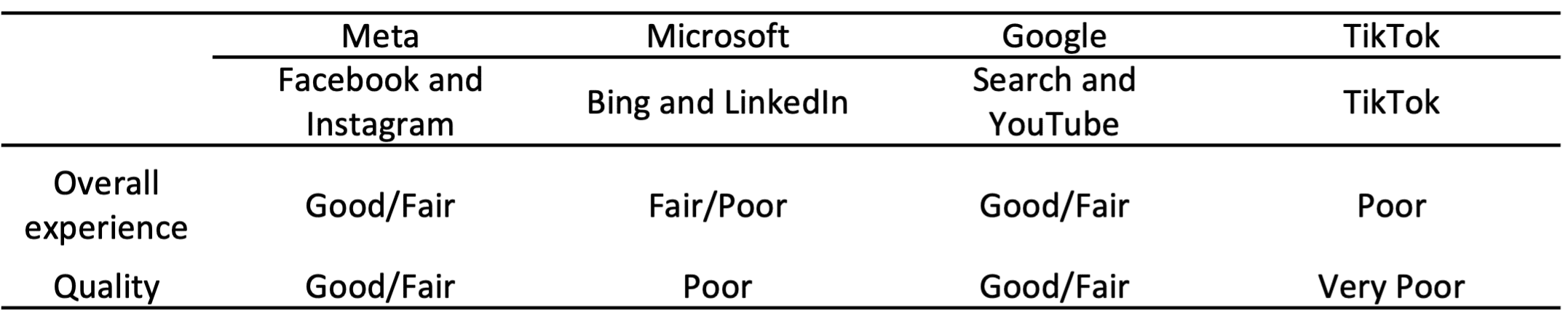
On average, the fact-checking experts rate their overall experience regarding their partnerships with Meta and Google as “good” or “fair.” The overall experience of fact-checking agreements with Microsoft Bing is rated predominantly as “poor,” and the rating for TikTok ranges from “poor” to “very poor” (see Table 3).
A recurring concern across responses is the lack of transparency regarding how their work informs platform moderation decisions, particularly in relation to TikTok. Fact checkers frequently report insufficient feedback on whether and how their outputs lead to enforcement actions, ranking, or content visibility. Several respondents also stress slow, inconsistent, or ad hoc communication with platforms, which adds to the constraining nature of the collaborations.
The asymmetries identified in our survey are best understood through Rone’s (2021) framework of platform governance, which characterizes interaction with state and civil actors as an oscillation between proactive and adversarial cooperation. Platforms often integrate just enough fact-checking to remain on the safe side from a regulation perspective without ceding control over their moderation systems. Concurrently, they maintain an adversarial stance by withholding the critical data fact-checkers need in order to achieve a meaningful impact.
As a postscript to the research findings, the “good” and “fair” ratings associated with Meta must be reevaluated in light of its recent withdrawal from professional fact-checking programs (predominantly in the United States and selected international markets). This strategic shift exemplifies the transition from structured moderation to information chaos as theorized by Cazzamatta (2026). In this context, the removal of institutional support for many fact checkers leaves a verification vacuum in the battle over accuracy and truth. Furthermore, while platforms claim to use fact checks for “down-ranking,” empirical evidence from Watt et al. (2025) and our own survey confirms that fact checkers do not have information on the degree of visibility reduction applied to posts. This opacity indicates that these partnerships are not operational. Rather than being integrated into functional, transparent, and collaborative daily workflows, they remain symbolic, serving primarily as public gestures designed to signal compliance while precluding meaningful oversight or a genuine role for fact-checking organizations in shared governance.
Finding 2: Integration of fact-checking outputs (Commitment 31).
How platforms actually use fact checks remains a black box (Table 4). Compliance here is partial at best. Most platforms claim to use labels or demote false content (reducing how many people see it), but they offer no proof of how well these tools work in practice through, for example, data on their reach and effectiveness. As a general observation, where metrics are reported, they are typically high-level and are not disaggregated at the country level.
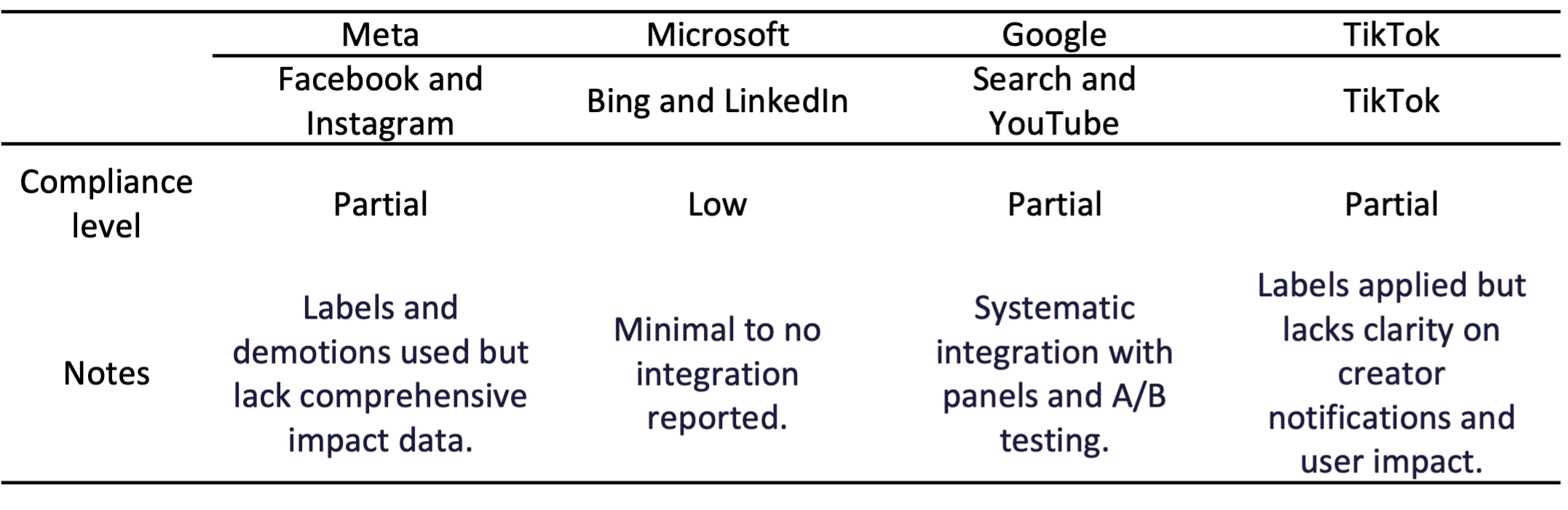
Survey responses corroborate such reports’ findings while also revealing discrepancies between platform self-reporting and fact checkers’ experiences. Respondents rated the use and integration of fact-checking in Meta’s products on average as “good” or “fair.” In contrast, TikTok’s integration of fact checks was assessed more critically, with ratings ranging from “poor” to “very poor.” Across platforms, the main issue is a lack of feedback. Fact checkers rarely know if their work led to a content label or a change in the algorithm. The majority of respondents pointed to insufficient data access and feedback, limited availability of usable APIs or structured datasets, and reliance on self-reported metrics. Without this data, fact checkers could not measure their own effectiveness and reach.
Our survey findings are strongly supported by recent empirical work. Watt et al. (2025) argue that the “art of the platform deal” involves keeping fact checkers in the dark regarding the technical specifics of downlinking, that is, the degree to which a post’s visibility is reduced. As Cazzamatta (2026) and Graves (2025) demonstrate, fact checkers report having no visibility into the consequences of their labels at the algorithmic level. This transparency deficit suggests that platforms may treat fact-checking as a symbolic input rather than an operational component of a collaborative governance framework.
Finding 3: Data access for fact-checking organizations (Commitment 32).
The analysis of self-reports indicates a structurally weak implementation of Commitment 32. From both a quantitative and qualitative reporting perspective, all major platforms demonstrate limited compliance (see Table 5). Meta reports the existence of tools specifically designed for fact checkers, but there is no substantial evidence on their uptake, usage frequency, or analytical values. Microsoft performs the weakest in this regard, offering no reporting at all on tools, interfaces, or data access specifically designed for fact checkers. Google, despite referencing several fact-checking partnerships, similarly fails to describe any concrete mechanisms, tools, or data channels through which fact checkers can access platform data. TikTok reports the availability of dashboards for fact checkers and provides some quantitative information on their existence, yet offers no evidence regarding the outcomes of these tools or whether the data has sufficient depth and is offered in a timely manner. There is no documentation on whether fact checkers have access to key metrics such as impressions, reach, or user engagement.
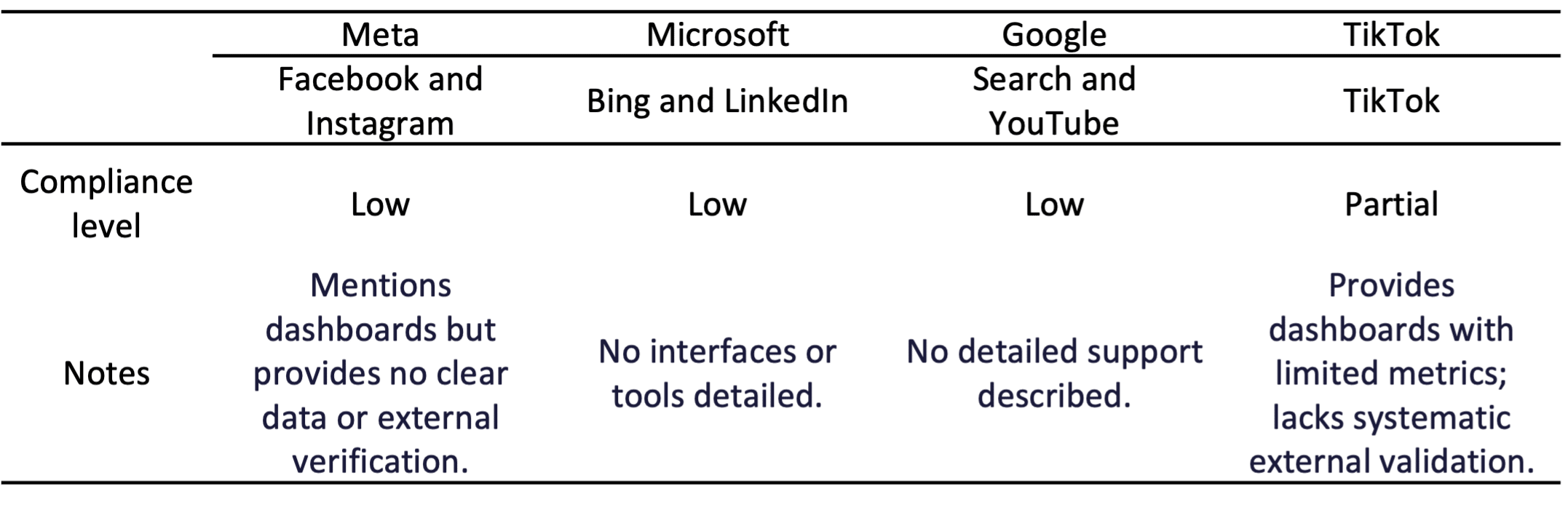
The reporting gaps are directly corroborated by our survey findings. Fact checkers reported insufficient access to actionable data; limited, non-functional, or non-existent APIs; and dashboards that were not designed for independent analysis. Respondents emphasized that available tools rarely allow for longitudinal or cross-platform evaluation and provide little to no feedback on how fact checks influence platforms’ decisions. Where data access exists, it is described as controlled by platforms, delayed, or selectively disclosed; all these aspects illustrate the asymmetrical relationship where one side (the platforms) holds all the data and power, while the other side (the fact checkers) has limited insight and influence.
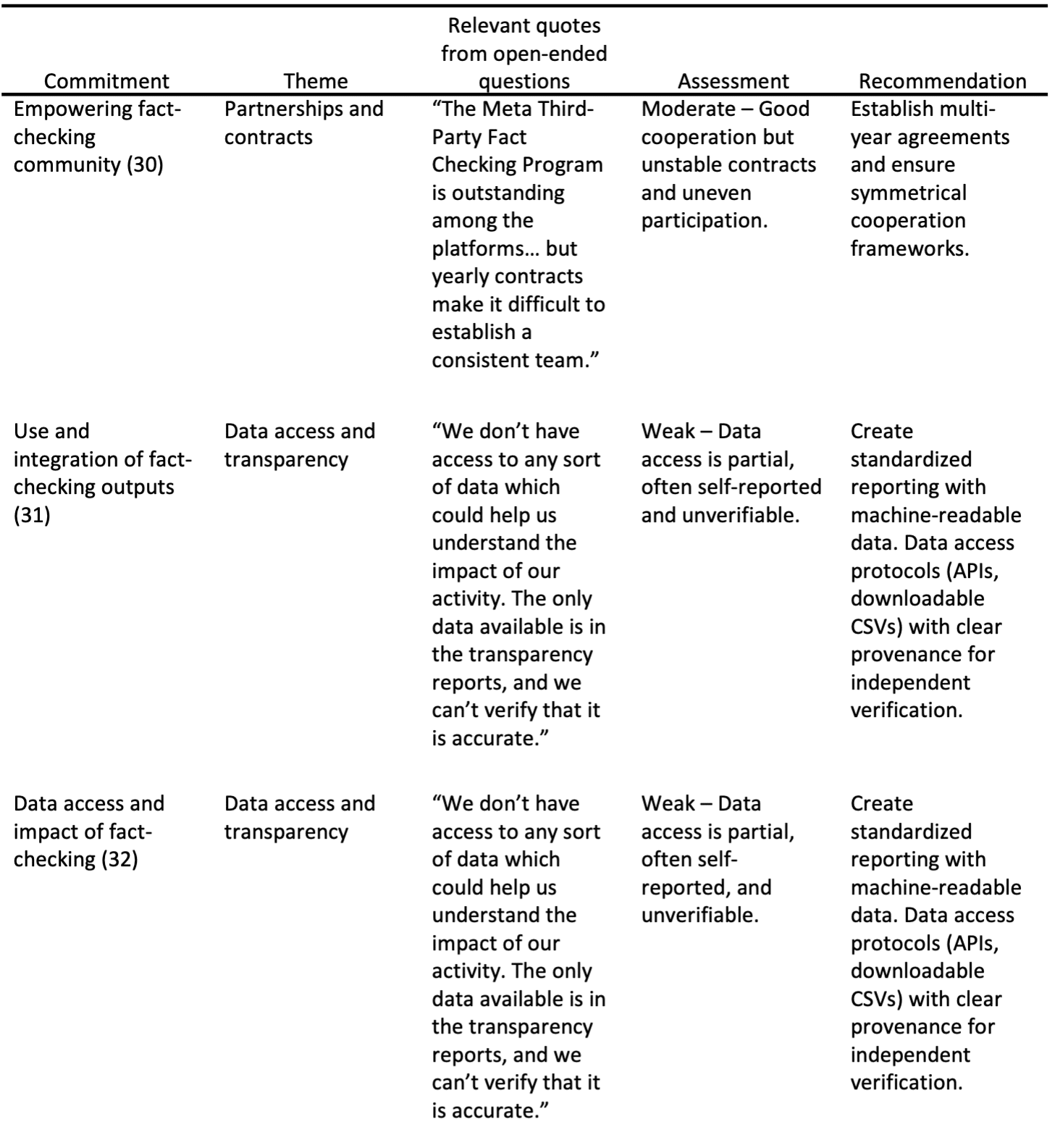
Survey findings are summarized in Table 6 and show, in general, systemic weaknesses in the implementation of all of CoPD’s commitments towards fact checkers. While some platforms, most notably Meta, are perceived by fact checkers as offering relatively strong cooperation frameworks, the reliance on short-term arrangements undermines the stability and the institutional capacity of the fact-checking community. These structural fragilities are amplified by the limited and opaque integration of fact-checking outputs into platform products, where fact checkers report a lack of feedback, restricted access to original content, and no visibility into the impact of fact-checked content.
Recent developments related to platforms’ reduced support for professional fact-checking programs that signal a policy shift at the corporate level support our argument that cooperation is performative—platforms still use fact-checking arrangements in the EU because they have to, not because they view them as core partnerships. In fact, the DSA seems to be the only element keeping the European fact-checking ecosystem from the “chaos” seen in the United States (Cazzamatta, 2026). While platforms maintain their fact-checking commitments in Europe to comply with regulation, the current transatlantic divergence represents a good illustration of what Rone (2021) describes as “preemptive cooperation.” Platforms may keep symbolic ties in strictly regulated markets such as the EU, while simultaneously dismantling the fact-checking infrastructure where regulatory pressure is lower or where it is lacking.
Methods
This study employed a mixed-methods research design combining a systematic review of platform transparency reports with an expert survey of fact-checking practitioners. This approach allowed for triangulation between platform self-reporting and independent assessments by actors directly involved in the implementation of the CoPD. The objective is not to measure the effectiveness of fact-checking interventions per se, but to examine how platforms operationalize their commitments toward fact checkers and whether these arrangements support meaningful participation in the EU’s anti-disinformation governance framework.
The first component of the study consisted of an analysis of transparency reports published in 2024 and the first quarter of 2025 by very large online platforms (VLOPs) that are signatories of the CoPD, namely Meta (Instagram & Facebook), Google (Search & YouTube), Microsoft (LinkedIn & Bing), and TikTok. These reports constitute the primary source through which platforms communicate their compliance with voluntary commitments and, more recently, with regulatory expectations under the DSA.
Reports were analyzed using a structured coding framework (see a sample in Appendix A and, for a detailed reporting, see Botan & Meyer, 2025). Particular attention was paid to the quality, completeness, and verifiability of the reported information. When available, external data sources were consulted to verify how accurate reported metrics and claims were.
To complement platform self-reporting, and to answer, the study draws on an original survey conducted in February 2025 among fact-checking professionals affiliated with or collaborating with the European Digital Media Observatory (EDMO) and its national hubs.1Greece – Mediterranean Digital Media Observatory (MedDMO); Croatia – Adria Digital Media Observatory (ADMO); Hungary – Hungarian Digital Media Observatory (HDMO); Austria/Germany – German-Austrian Digital Media Observatory (GADMO); France – Observatoire de l’Information et des Médias (ODIM) and Agence France Presse (AFP); Belgium/Luxembourg – BeLux Digital Media Observatory; Spain – Iberian Digital Media Research and Fact-Checking Hub; Bulgaria/Romania – Bulgarian-Romanian Observatory of Digital Media (BROD). A total of 41 expert respondents from 21 European countries2Austria, Belgium, Bulgaria, Croatia, Cyprus, Czechia, Denmark, France, Germany, Greece, Hungary, Ireland, Latvia, Malta, Netherlands, Poland, Portugal, Romania, Slovakia, Spain, and Sweden. participated in the survey, representing a diverse range of institutional contexts and platform partnerships (50 in total). While the sample provides broad geographical coverage, the distribution reflects the varying density of the EDMO hubs network. Higher concentrations of respondents were recorded in countries with hubs that are very well integrated, such as Belgium and France (approximately seven to nine respondents each), while other countries (e.g., Estonia, Latvia, and Portugal) are represented by single high-level experts. From a professional perspective, the sample is characterized by a high degree of seniority: in the majority of cases, respondents hold leadership or very specialized oversight roles, such as Editor-in-Chief, CEO, Head of Fact-Checking Unit, or Lead Disinformation Researcher. This means, in practice, that the qualitative insights they provided reflect the perspectives of those with direct responsibility for overseeing partnerships with platforms and monitoring Code of Practice (under the DSA) compliance.
All respondents were directly engaged in fact-checking activities and were invited via an official EDMO email, based on their professional experience, prior work relevant to the CoPD and disinformation research, and representation across different institutional and geographic contexts. All participants were required to have relevant subject-matter expertise and to contribute in line with the objectives and the scope of the EDMO survey.
The survey combined closed-ended questions (Likert-type assessments of cooperation quality, integration, and data access) with open-ended questions inviting respondents to elaborate on their experiences, challenges, and perceptions of impact. Questions were explicitly mapped to Commitments 30–32, enabling systematic comparison with platform disclosures (a sample blank copy of the survey is available in Appendix B).
Participants assessed the availability and relevance of cooperation agreements, data-access protocols, and independent verification tools, and provided qualitative comments as well. The insights extracted from the survey were then cross-referenced with findings from the platforms’ transparency reports, allowing for a more robust evaluation of how platforms meet the objectives under the CoPD.
Several limitations should be acknowledged. First, transparency reports are selective and often attentively curated, reflecting a platform’s strategic communication choices rather than verifiable accounts of practice (Botan & Meyer, 2025). Second, while the survey identifies experts’ perspectives across a wide range of European contexts, the sample size does not allow for statistical representation at the country or EU level. Thus, the survey serves not as a statistically representative map but as a critical cross-reference to the selective narratives found in platform transparency reports. Third, the study does not directly observe platform moderation processes or algorithmic systems, relying instead on reported practices and practitioner experience. Future studies could benefit from trying to cross-validate platform practices and practitioners’ perspectives.
Finally, ongoing changes to platform policies and to the regulatory environment mean that practices and collaborations evolve over time, which underscores the need for continued empirical monitoring of how voluntary commitments related to fact-checking are implemented in reality. Despite these limitations, the integration of reports analysis and expert testimony provides a solid basis for assessing how the CoPD’s commitments toward fact checkers are currently implemented and where their design prevents meaningful platform transparency and accountability.
Topics
Bibliography
Bélair-Gagnon, V., Larsen, R., Graves, L., & Westlund, O. (2023). Knowledge work in platform fact-checking partnerships. International Journal of Communication, 17, 1169–1189. https://ijoc.org/index.php/ijoc/article/view/19851/4044
Bleyer-Simon, K. (2025). Fact-checking as a policy focus in the EU. Medijske Studije, 16, 7–30. https://doi.org/10.20901/ms.16.31.1
Borz, G., De Francesco, F., Montgomerie, T. L., & Bellis, M. P. (2024). The EU soft regulation of digital campaigning: Regulatory effectiveness through platform compliance to the code of practice on disinformation. Policy Studies, 45(5), 709–729. https://doi.org/10.1080/01442872.2024.2302448
Botan, M., & Meyer, T. (2025). Implementing the EU Code of Practice on Disinformation: An evaluation of VLOPSE compliance and effectiveness (Jan–Jun 2024). European Digital Media Observatory. https://edmo.eu/wp-content/uploads/2025/06/EDMO-Report-%E2%80%93-Implementing-the-EU-Code-of-Practice-on-Disinformation.pdf
Cazzamatta, R. (2026). From moderation to chaos: Meta’s fact-checking and the battle over truth and free speech. New Media & Society. https://doi.org/10.1177/14614448251413687
Cazzamatta, R. (2024). The content homogenization of fact-checking through platform partnerships: A comparison between eight countries. Journalism & Mass Communication Quarterly, 102(1), 120–157. https://doi.org/10.1177/10776990241261725
European Commission. (2024). Democracy and our values: Protecting our democracy, upholding our values. https://commission.europa.eu/priorities-2024-2029/democracy-and-our-values_en
European Parliament. (2025). Democracy Shield proposal. https://www.europarl.europa.eu/legislative-train/theme-protecting-our-democracy-upholding-our-values/file-european-democracy-shield
Google. (2024). Code of Practice on Disinformation – Google baseline report [Data set]. Transparency Centre. https://disinfocode.eu/reports
Gorwa, R. (2019). The platform governance triangle: Conceptualising the informal regulation of online content. Internet Policy Review, 8(2). https://doi.org/10.14763/2019.2.1407
Gorwa, R., & Ash, T. G. (2020). Democratic transparency in the platform society. In N. Persily & J. Tucker (Eds.), Social media and democracy: The state of the field and prospects for reform (pp. 286–312). SocArXiv. https://doi.org/10.31235/osf.io/ehcy2
Graves, L. (2025, January 13). Will the EU fight for the truth on Facebook and Instagram? The Guardian. https://www.theguardian.com/technology/2025/jan/13/meta-facebook-factchecking-eu
Graves, L., & Amazeen, M. A. (2019). Fact-checking as idea and practice in journalism. In M. Powers (Ed.), Oxford research encyclopedia of communication. Oxford University Press. https://doi.org/10.1093/acrefore/9780190228613.013.808
Horne, B. D., & Craig, M. J. A. (2025). Despite Meta ending its third-party fact-checking program, most people still want fact checkers on social media. Information Integrity Institute. https://doi.org/10.7290/iii037fjd
Lauer, D., & Graves, L. (2024). How to grow a transnational field: A network analysis of the global fact-checking movement. New Media & Society, 27(6), 3505–3523. https://doi.org/10.1177/14614448241227856
Marsden, C., Meyer, T., & Brown, I. (2020). Platform values and democratic elections: How can the law regulate digital disinformation? Computer Law & Security Review, 36, Article 105373. https://doi.org/10.1016/j.clsr.2019.105373
Meta. (2024). Code of Practice on Disinformation – Meta baseline report [Data set]. Transparency Centre. https://disinfocode.eu/reports
Meyer, T., & Vetulani‐Cęgiel, A. (2024). Transparency as an empty signifier? Assessing transparency in EU and platform initiatives on online political advertising and actors. Policy & Internet, 17(1), Article e417. https://doi.org/10.1002/poi3.417
Microsoft. (2024). Code of Practice on Disinformation – Microsoft baseline report [Data set]. Transparency Centre. https://disinfocode.eu/reports
Mündges, S., & Park, K. (2024). But did they really? Platforms’ compliance with the Code of Practice on Disinformation in review. Internet Policy Review, 13(3). https://doi.org/10.14763/2024.3.1786
Park, K., & Culloty, E. (2022). Beyond performative transparency: Lessons learned from the EU Code of Practice on Disinformation. AoIR Selected Papers of Internet Research. https://doi.org/10.5210/spir.v2022i0.13067
Peukert, A. (2024). The regulation of disinformation: A critical appraisal. Journal of Media Law, 16(1), 1–7. https://doi.org/10.1080/17577632.2024.2362485
Rone, J. (2021). The return of the state? Power and legitimacy challenges to the EU’s regulation of online disinformation. In B. Haggart, N. Tusikov, & J. A. Scholte (Eds.), Power and authority in internet governance: Return of the state? (pp. 171–194). Routledge.
Urman, A., & Makhortykh, M. (2023). How transparent are transparency reports? Comparative analysis of transparency reporting across online platforms. Telecommunications Policy, 47(3). https://doi.org/10.1016/j.telpol.2022.102477
Watt, E., Montaña-Niño, S., & Riedlinger, M. (2025). The art of the (platform) deal. Tech platforms, fact checkers, and the politics of truth. Weizenbaum Journal of the Digital Society, 5(2). https://doi.org/10.34669/WI.WJDS/5.2.1
TikTok. (2024). Code of Practice on Disinformation – TikTok baseline report [Data set]. Transparency Centre. https://disinfocode.eu/reports
Funding
No funding has been received to conduct this research.
Competing Interests
The author declares no competing interests.
Ethics
The research protocol employed was approved by the Code of Ethics and Deontology of the National University of Political Sciences and Administration (NUPSA) and the respondents participating in the survey provided informed consent.
Copyright
This is an open access article distributed under the terms of the Creative Commons Attribution License, which permits unrestricted use, distribution, and reproduction in any medium, provided that the original author and source are properly credited.
Data Availability
All materials needed to replicate this study are available via the Harvard Dataverse: https://doi.org/10.7910/DVN/X961NQ