
Peer Reviewed
Amplifying the storm: Climate disinformation dynamics during natural disasters on right-wing extremist Telegram channels
Article Metrics

0
CrossRef Citations
PDF Downloads
Page Views
Climate change amplifies natural disasters, posing an existential threat to our society. However, a digital storm is raging on right-wing extremist Telegram channels where climate disinformation works to delegitimize scientific consensus. Investigating the factors that amplify climate disinformation is as critical to combating it as understanding natural disasters and their drivers. We find that climate disinformation is consistently amplified through unregulated platforms and conspiracist sources. Strikingly, a substantial portion of this amplification reflects coordinated behavior, suggesting both an opportunistic nature and the potential involvement of actors seeking to control climate narratives.
Research Questions
- What sources and platforms are amplified to construct climate disinformation within extremist1Our definition of right-wing extremism aligns with five key features highlighted by Mudde (1995): nationalism, racism, xenophobia, anti-democracy, and the strong state. Telegram channels?
- How do scale and likelihood of climate amplification compare to baseline extremist Telegram discourse?
- How much of extremist climate discourse signals coordinated amplification?
Essay Summary
- To examine the amplification ecosystem of climate disinformation, we collected 586,189 messages and metadata from 116 active right-wing extremist Telegram channels during the period encompassing three major natural disasters: Hurricane Milton, Hurricane Helene, and the January 2025 California wildfires.
- After classifying a climate and non-climate subsample, we extracted website links from both subsamples and found significant overlap,2Specifically, we extracted root domains, which are the main part of the website’s address excluding any sub-addresses (e.g., youtube.com). suggesting climate discussion is embedded within the broader extremist ecosystem of self-referencing echo chambers, low-moderated platforms, conspiracy sources, and ideologically coherent media.
- Climate content tends to be forwarded more compared to baseline extremist Telegram discourse and follows an episodic pattern, with climate discussion and amplification peaking at the onset of natural disasters before returning to a minor baseline prevalence.
- The climate disinformation ecosystem demonstrates an alarming percentage of coordinated behavior that disseminates claims of weather modification and climate hoaxes.
- Our findings highlight the importance of monitoring interventions across all social media platforms, particularly during stated natural disaster windows, when information uncertainty and climate discourse are at their highest.
Implications
In 2017, Hurricane Harvey struck the coast of Texas, causing an estimated $67 billion in damages, displacing 30,000 people, and resulting in 70 fatalities (Frame et al., 2020; Jonkman et al., 2018; Merdjanoff et al., 2022). Alongside the disaster came a downpour of mis/disinformation on social media,3We recognize the complexity of categorizing content within extremist Telegram channels due to overlaps between misinformation, disinformation, and climate conspiracism. Therefore, we use misinformation as a broad content-level descriptor of false information, disinformation when network-level patterns suggest deliberate amplification of false information, and climate conspiracism as an underlying ideological framework. some with harmful consequences—notably, the narrative of “immigration status is checked at shelters” causing many undocumented people to avoid seeking assistance (Hunt et al., 2020).
The Hurricane Harvey case highlights a broader pattern in which social media platforms serve as actors in the dissemination of climate-related mis/disinformation and its associated consequences (Essien, 2025; Lewandowsky, 2021; Storani et al., 2025; Tomassi et al., 2025). While these instances of disaster-related rumors were observed on other mainstream platforms like Facebook, Telegram has become a critical new frontier for climate disinformation (Börgmann et al., 2025).
This is unsurprising given that the rise of Telegram coincides with the mass ban of right-wing extremist groups on mainstream social media, who then found refuge within the platform’s affordances of limited content moderation, enabling users to spread hateful and fake messages (Urman & Katz, 2022). For instance, emotional narratives of weather modification and climate hoaxes are mobilized to sow distrust and fear on Telegram channels (Tucci et al., 2025).
Exploiting these affordances are disinformation actors looking to control narratives. On Telegram, identified curated content on topics ranging from the Russian-Ukrainian war, COVID-19, and climate conspiracies has been deposited within extremist channels that function as both echo chambers and mechanisms for mass broadcast (Börgmann et al., 2025; Dukach et al., 2025; Kireev et al., 2025; Herasimenka et al., 2023; Vergani et al., 2022; Walther & McCoy, 2021). This is especially consequential for extremist groups, who are more vulnerable to disinformation and actively aid its propagation (Baptista & Gradim, 2022; Herasimenka et al., 2023; Nikolov et al., 2021; Törnberg & Chueri, 2025).
When these dynamics converge, they create a perfect sociotechnical storm that hinders the ability to address climate change and its consequences (World Meteorological Organization, 2024). The stakes of these consequences have become increasingly apparent in the devastating impacts of disasters such as Hurricane Helene, Hurricane Milton, and the January 2025 California wildfires,4Discussion was predominantly focused on the Southern California wildfires. which together accounted for approximately $161 billion in damages, 221 direct fatalities, and an additional estimated 440 excess deaths5Excess mortality estimates were not reported for Hurricane Helene or Hurricane Milton. linked to the California wildfires (Amorim et al., 2025; Beven II et al., 2025; Hagen et al., 2026; LAEDC, 2025; Newman & Noy, 2023; Paglino et al., 2025). Further emphasizing the relevance of the natural disaster under study, harmful narratives on social media produced credible threats against first responders during Hurricane Helene (ISD, 2024), forcing operational changes, such as FEMA halting door-to-door outreach after threats, that posed a systemic risk to disaster-response capacity for the broader population (Selig, 2024).
This pattern demonstrates that disinformation repeatedly undermines disaster preparation and response. Therefore, we argue that addressing climate change and its consequences requires attention to the informational ecosystem, specifically mapping how right-wing extremists produce climate disinformation.6While individual intent cannot be definitively confirmed, our analysis focuses on network-level amplification patterns rather than individual intent. Because the observed coordination signals are more consistent with deliberate amplification, we interpret these findings through the lens of disinformation (Gigiletto et al., 2020). Within this context, we collected extremist Telegram data from 116 active channels (see Appendix A) from August 24, 2024, to March 3, 2025, to capture the disaster preparation, the event, and recovery from three major natural disasters: Hurricane Helene, Hurricane Milton, and the January 2025 California wildfires. This timeframe underscores the importance of analyzing discourse during periods in which uncertainty coincides with widespread destruction. Specifically, we examined the amplification of climate-related content through forwards, domain-sharing practices, and indicators of inauthentic behavior. Investigating amplification patterns is methodologically valuable because it reveals which actors and information are prioritized for circulation within fringe discursive ecosystems.
Firstly, we found that climate disinformation on Telegram is not constructed in isolation. By classifying and then analyzing climate and non-climate extremist discourse from the study’s timeframe, we found significant overlap between upstream sources. The domain sources draw largely from Telegram itself, other low-to-moderate moderated platforms (X and Rumble), conspiracy platforms, and right-leaning news sources. This result corroborates existing literature on echo chamber dynamics and self-confirming behavior within extremist spaces on Telegram (Herasimenka et al., 2023; Urman & Katz, 2022; Walther & McCoy, 2021; Willaert et al., 2022). Critically, it also exposes a challenge in content moderation, as extremist communities do not source content from a single platform. Rather, content moderation needs broader intervention across platforms to curb the spread of climate disinformation, especially during natural disasters.
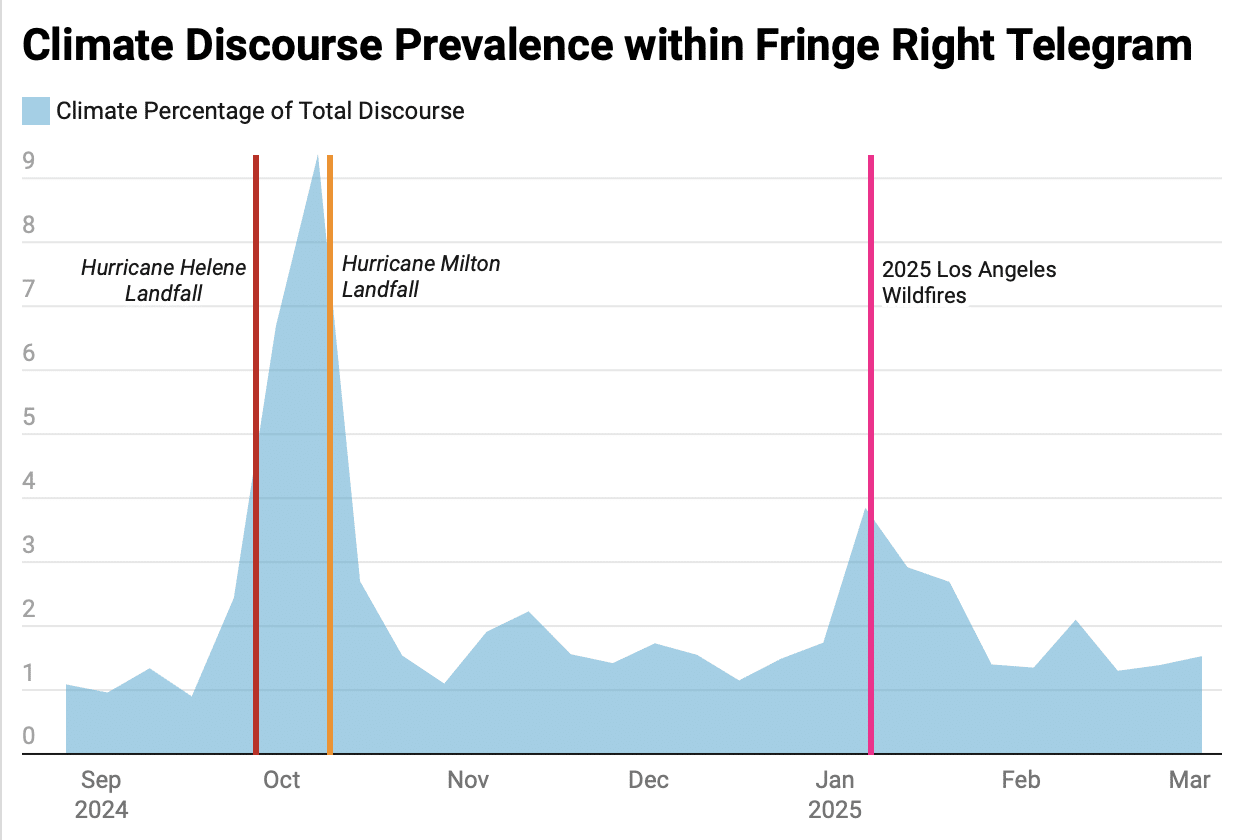
Secondly, we assessed the scale and propensity of amplification of climate-related content within the extremist network relative to baseline extremist discourse on Telegram. The results show an episodic trend in which climate discourse spikes around the events of each disaster, peaking at 9.38% of all extremist discourse on Telegram during the disaster windows of Hurricane Milton and Hurricane Helene. This spike in discourse coincides with amplification, as climate-related content shows an overall 40% higher likelihood of being forwarded compared to the baseline. These findings highlight climate as a relevant point of discussion in fringe communities and its potential for amplification.
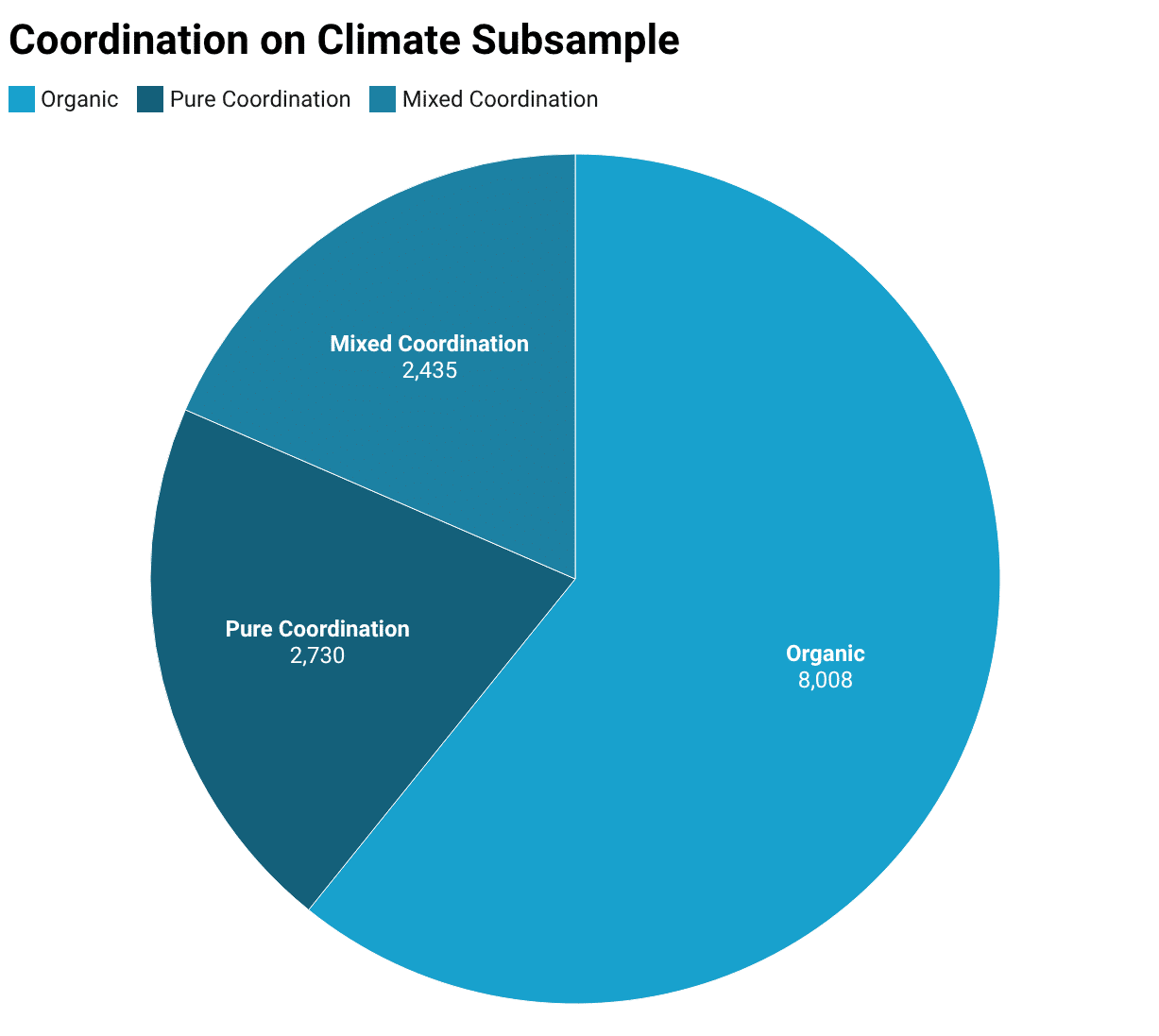
Finally, building on previous research on inorganic behavior on Telegram, we demonstrate that the ecosystem contains an alarming percentage of coordinated messages primarily disseminating climate disinformation (Blas et al., 2025; Dukach et al., 2025; Herasimenka et al., 2023; Kireev et al., 2025).7We use coordinated to describe observable patterns suggesting artificial network-level amplification without making stronger claims about actor intent or degree of robotic automation. On the lower bound, approximately 20.7% of all climate messages sampled were exact or near-exact messages posted in different channels within 24 hours of each other, bypassing the forward feature built into Telegram. Regarding the upper bound, approximately 39.2% of sampled climate-related messages met the specified criteria, with some messages appearing across separate channels while both using and circumventing the forward feature. This upper bound likely reflects a mixture of coordinated and organic sharing.
Taken together, these three findings build a cumulative argument that climate disinformation on Telegram is embedded within a shared sociotechnical extremist infrastructure, opportunistically amplified during natural disasters, and exhibits patterns of coordination. We call on policymakers, academics, and science communicators to treat low-moderated platforms as a new frontier of climate disinformation, particularly following the migration of extremist communities from mainstream platforms (Urman & Katz, 2022). Combating this phenomenon cannot be reduced to single-platform moderation. We recommend that cross-platform detection of the coordinated infrastructure be established during declared natural disaster windows as a regulatory standard applied uniformly across all social platforms to preserve authentic rather than manufactured voices,8Potential monitoring protocols may unintendedly exacerbate the production of conspiratorial narratives. Therefore, we call on further research to investigate appropriate implementation of this detection protocol. thereby elevating free expression.
Findings
Finding 1: Climate discussions in extremist channels reflect the same domain-sharing patterns as the broader extremist ecosystem.
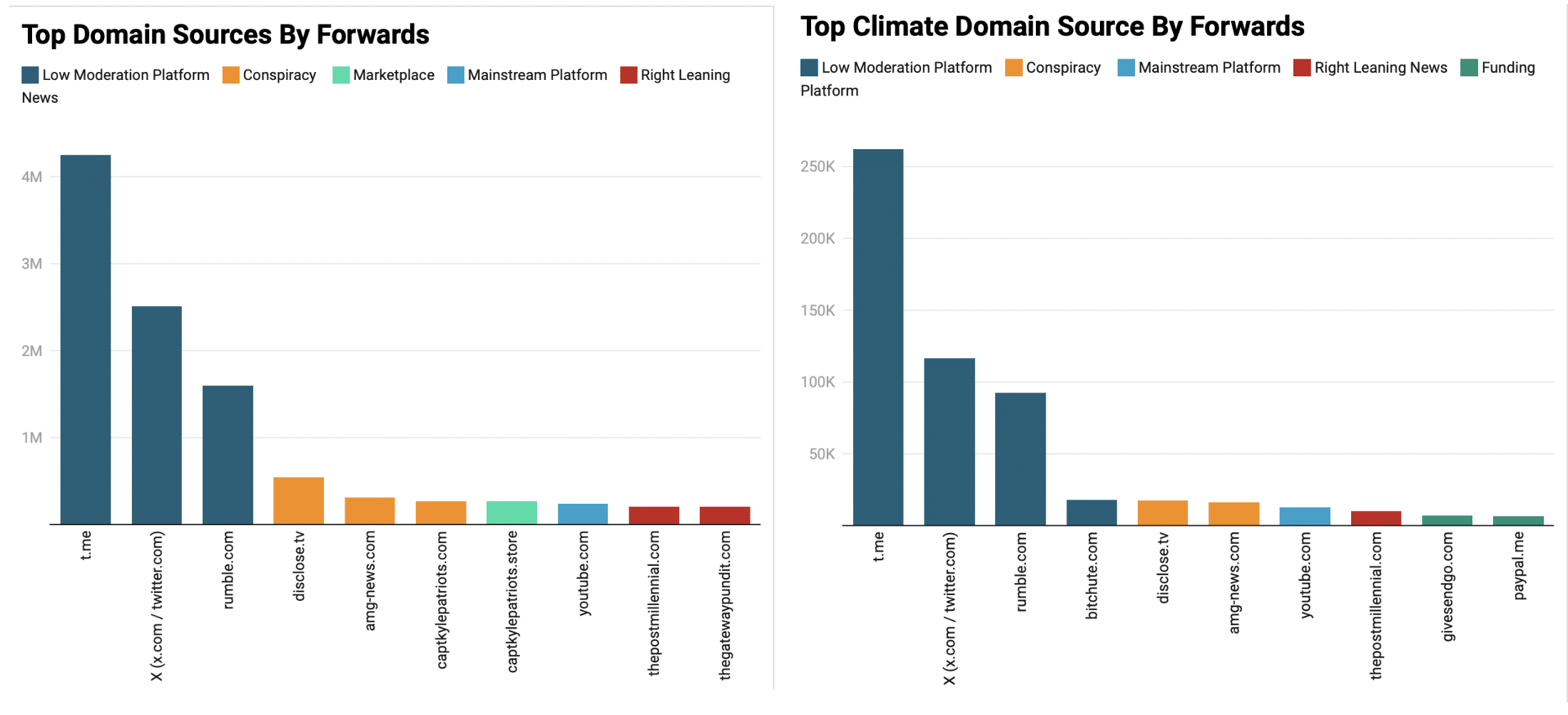
After performing binary classification to separate climate and non-climate discussion from 586,189 total messages taken from 116 active right-wing extremist Telegram channels, a subsample of 13,173 climate and 573,016 non-climate messages was extracted. Telegram represents the highest forwarded domain across both climate and non-climate subsamples, comprising 261,797 and 4,243,124 forwards, respectively. This makes up 19.7% of the total 1,331,120 climate forwards and 11.1% of the total 39,382,749 non-climate forwards, making Telegram domain sharing a notable 10.8% of all root domain sources.
Figure 1 demonstrates this continual dominance of low-to-moderate platform amplification in both subsamples’ ecosystems, with X (formerly Twitter) and Rumble, a self-proclaimed alternative platform that “continues to embrace ‘cancel culture’,” leading domain forwarding (Ghosh & Stocking, 2022; Özturan et al., 2025). This is followed directly by conspiracy-identified sources such as disclose-tv and amg-news, suggesting an overall conspiracy-leaning within climate disinformation (Van Zandt, 2022, 2025). The remaining domains represent a smaller share of amplified content and include right-leaning news sources such as The Post Millennial, as well as YouTube, which, despite being comparatively more moderated than Telegram, has been identified as a platform that conspiracy-oriented communities continue to use alongside low-moderation alternatives (Zeng & Schäfer, 2021).
Despite broad structural similarity across subsamples, minor distributional differences warrant note. Bitchute, an alternative video platform, appears prominently in the climate subsample, likely reflecting the displacement of climate denial content following YouTube’s targeted removal policies for climate misinformation (Zeng & Schäfer, 2021). Additionally, the presence of funding platforms such as GiveSendGo and PayPal in the climate subsample and captkylepatriots.store in the non-climate subsample suggests that both subsamples embed commercial monetization infrastructure alongside content distribution. Regardless of these differences, the overall similarity between domain distributions indicates that climate denial on Telegram is not operating through a distinct information ecosystem but is instead embedded within the broader extremist one.
Finding 2: Climate discourse spikes during natural disasters and shows higher amplification within extremist Telegram channels.
To examine how climate discourse is mobilized within fringe-right Telegram communities, a weekly temporal analysis was conducted, tracking climate content as a proportion of total network discourse, allowing for the identification of periods of elevated climate engagement relative to total activity. Figure 2 demonstrates heightened episodic spikes during Hurricane Helene, Hurricane Milton, and the January 2025 California wildfires, followed by a sharp proportional decline from peak values to a baseline that rarely exceeds 2% of total network discourse during both pre-disaster and post-disaster recovery. This signals opportunistic engagement with climate-related issues rather than sustained ideological interest. Additionally, the hurricanes generated a combined peak of 9.38% of network discourse versus 3.85% for the California wildfires, possibly reflecting the political context of the November 2024 U.S. presidential election and subsequent inauguration on January 20, 2025.
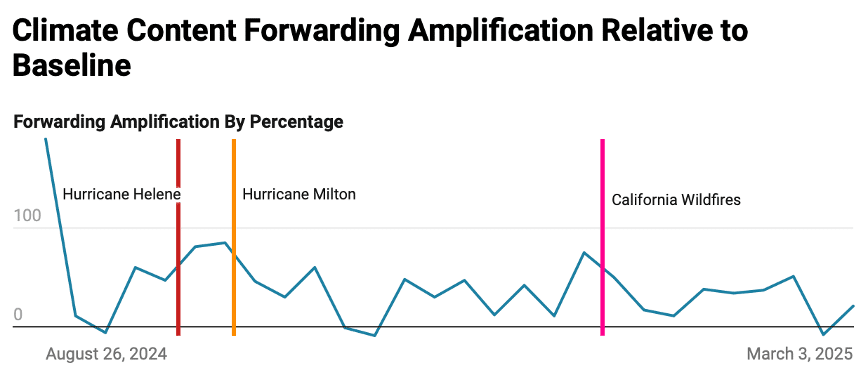
Figure 3 further demonstrates the amplification of climate narratives through the affordance of forwards. Consistently, climate-related messages have a 40% higher forward rate than the baseline, with spikes also coinciding with the three natural disasters under study. This may further reinforce the opportunistic and amplifying potential of natural disasters, which corroborates existing research on fear as a driver of engagement and disinformation within right-wing extremist spaces (Hilberts et al., 2025; Törnberg & Chueri, 2025). Interestingly, the forwarding amplification spike observed in late August 2024 does not correspond to any identifiable major climate event, nor does it coincide with elevated climate discourse prevalence, suggesting that forwarding amplification within these networks is not exclusively driven by climate events themselves. This decoupling between amplification and discourse volume may reflect a high-engagement post or non-climate external event temporarily inflating forwarding activity, suggesting that climate content amplification in these communities can be mediated by factors beyond climate salience.
Finding 3: Climate discussion within extremist Telegram channels has significant signals of coordinated behavior.
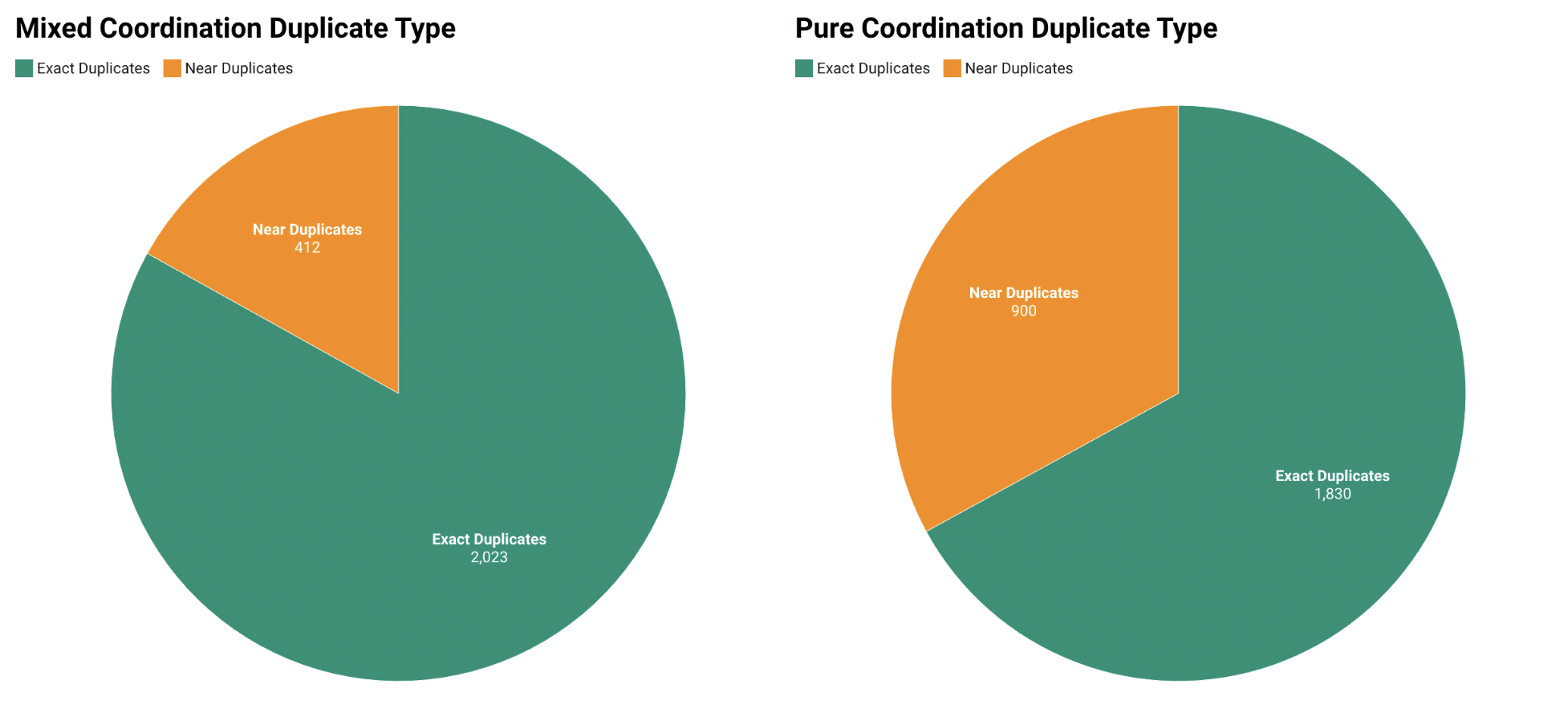
Extending research on coordinated activity on Telegram, this study argues that amplification also involves the coordinated sharing of content across channels that strategically bypass the platform’s forward feature. From this perspective, measuring coordination may give further insights into why climate-related discussion is amplified and opportunistic within extremist ecosystems. In Figure 4, at the lower bound, 2,730 (20.7%) “pure coordinated” messages within the climate subsample had content that appeared in other channels within a 24-hour window and did not use the forward feature built into Telegram. Of those purely coordinated messages, 1,830 (67.0%) used a copy-and-paste method, suggesting a bot approach to amplification (see figure 5), compared to 900 near-duplicate messages. Mixed Messages, defined as content that appeared in other channels within a 24-hour window but also included at least one forwarded message, totaled 2,425 (18.5%), suggesting a mix of coordination and potential organic forwarding. Similarly, the mixed message group had 2,023 (83.0%) exact duplicates (see Figure 5). Taken together, this yields an upper bound of 5,165 (39.2%) messages, with 8,008 (60.8%) classified as organic.
Beyond the quantitative patterns of coordination, a qualitative examination of the coordinated messages revealed the substance of what was being amplified. Messages from the coordination group exhibited narratives characterized by climate change denial, allegations of “scientific fraud,” blame of political opponents for neglecting natural disaster victims, and weather modification claims (see Appendix B). While this qualitative analysis is exploratory, given the study’s scope, the narratives identified are illustrative of broader patterns amplified through coordination. These findings corroborate both the source domains being propagated and existing research on climate conspiracy narratives, further establishing right-wing extremist Telegram channels as a conduit for their spread.
Methods
Snowball sampling
This study employed a snowball sampling method (SSM) to gather data on American right-wing extremist Telegram channels, which has been established as an appropriate method for hard-to-reach social media populations (Dosek, 2021). An alias account was created to minimize suspicion, and all data were collected from public channels, anonymized, and managed in accordance with IRB-approved protocols (IRB #7051). SSM was initiated by joining eight channels using keywords associated with right-wing groups, with subsequent channels identified through shared source content and Telegram’s algorithm-driven channel recommendations. While amassing the corpus, a bot extracted key metrics from all posts, including message content, views, channel ID, forwards, and data, and stored them in an encrypted database.
Dictionary classification
A custom dictionary method was employed to classify climate and non-climate messages via keyword matching (Silge & Robinson, 2017). Small variations in keyword spelling and pluralization were accounted for to ensure comprehensive capture of each term used within each message. This method is both empirically validated and consistent with Telegram’s terms of service, which prohibit AI training on platform data (Macanovic & Przepiorka, 2024; Telegram, 2025). The dictionary was initially built upon an existing National Oceanic and Atmospheric Administration (NOAA) climate glossary to maintain alignment with established terminology and iteratively refined through manual validation of 200 randomly sampled messages per subsample (National Oceanic and Atmospheric Administration, 2023). Validity was determined by whether a message explicitly addressed a climate-related topic in some capacity, whether through engagement with a natural disaster or through comments about a weather-related organization such as the Federal Emergency Management Agency (FEMA).
As extremist communities often engage with climate topics conspiratorially, standard climate terminology requires refinement to accurately capture this discourse. During refinement, overly generic or politically adjacent terms generating false positives were removed from the dictionary, while climate-specific policy terminology was added to better capture the nuanced language of the discursive ecosystem under study. Classification performance of the initial round had a total F1 score of 0.678, while the final round yielded a notable increase with a final F1 score of 0.890, making it a robust method for binary classification. Further detailed classifier validation results are provided in Appendix C, with the full final dictionary in Appendix D and an omitted keyword list in Appendix E.
Amplification forward tracking
After the final climate and non-climate subsamples were curated, total messages and forwards were analyzed temporally by comparing the message-to-forward ratio of each subsample. The full temporal analysis spanned weekly intervals from the study period, providing a baseline measure of discourse volume and amplification.
Tracking content sharing by website
Root domains were extracted across each Telegram message present within the study’s timeframe to identify upstream content sources and cross-platform contamination. Amplification was ranked by aggregating forward counts across domains. Prominent root domains such as Twitter/X were combined to match root domains with functionally equivalent sources.
Coordination detection
Building on established methods, we apply text-based coordinated detection techniques to the climate change subsample, using text similarity, bypassing Telegram’s forward feature, and temporal proximity as a proxy for coordination (Blas et al., 2025; Giglietto et al., 2020). Exact duplicates were identified as identical messages appearing across at least two distinct channels. Near duplicates were identified using TF-IDF vectorization with cosine similarity computed across all cross-channel message pairs, flagging those with a score at or above 0.85. This threshold reflects a conservative detection approach that accounts for minor variations in messaging, such as minor misspellings, emoji deviations, and punctuation, while minimizing false positives. Flagged messages were then assessed against a 24-hour posting window and the presence or absence of Telegram’s native forwarding feature to distinguish between organic, mixed, and coordinated transmission patterns.
Limitations
The classifier’s 81% precision rate (see Appendix C) means approximately one in five climate messages may be false positives, potentially inflating prevalence estimates. The snowball sampling methodology excluded private channels, which limited generalizability across all extremist Telegram channels. Future quasi-experimental research would strengthen causal claims about the role natural disasters play in shaping climate disinformation. Such research would offer further insight into whether these events precede climate disinformation spikes or are associated with them. Finally, further investigation of the channels involved in cross-posting and coordinated activity could determine whether amplification dynamics are driven by a small number of highly active actors or are more broadly distributed across the network, informing methods for detecting coordinated behavior during crises.
Topics
Bibliography
Amorim, R., Villarini, G., Czajkowski, J., & Smith, J. (2025). Flooding from Hurricane Helene and associated impacts: A historical perspective. Journal of Hydrology X, 27, Article 100204. https://doi.org/10.1016/j.hydroa.2025.100204
Baptista, J. P., & Gradim, A. (2022). Who believes in fake news? Identification of political (a)symmetries. Social Sciences, 11(10), Article 460. https://doi.org/10.3390/socsci11100460
Beven, J. L., II, Alaka, L., & Fritz, C. (2025). Tropical cyclone report: Hurricane Milton (AL142024). National Hurricane Center. https://www.nhc.noaa.gov/data/tcr/AL142024_Milton.pdf
Blas, L., Saraf, D., Salkar, T., et al. (2025). Large-scale detection of multilingual coordinated activity on Telegram. npj Complexity, 2, Article 33. https://doi.org/10.1038/s44260-025-00056-w
Börgmann, H., Hammer, D., Beyer, J., Ziock, J., Stegers, F., Keßling, P., & Münch, F. (2025, April 24). Destructive discourses: The digital dissemination of climate misinformation and disinformation. Institute for Strategic Dialogue Germany. https://isdgermany.org/destruktive-diskurse-digitale-verbreitung-von-klimabezogener-mis-und-desinformation-2/
Dosek, T. (2021). Snowball sampling and Facebook: How social media can help access hard-to-reach populations. PS: Political Science and Politics, 54(4), 651–655. https://doi.org/10.1017/S104909652100041X
Dukach, Y., Adam, I., & Furbish, M. (2025). Digital occupation: Pro-Russian bot networks target Ukraine’s occupied territories on Telegram. Atlantic Council. https://www.atlanticcouncil.org/in-depth-research-reports/report/report-russian-bot-networks-occupied-ukraine/
Essien, E. O. (2025). Climate change disinformation on social media: A meta-synthesis on epistemic welfare in the post-truth era. Social Sciences, 14(5), Article 304. https://doi.org/10.3390/socsci14050304
Frame, D. J., Wehner, M. F., Noy, I., Rosner, S., & Kopp, R. E. (2020). The economic costs of Hurricane Harvey attributable to climate change. Climatic Change, 160(2), 271–281. https://doi.org/10.1007/s10584-020-02692-8
Ghosh, S., & Stocking, G. (2022, December 21). Key facts about rumble. Pew Research Center. https://www.pewresearch.org/short-reads/2022/12/21/key-facts-about-rumble/
Giglietto, F., Righetti, N., Rossi, L., & Marino, G. (2020). It takes a village to manipulate the media: Coordinated link sharing behavior during 2018 and 2019 Italian elections. Information, Communication & Society, 23(6), 867–891. https://doi.org/10.1080/1369118X.2020.1739732
Hagen, A. B., Cangialosi, J. P., Chenard, M., Alaka, L., & Delgado, S. (2026). Tropical cyclone report: Hurricane Helene (AL092024). National Hurricane Center. https://www.nhc.noaa.gov/data/tcr/AL092024_Helene.pdf
Herasimenka, A., Bright, J., Knuutila, A., & Howard, P. N. (2023). Misinformation and professional news on largely unmoderated platforms: The case of telegram. Journal of Information Technology & Politics, 20(2), 198–212. https://doi.org/10.1080/19331681.2022.2076272
Hilberts, S., Govers, M., Petelos, E., & Evers, S. (2025). The impact of misinformation on social media in the context of natural disasters: Narrative review. JMIR Infodemiology, 5, Article e70413. https://doi.org/10.2196/70413
Hunt, K., Wang, B., & Zhuang, J. (2020). Misinformation debunking and cross-platform information sharing through Twitter during Hurricanes Harvey and Irma: A case study on shelters and ID checks. Natural Hazards, 103(1), 861–883. https://doi.org/10.1007/s11069-020-04016-6
Institute for Strategic Dialogue [ISD]. (2024, October 8). Hurricane Helene brews up storm of online falsehoods and threats. Institute for Strategic Dialogue. https://www.isdglobal.org/digital-dispatch/hurricane-helene-brews-up-storm-of-online-falsehoods-and-threats/
Jonkman, S. N., Godfroy, M., Sebastian, A., & Kolen, B. (2018). Loss of life due to Hurricane Harvey. Natural Hazards and Earth System Sciences, 18(4), 1073–1078. https://doi.org/10.5194/nhess-18-1073-2018
Kireev, K., Mykhno, Y., Troncoso, C., & Overdorf, R. (2025). Characterizing and detecting propaganda-spreading accounts on Telegram. In Proceedings of the 34th USENIX Security Symposium. USENIX Association. https://www.usenix.org/system/files/usenixsecurity25-kireev.pdf
Lewandowsky S. (2021). Climate change disinformation and how to combat it. Annual Review of Public Health, 42, 1–21. https://doi.org/10.1146/annurev-publhealth-090419-102409
Los Angeles County Economic Development Corporation. (2025). Impact of 2025 Los Angeles wildfires and comparative study. https://laedc.org/wildfirereport/
Macanovic, A., & Przepiorka, W. (2024). A systematic evaluation of text mining methods for short texts: Mapping individuals’ internal states from online posts. Behavior Research Methods, 56(4), 2782–2803. https://doi.org/10.3758/s13428-024-02381-9
Merdjanoff, A. A., Abramson, D. M., Park, Y. S., & Piltch-Loeb, R. (2022). Disasters, displacement, and housing instability: Estimating time to stable housing 13 years after Hurricane Katrina. Weather, Climate, and Society, 14(3), 535–550. https://doi.org/10.1175/WCAS-D-21-0057.1
Mudde, C. (1995). Right‐wing extremism analyzed: A comparative analysis of the ideologies of three alleged right‐wing extremist parties (NPD, NDP, CP’86). European Journal of Political Research, 27(2), 203–224. https://doi.org/10.1111/j.1475-6765.1995.tb00636.x
National Oceanic and Atmospheric Administration. (2023, September 11). Weather glossary. https://www.noaa.gov/jetstream/appendix/weather-glossary
Newman, R., & Noy, I. (2023). The global costs of extreme weather that are attributable to climate change. Nature Communications, 14, Article 6103. https://doi.org/10.1038/s41467-023-41888-1
Nikolov, D., Flammini, A., & Menczer, F. (2021). Right and left, partisanship predicts (asymmetric) vulnerability to misinformation. Harvard Kennedy School (HKS) Misinformation Review, 1(7). https://doi.org/10.37016/mr-2020-55
Özturan, B., Quintana-Mathé, A., Grinberg, N., Ognyanova, K., & Lazer, D. (2025). Declining information quality under new platform governance. Harvard Kennedy School (HKS) Misinformation Review, 6(3). https://doi.org/10.37016/mr-2020-176
Paglino, E., Raquib, R. V., & Stokes, A. C. (2025). Excess deaths attributable to the Los Angeles wildfires from January 5 to February 1, 2025. JAMA, 334(11), 1018–1019. https://doi.org/10.1001/jama.2025.10556
Selig, K. (2024, October 14). Meteorologists face harassment and death threats amid hurricane disinformation. The New York Times. https://www.nytimes.com/2024/10/14/us/meteorologists-threats-conspiracy-theories-hurricanes.html
Silge, J., & Robinson, D. (2017). Text mining with R: A tidy approach. O’Reilly Media. https://www.tidytextmining.com
Storani, S., Falkenberg, M., Quattrociocchi, W., Lodi, G., & Vicini, A. (2025). Relative engagement with sources of climate misinformation is growing across social media platforms. Scientific Reports, 15(1), Article 18629. https://doi.org/10.1038/s41598-025-03082-9
Telegram. (2025). Telegram channels. https://telegram.org/tour/channels
Tomassi, A., Falegnami, A., & Romano, E. (2025). Disinformation in the digital age: Climate change, media dynamics, and strategies for resilience. Publications, 13(2), Article 24. https://doi.org/10.3390/publications13020024
Törnberg, P., & Chueri, J. (2025). When do parties lie? Misinformation and radical-right populism across 26 countries. The International Journal of Press/Politics, 31(2). https://doi.org/10.1177/19401612241311886
Tucci, G., Bastos, J. G., & Carneiro, B. (2025). Contesting climate futures: Mapping misinformation narratives and networks on Telegram. Digital Methods Initiative. https://www.digitalmethods.net/Dmi/SummerSchool2025ContestingClimateFutures
Urman, A., & Katz, S. (2022). What they do in the shadows: Examining the far-right networks on Telegram. Information, Communication & Society, 25(7), 904–923. https://doi.org/10.1080/1369118X.2020.1803946
Van Zandt, D. (2022, September 16). Disclose TV. Media Bias/Fact Check. https://mediabiasfactcheck.com/disclose-tv/
Van Zandt, D. (2025, January 3). American Media Group (AMG-news.com). Media Bias/Fact Check. https://mediabiasfactcheck.com/amg-news/
Vergani, M., Martinez Arranz, A., Scrivens, R., & Orellana, L. (2022). Hate speech in a Telegram conspiracy channel during the first year of the COVID-19 pandemic. Social Media + Society, 8(4). https://doi.org/10.1177/20563051221138758
Vraga, E. K., & Bode, L. (2020). Defining misinformation and understanding its bounded nature: Using expertise and evidence for describing misinformation. Political Communication, 37(1), 136–144. https://doi.org/10.1080/10584609.2020.1716500
Walther, S., & McCoy, A. (2021). US extremism on Telegram: Fueling disinformation, conspiracy theories, and accelerationism. Perspectives on Terrorism, 15(2), 100–124. https://www.jstor.org/stable/27007298
Willaert, T., Sessa, M. G., & Van Soest, J. (2022, November 14). The disinformative ecosystem: Link-sharing practices on Telegram as evidence of cross-platform amplification (EDMO BELUX Investigative Report). EU DisinfoLab. https://www.disinfo.eu/publications/the-disinformative-ecosystem-link-sharing-practices-on-telegram-as-evidence-of-cross-platform-amplification/
World Meteorological Organization. (2024). State of the global climate 2023 (WMO-No. 1347). https://wmo.int/publication-series/state-of-global-climate/state-of-global-climate-2023
Zeng, J., & Schäfer, M. S. (2021). Conceptualizing “dark platforms”: Covid-19-related conspiracy theories on 8kun and Gab. Digital Journalism, 9(9), 1208–1230. https://doi.org/10.1080/21670811.2021.1938165
Funding
No funding has been received to conduct this research.
Competing Interests
The authors declare no competing interests.
Ethics
All data were collected from public channels, anonymized, and managed in accordance with IRB-approved protocols (University of Virginia IRB #7051).
Copyright
This is an open-access article distributed under the terms of the Creative Commons Attribution License, which permits unrestricted use, distribution, and reproduction in any medium, provided that the original author and source are properly credited.
Data Availability
All materials needed to replicate this study are available via the Harvard Dataverse:
https://doi.org/10.7910/DVN/ZDZ55T
Acknowledgments
We would like to thank all the staff at the Karsh Institute of Democracy and the Digital Technology for Democracy Lab at the University of Virginia.