
Explore All Articles
All Articles
Article Topic
Fact-checking Trump’s election lies can improve confidence in U.S. elections: Experimental evidence
Catie Snow Bailard, Ethan Porter and Kimberly Gross
As the 2020 campaign unfolded, with a mix of extraordinary embellishments and outright falsehoods, President Trump’s attacks on the integrity of the U.S. electoral system grew louder and more frequent. Trump-aligned Republican candidates have since advanced similar false claims in their own campaigns in the lead-up to the 2022 midterm elections.
Research note: Explicit voter fraud conspiracy cues increase belief among co-partisans but have broader spillover effects on confidence in elections
Benjamin A. Lyons and Kaitlyn S. Workman
In this pre-registered experiment, we test the effects of conspiracy cue content in the context of the 2020 U.S. elections. Specifically, we varied whether respondents saw an explicitly stated conspiracy theory, one that was merely implied, or none at all. We found that explicit cues about rigged voting machines increase belief in such theories, especially when the cues target the opposing political party.
A story of (non)compliance, bias, and conspiracies: How Google and Yandex represented Smart Voting during the 2021 parliamentary elections in Russia
Mykola Makhortykh, Aleksandra Urman and Mariëlle Wijermars
On 3 September 2021, the Russian court forbade Google and Yandex to display search results for “Smart Voting,” the query referring to a tactical voting project by the jailed Russian opposition leader Alexei Navalny. To examine whether the two search engines complied with the court order, we collected top search outputs for the query from Google and Yandex.
Research note: Tiplines to uncover misinformation on encrypted platforms: A case study of the 2019 Indian general election on WhatsApp
Ashkan Kazemi, Kiran Garimella, Gautam Kishore Shahi, Devin Gaffney and Scott A. Hale
There is currently no easy way to discover potentially problematic content on WhatsApp and other end-to-end encrypted platforms at scale. In this paper, we analyze the usefulness of a crowd-sourced tipline through which users can submit content (“tips”) that they want fact-checked.
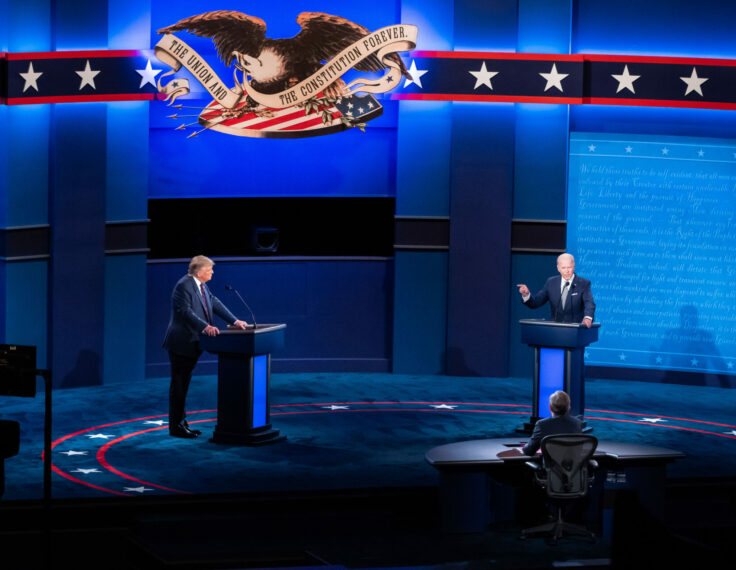
Research note: Lies and presidential debates: How political misinformation spread across media streams during the 2020 election
Jaren Haber, Lisa Singh, Ceren Budak, Josh Pasek, Meena Balan, Ryan Callahan, Rob Churchill, Brandon Herren and Kornraphop Kawintiranon
When U.S. presidential candidates misrepresent the facts, their claims get discussed across media streams, creating a lasting public impression. We show this through a public performance: the 2020 presidential debates. For every five newspaper articles related to the presidential candidates, President Donald J.
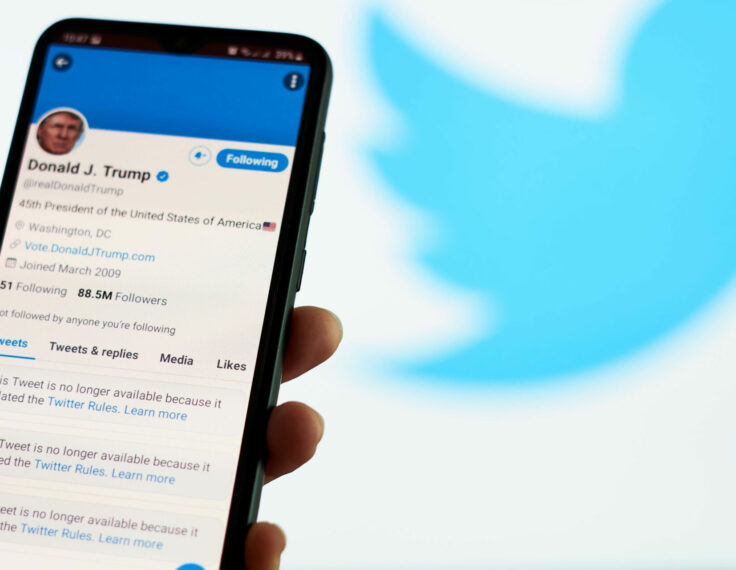
Twitter flagged Donald Trump’s tweets with election misinformation: They continued to spread both on and off the platform
Zeve Sanderson, Megan A. Brown, Richard Bonneau, Jonathan Nagler and Joshua A. Tucker
We analyze the spread of Donald Trump’s tweets that were flagged by Twitter using two intervention strategies—attaching a warning label and blocking engagement with the tweet entirely. We find that while blocking engagement on certain tweets limited their diffusion, messages we examined with warning labels spread further on Twitter than those without labels.
Elections
The presumed influence of election misinformation on others reduces our own satisfaction with democracy
Erik C. Nisbet, Chloe Mortenson and Qin Li
Pervasive political misinformation threatens the integrity of American electoral democracy but not in the manner most commonly examined. We argue the presumed influence of misinformation (PIM) may be just as pernicious, and widespread, as any direct influence that political misinformation may have on voters.

Elections
COVID-19 disinformation and political engagement among communities of color: The role of media literacy
Erica Weintraub Austin, Porismita Borah and Shawn Domgaard
Communities of color, suffering equity gaps and disproportionate COVID-19 effects, also must resist ongoing disinformation campaigns designed to impede their political influence. A representative, national survey (N=1264) of adults conducted June-July 2020 found that nonwhite respondents tended to report less COVID-19 knowledge, media literacy, and voting intent than white respondents, but more acceptance of COVID-19 disinformation and for risks associated with protesting for social justice.
Elections
COVID-19 misinformation and the 2020 U.S. presidential election
Emily Chen, Herbert Chang, Ashwin Rao, Kristina Lerman, Geoffrey Cowan and Emilio Ferrara
Voting is the defining act for a democracy. However, voting is only meaningful if public deliberation is grounded in veritable and equitable information. This essay investigates the politicization of public health practices during the Democratic primaries in the context of the 2020 U.S.