
Explore All Articles
All Articles
Article Topic
Who knowingly shares false political information online?
Shane Littrell, Casey Klofstad, Amanda Diekman, John Funchion, Manohar Murthi, Kamal Premaratne, Michelle Seelig, Daniel Verdear, Stefan Wuchty and Joseph E. Uscinski
Some people share misinformation accidentally, but others do so knowingly. To fully understand the spread of misinformation online, it is important to analyze those who purposely share it. Using a 2022 U.S. survey, we found that 14 percent of respondents reported knowingly sharing misinformation, and that these respondents were more likely to also report support for political violence, a desire to run for office, and warm feelings toward extremists.
Vaccine hesitancy in online spaces: A scoping review of the research literature, 2000-2020
Timothy Neff, Jonas Kaiser, Irene V. Pasquetto, Dariusz Jemielniak, Dimitra Dimitrakopoulou, Siobhan Grayson, Natalie Gyenes, Paola Ricaurte, Javier Ruiz-Soler and Amy Zhang
We review 100 articles published from 2000 to early 2020 that research aspects of vaccine hesitancy in online communication spaces and identify several gaps in the literature prior to the COVID-19 pandemic. These gaps relate to five areas: disciplinary focus; specific vaccine, condition, or disease focus; stakeholders and implications; research methodology; and geographical coverage.
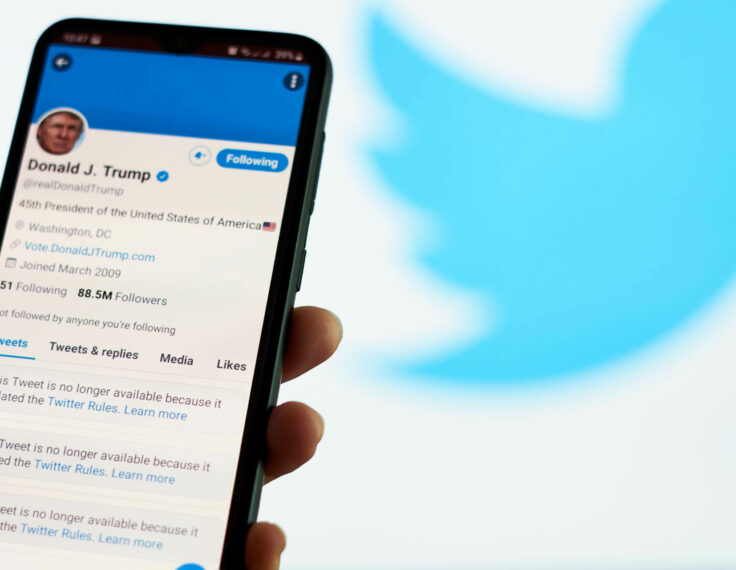
Twitter flagged Donald Trump’s tweets with election misinformation: They continued to spread both on and off the platform
Zeve Sanderson, Megan A. Brown, Richard Bonneau, Jonathan Nagler and Joshua A. Tucker
We analyze the spread of Donald Trump’s tweets that were flagged by Twitter using two intervention strategies—attaching a warning label and blocking engagement with the tweet entirely. We find that while blocking engagement on certain tweets limited their diffusion, messages we examined with warning labels spread further on Twitter than those without labels.
Elections
Source alerts can reduce the harms of foreign disinformation
Jason Ross Arnold, Alexandra Reckendorf and Amanda L. Wintersieck
Social media companies have begun to use content-based alerts in their efforts to combat mis- and disinformation, including fact-check corrections and warnings of possible falsity, such as “This claim about election fraud is disputed.” Another harm reduction tool, source alerts, can be effective when a hidden foreign hand is known or suspected.
Research note: Likes, sarcasm and politics: Youth responses to a platform-initiated media literacy campaign on social media
Ioana Literat, Abubakr Abdelbagi, Nicola YL Law, Marcus Y-Y Cheung and Rongwei Tang
To better understand youth attitudes towards media literacy education on social media, and the opportunities and challenges inherent in such initiatives, we conducted a large-scale analysis of user responses to a recent media literacy campaign on TikTok. We found that reactions to the campaign were mixed, and highly political in nature.

Tackling misinformation: What researchers could do with social media data
HKS Misinformation Review Guest Authors
Written by Irene V. Pasquetto, Briony Swire-Thompson, Michelle A. Amazeen, Fabrício Benevenuto, Nadia M. Brashier, Robert M. Bond, Lia C. Bozarth, Ceren Budak, Ullrich K. H. Ecker, Lisa K. Fazio, Emilio Ferrara, Andrew J. Flanagin, Alessandro Flammini, Deen Freelon, Nir Grinberg, Ralph Hertwig, Kathleen Hall Jamieson, Kenneth Joseph, Jason J.

COVID-19
The weaponization of web archives: Data craft and COVID-19 publics
Amelia Acker and Mitch Chaiet
An unprecedented volume of harmful health misinformation linked to the coronavirus pandemic has led to the appearance of misinformation tactics that leverage web archives in order to evade content moderation on social media platforms. Here we present newly identified manipulation techniques designed to maximize the value, longevity, and spread of harmful and non-factual content across social media using provenance information from web archives and social media analytics.

Research note: The spread of political misinformation on online subcultural platforms
Anthony G. Burton and Dimitri Koehorst
This research note explores the extent to which misinformation and other types of “junk” content are spread on political boards and forums on 4chan and Reddit. Our findings suggest that these userbases are impervious to the appeal of low-quality “pink slime” news sites with algorithmically generated conservative talking points masquerading as journalism.