
Peer Reviewed
Professional and community-based fact-checking show different strengths, but neither performs strongly across trust, scalability, and impact
Article Metrics

1
CrossRef Citations
PDF Downloads
Page Views
Fact-checking on social media matters more than ever. When Meta abandoned professional fact checkers in 2025 in favour of crowd-sourced annotations, it bet that community participation could substitute for institutional expertise. Our systematic review of 21 empirical studies of social media fact-checking (2022–2025) suggests the picture is more complicated than it appears. Community-based fact-checking is faster and scalable, whereas professional fact checkers are generally more trusted but often slow. Neither model, on its own, performs strongly across trust, scalability, and impact. The evidence suggests that hybrid systems combining community speed with expert verification are likely to be the most effective approach.

Research Questions
- How do professional and community-based fact-checking systems on social media compare in terms of user trust?
- How do they compare in terms of scalability, including both processing volume and audience reach on social media?
- How do they compare in terms of impact on misinformation beliefs and sharing behavior on social media?
- What do potential differences imply for the design of more effective social media fact-checking interventions?
Essay Summary
- We conducted a PRISMA-guided systematic review of 21 peer-reviewed empirical studies published between 2022 and 2025 (i.e., the period capturing the emergence of community-based fact-checking systems in mainstream platform governance), identified through searches in ACM Digital Library, Web of Science, Scopus, and JSTOR.
- The studies were compared using a three-part framework focused on trust, scalability, and impact.
- Neither professional nor community-based fact-checking on social media performs strongly across all three dimensions at the same time.
- Professional fact-checking tends to perform better on trust and shows moderate impact but remains limited by low to moderate scalability.
- Community-based fact-checking seems to perform better on scalability, but its trust and impact remain moderate because visibility, partisanship, and selective uptake limit its corrective effects.
- The key problem is not that one model works and the other fails, but that current systems optimize different dimensions of fact-checking effectiveness on social media.
- Hybrid systems combining crowd-based speed with expert validation may offer a more promising path than treating professional and community-based fact-checking as direct substitutes.
Implications
Fact-checking on social media plays a crucial role in identifying and correcting misinformation (Lee et al., 2023). At the same time, social media has changed how people evaluate information and determine what to trust. The ability to search, compare sources, and investigate claims independently has made professional expertise one source of authority among many (Bartsch et al., 2025). One manifestation of this broader shift was Meta’s 2025 decision to replace third-party professional fact checkers with crowd-sourced annotations. These developments have intensified debates over the relative strengths and limitations of different fact-checking models. This systematic review compares professional and community-based fact-checking across three dimensions central for fact-checking effectiveness on social media: trust, scalability, and impact. Although professional and community-based fact-checking should not be treated as mutually exclusive categories, the findings show that these models involve distinct trade-offs. Professional fact-checking seems to generate higher levels of trust and offers clearer verification standards, but it is also slower and less scalable. Community-based fact-checking can operate with greater speed and scale, but its corrective effects are more uneven because they depend on participation, visibility, user acceptance, and the risk of ideological bias in who contributes and which claims are corrected. Based on these findings, we identify three main implications.
Implications for platform design
Social media platforms often present community-based fact-checking as a scalable solution to the limits of professional fact-checking (Meta, 2025). Our review suggests that this claim should be treated cautiously. Community-based fact-checking clearly improves processing volume and can annotate misleading content much faster than professional fact-checking (Allen et al., 2021; Saeed et al., 2022; Zhao & Naaman, 2023). However, scalability at the point of annotation is not the same as scalability at the point of correction. Many community notes are never shown publicly because they fail to receive sufficient support from contributors representing diverse perspectives. (La Barbera et al., 2024; Pröllochs, 2022). Even visible notes may appear too late to interrupt early spread (Chuai et al., 2024), and they do not persuade all users equally (Allen et al., 2022; Kuuse et al., 2025). Community-based fact-checking should therefore not be treated as a self-sufficient replacement for professional expertise. Platforms should invest more in how corrections are surfaced and report what proportion of submitted notes become visible and are actually seen by users. This matters especially in engagement-driven environments where misleading and AI-generated content can spread rapidly (Cotter, 2021; Metzler & Garcia, 2023; Schroeder et al., 2026).
Implications for policymakers and regulators
Public debate often frames fact-checking as either a censorship issue or a free-speech issue (Lewandowsky, 2025). Our findings suggest that this framing is too narrow. Fact-checking is also part of the epistemic infrastructure of digital public life. Across the reviewed studies, the central issue is whether corrective systems generate trust, achieve sufficient visibility, and produce meaningful impact. In this sense, a system that handles many posts but reaches only a small share of exposed users may satisfy formal expectations of participation while still having limited corrective value (Liu et al., 2025; Pilarski et al., 2024; Roozenbeek et al., 2024; Seelam et al., 2024). From this perspective, it is not enough to ask whether a system is open or participatory. It is also necessary to ask whether it works. Regulators should, therefore,look beyond process and consider functional effectiveness.
Implications for fact-checking organisations
Platform shifts toward community-based fact-checking should not be interpreted as evidence that professional fact-checking has become irrelevant. The reviewed literature suggests the opposite. Professional fact checkers retain a comparative advantage in trust and in the procedural rigor and domain-specific expertise that help sustain it (Liu et al., 2025; Primig, 2022; Zhao & Naaman, 2023). This remains especially important in high-stakes domains such as health and public affairs, where the costs of weak or inaccurate correction may be substantial (Allen et al., 2024; Zhao & Naaman, 2023). At the same time, professional fact-checking is unlikely to compete on speed and volume alone. Its most viable role may therefore lie in hybrid systems, where community participants help identify and annotate content at scale while professional fact checkers provide expert review of high-reach or high-stakes claims (Pilarski et al., 2024; Saeed et al., 2022; Zhao & Naaman, 2023).
Finally, impact should not be equated with volume. A correction system is only effective if people see it, trust it, and respond to it (Roozenbeek et al., 2024). Trust, scalability, and impact are linked, but they are not interchangeable. A system may scale without producing meaningful correction, while a trusted system may still fail to reach enough people to matter at the population level (Kyriakidou et al., 2022; Liu et al., 2025). Fact-checking also has to work inside engagement-driven platforms. Misleading content can generate attention, interaction, and advertising value, so platforms may face a tension between reducing misinformation and maximizing engagement (Metzler & Garcia, 2023; Schroeder et al., 2026). For this reason, platforms should report not only how many corrections are produced, but also how often users actually see them and whether the corrections reduce exposure to and sharing of misinformation. Platforms may reduce accusation of ideological bias by using transparent labeling criteria, consistent application across political viewpoints, and independent oversight where possible. Such functions could make fact-checking more accountable and less easy to dismiss as arbitrary or partisan. This matters even more as AI-generated content is likely to increase both the volume and speed of misleading content (Bashardoust et al., 2024; Schroeder et al., 2026). The practical challenge, then, is not to choose between professional and community-based fact-checking but to develop hybrid systems better aligned with trust, scalability, and impact within the same corrective model.
Findings
Finding 1: No single model performs strongly across trust, scalability, and impact at the same time.
Across the 21 studies reviewed, the clearest pattern is that trust, scalability, and impact do not align strongly within any current fact-checking model (see Appendix A for details). Professional fact-checking tends to show moderate trust and moderate impact but low to moderate scalability. Community-based fact-checking tends to allow high scalability but only moderate trust and moderate impact (Ejaz et al., 2025; Liu et al., 2025; Primig, 2022; Saeed et al., 2022; Zhao & Naaman, 2023). The problem is therefore not simply that one model works and the other does not. Rather, each model is built around a different design logic. Third-party professional fact-checking prioritizes procedural rigor and credibility, while community-based approaches prioritize speed and distributed participation. Neither model performs strongly across all three dimensions at once (Drolsbach et al., 2024; He et al., 2025; Zhou et al., 2025), suggesting that current fact-checking systems are structured around trade-offs rather than comprehensive effectiveness. Importantly, we view these models as analytical ideal types rather than mutually exclusive categories. Several reviewed studies suggest that hybrid arrangements may be more viable, combining community-based identification and annotation at scale with professional review of high-reach or high-stakes claims (Pilarski et al., 2024; Saeed et al., 2022; Zhao & Naaman, 2023).
Finding 2: Community-based fact-checking is faster and more scalable, but this does not reliably produce stronger correction.
The strongest comparative advantage of community-based fact-checking is scalability. Systems such as Community Notes can process large volumes of content and often do so much faster than professional fact checkers (Chuai et al., 2024; Saeed et al., 2022; Zhao & Naaman, 2023). However, scalability does not automatically translate into stronger impact. Many notes remain invisible because they fail to meet consensus thresholds (La Barbera et al., 2024; Pröllochs, 2022), others appear too late to alter early diffusion (Chuai et al., 2024), and coverage of topics can remain uneven (Pilarski et al., 2024). Community-based systems also appear vulnerable to ideological or partisan skew, both in participation and in corrective outcomes (Allen et al., 2022; Drolsbach et al., 2024; Kuuse et al., 2025; Pröllochs, 2022; Saeed et al., 2022). One comparative study also found no significant difference in misinformation reduction between professional fact-checking and Community Notes, despite the latter’s much greater scalability (Liu et al., 2025). Taken together, this reveals that speed and reach alone are insufficient unless corrections also achieve visibility, timeliness, user acceptance, and sufficient protection against ideological or partisan distortion.
Finding 3: Trust is fragile in both models and depends on source identity, perceived neutrality, and framing.
Trust is central to the success of any fact-checking system, but it is fragile in both models. For professional fact checkers, trust often depends on institutional reputation, prior media trust, and perceptions of political neutrality (Park, 2023; Primig, 2022). Distrust is common where fact checkers are seen as elite, partisan, or aligned with mainstream institutions (Ejaz et al., 2025; Lavilles et al., 2023). Community-based fact-checking faces a different trust problem. Their participatory structure can make it appear more open and transparent, and some studies find that it is trusted more than simple misinformation flags (Drolsbach et al., 2024). But trust remains highly conditional when users suspect ideological skew or biased participation (Allen et al., 2022; Kuuse et al., 2025; Pretus et al., 2024). Across both models, framing also matters. Corrections framed as confirmation rather than direct refutation can generate greater engagement and less resistance (Aruguete et al., 2024; Aruguete et al., 2025). This implies that trust is not built by sources alone but also by how corrections are rhetorically presented.
Finding 4: Both models show moderate impact, but the effects are often short-lived and unevenly distributed.
The overall evidence for impact is best described as moderate (see Appendix B). Professional fact-checking often reduces belief in false claims, especially among audiences predisposed to trust the source (Ejaz et al., 2025; Porter & Wood, 2021). Community-based fact-checking also shows measurable effects, including fewer reposts, greater deletion of misleading posts, and better recognition of misleading content (Chuai et al., 2024; Drolsbach & Pröllochs, 2022; Drolsbach et al., 2024). At the same time, many studies focus on short-term engagement or belief outcomes rather than longer-term behavioral change. Others suggest that fact-checking remains peripheral in everyday information routines (Kyriakidou et al., 2022). The main challenge is therefore not strong backfire effects, which appear to be rare, but the difficulty of getting corrections to the right users, at the right time, in a form they are willing to accept (Nyhan, 2021; Swire-Thompson et al., 2022). Overall, the findings point to a structural tension of current fact-checking systems: no existing model aligns trust, scalability, and impact in a consistently strong way. Professional and community-based approaches each address part of the problem, but neither fully resolves it. This suggests that the future of fact-checking may depend less on choosing between models than on finding ways to combine their respective strengths.
Methods
We conducted a PRISMA-guided systematic literature review of recent empirical studies (Page et al., 2020). The review focused on human-driven professional and community-based fact-checking. As detailed in Figure 1, we searched four academic databases, removed irrelevant records during title and abstract screening, and assessed the remaining full texts against predefined inclusion criteria. The four databases were selected to balance coverage across communication, psychology, journalism, HCI, information science, and computational social science: ACM Digital Library captures HCI and platform-governance research; Web of Science and Scopus provide broad interdisciplinary coverage; and JSTOR adds coverage of social science and media studies journals that may not be indexed as strongly in technical databases.
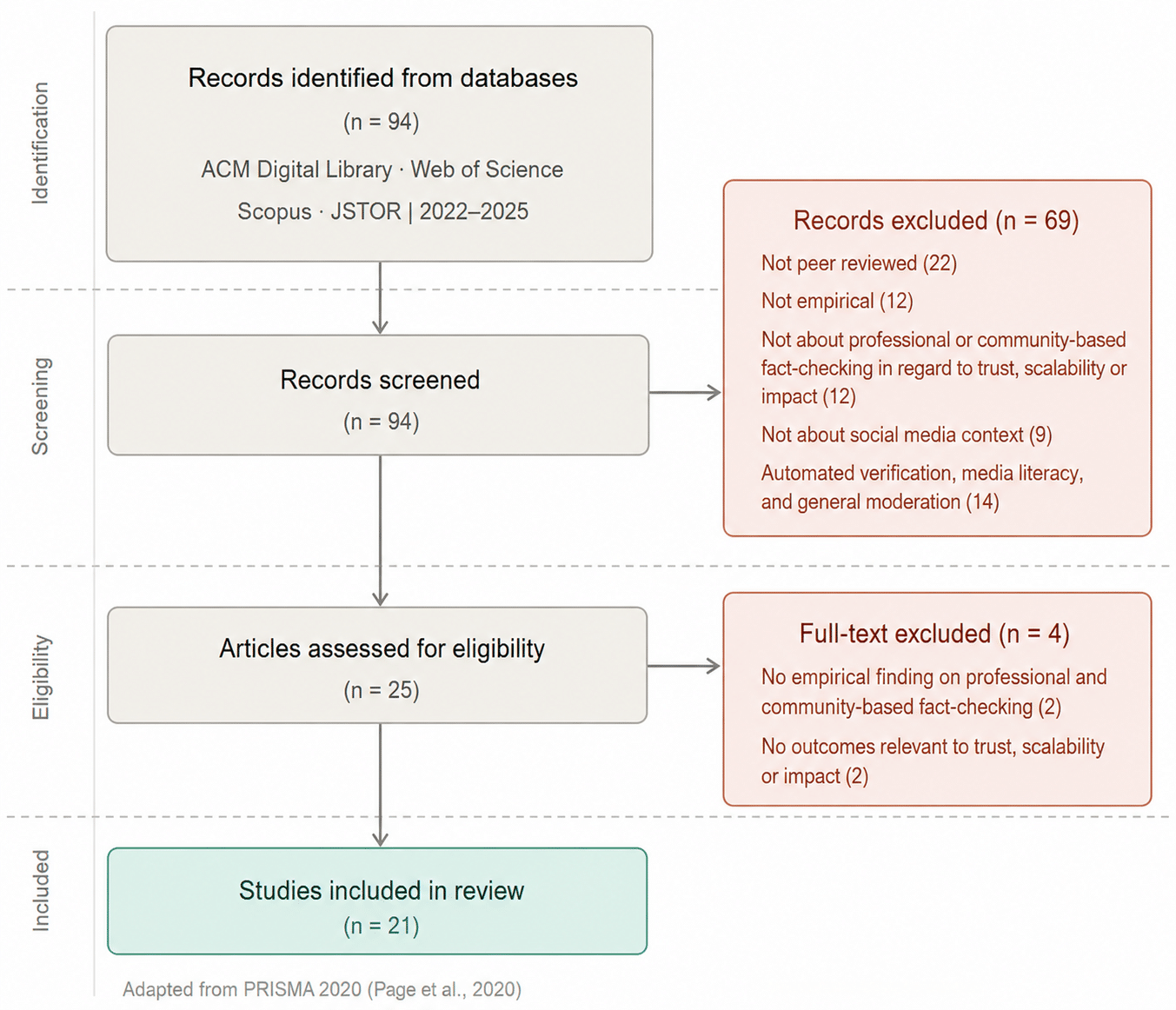
Search strings were constructed by combining three groups of terms with Boolean operators (see also Appendix C). Terms within each group were combined with OR, while the three groups were combined with AND. The search string was: (“misinformation” OR “disinformation”) AND (“social media” OR “platform*” OR “Twitter” OR “X” OR “Facebook” OR “WhatsApp”) AND (“fact-checking” OR “fact checking” OR “fact-check*” OR “misinformation correction” OR “Community Notes” OR “Birdwatch” OR “community fact-checking” OR “professional fact-checking” OR “crowdsourced verification” OR “peer fact-checking” OR “expert verification”).
The search was limited to studies published between 2022 and 2025 because the empirical study of community-based fact-checking as an operational platform-governance system, especially after Twitter’s Birdwatch/Community Notes, became available for empirical analysis in this period (Pröllochs, 2022; Saeed et al., 2022). Earlier work on crowd-based accuracy judgments is relevant (e.g., Allen et al., 2021; Godel et al., 2021). However, these studies were not included in the final sample because they examined crowd-based assessment models rather than deployed social media fact-checking systems with public annotations, visible contributor participation, and platform-level correction processes such as Birdwatch/Community Notes.
We included only peer-reviewed journal articles and accepted full conference proceedings that presented empirical findings on community-based and/or professional fact-checking on social media with relevance to trust, scalability, or impact. We excluded records that focused solely on automated detection, media literacy, or general content moderation when they did not examine human, community-based, or institutional fact-checking. From an initial yield of 94 unique records, 21 studies were retained after title, abstract, and full-text screening.
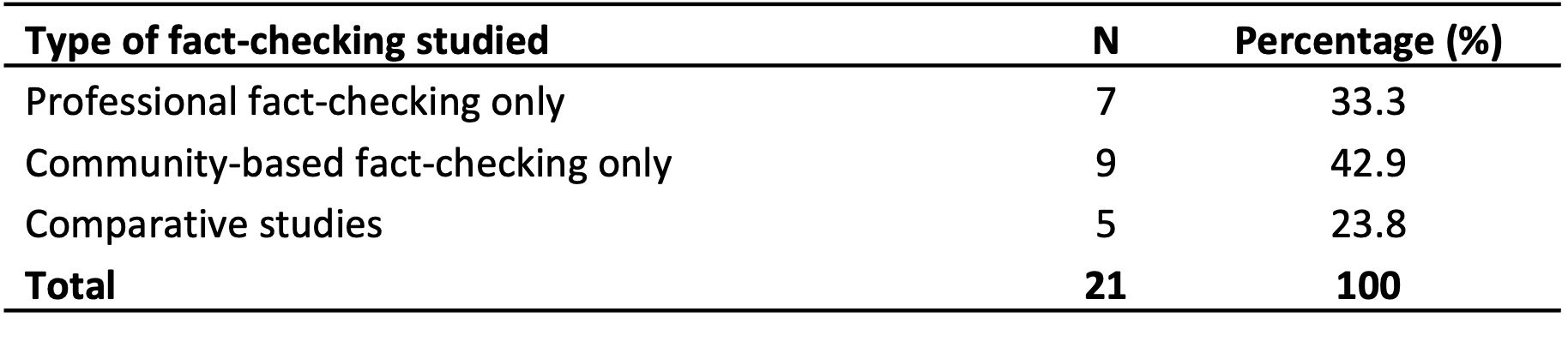
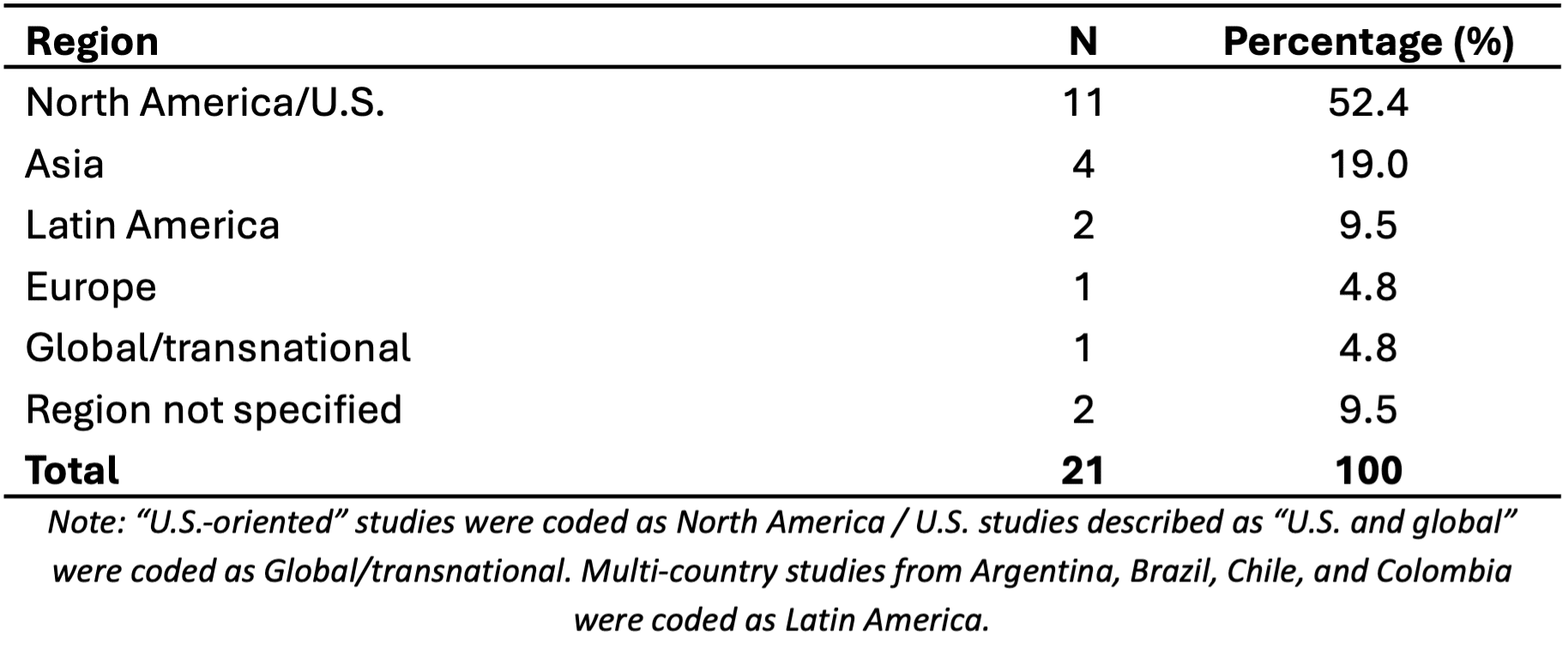
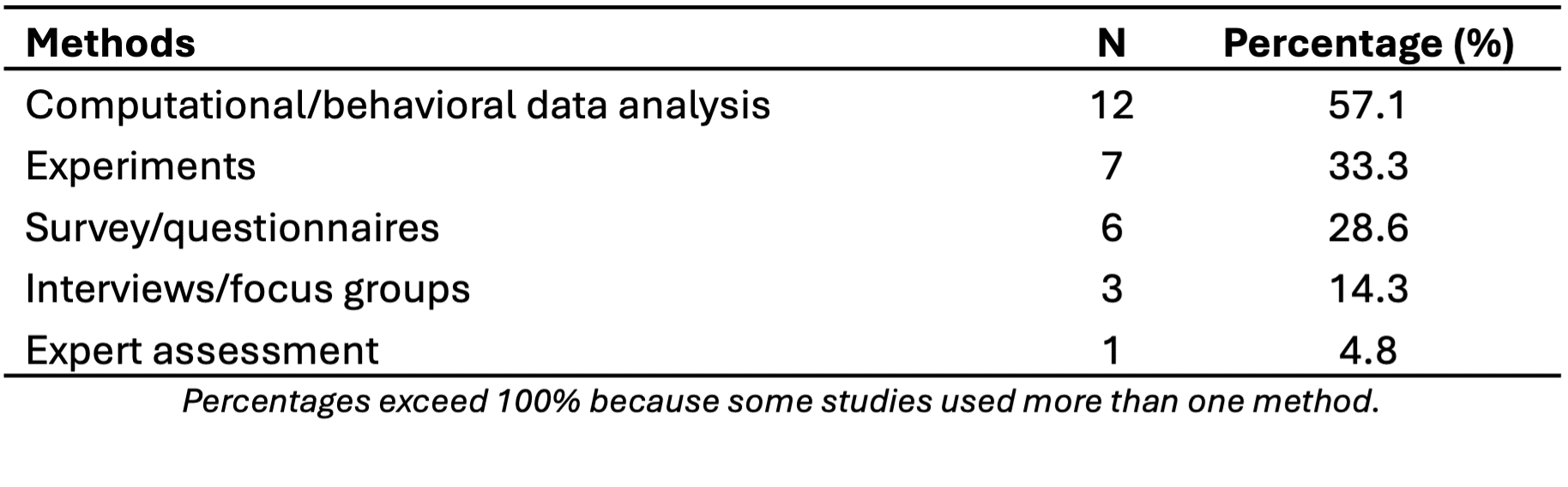
The final sample varied by study type (Table 1), region (Table 2), and methodological approach (Table 3). Studies of community-based fact-checking made up the largest share, followed by professional fact-checking studies and comparative studies. More than half were conducted in North America or were U.S.-oriented. Methodologically, over half relied primarily on computational or platform-based analyses, while one-third used experiments. Topics included elections and public affairs, COVID-19 and vaccination, health misinformation, and general political or social misinformation. In addition, 13 of the reviewed studies (61.9%) were conducted in the context of Birdwatch or Community Notes. This reveals how the sample reflects the structure of the emerging field itself: it is currently more focused on crowd-based fact-checking models, U.S.-centered platform environments, and measurable platform dynamics than on professional fact-checking in diverse contexts or on deeper user-oriented outcomes. In terms of platform coverage, Twitter/X was the dominant platform context, especially through studies of Birdwatch and Community Notes. Smaller numbers of studies examined Facebook, WhatsApp, and multi-platform or platform-unspecified contexts. Sample sizes varied considerably across methodological approaches: qualitative studies ranged from small expert interview samples (e.g., N = 12) to large survey experiments (e.g., N = 9,512), while computational studies analysed datasets ranging from approximately 4,900 Birdwatch notes to over 323,000 Community Notes and more than 2 million ratings. This variation in scale and method is reflected in the coding approach described in the Conceptual Framework section below.
Conceptual framework
The included studies varied substantially in research design, platform context, and outcome measures. Methodological heterogeneity of this kind is a common challenge in systematic reviews of complex interventions and makes it difficult to compare findings using a single standardized metric (Pigott & Shepperd, 2013). We therefore developed a simple conceptual framework, illustrated in Figure 2, to support a more systematic cross-study analysis. The framework was informed by recurring factors in the reviewed literature that either support or limit fact-checking effectiveness. It treats effective fact-checking as dependent on the alignment of three dimensions: trust, scalability, and impact. Trust refers to users’ perceived credibility of fact-checking outputs as credible, transparent, and politically neutral, and whether they are willing to accept corrections as legitimate (Brandtzaeg & Følstad, 2017; Lewandowsky et al., 2017). Scalability refers to resources, processing capacity, and dissemination reach (Allen et al., 2021; Godel et al., 2021). Impact refers to measurable effects on misinformation beliefs, sharing behavior, engagement, and deletion (Porter & Wood, 2021). These dimensions were applied across all included studies, regardless of whether they examined professional, community-based, or comparative approaches.
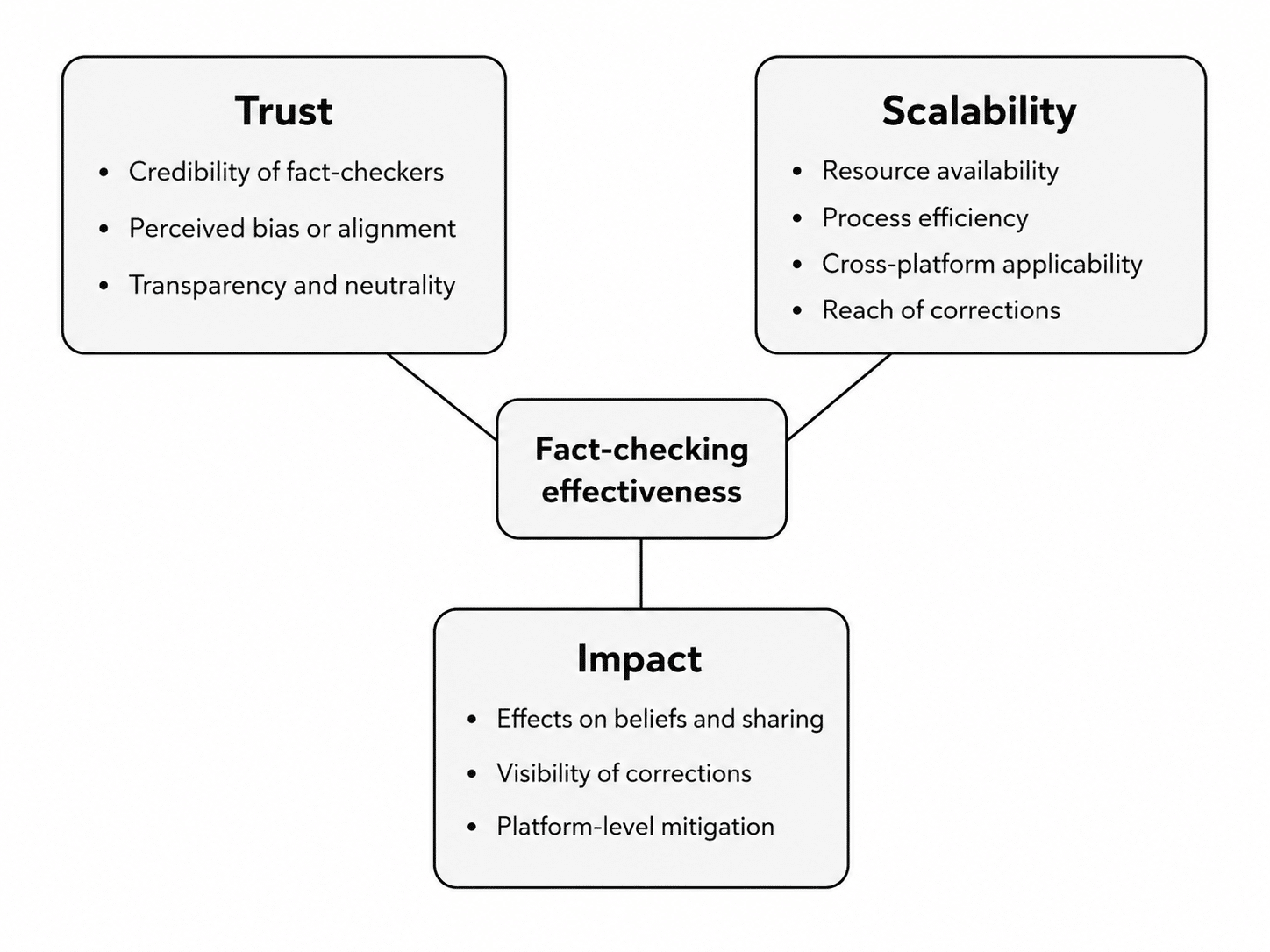
Each reviewed study was rated as low, moderate, or high on trust, scalability, and impact (see Appendix C for the rating criteria). To account for heterogeneity across the reviewed studies, the ratings were developed through a collaborative, consensus-based process. Three researchers first read the included studies independently and then discussed each study together until agreement was reached on the final ratings. We did not calculate formal intercoder reliability because the reviewed studies were too heterogeneous for a standardized reliability test to be meaningful. As O’Connor and Joffe (2020) note, formal intercoder reliability is not universally appropriate in qualitative or interpretive research, particularly when the task involves context-sensitive judgment rather than uniform coding of comparable material.
Finally, this review has several limitations. The literature is heavily concentrated on Twitter/X, especially in studies of Community Notes and Birdwatch, which limits generalizability to other platforms. The studies are methodologically heterogeneous, and many focus on short-term engagement or belief outcomes rather than long-term behavioral effects. Not all studies fully capture the growing role of AI-generated misinformation, which may place even greater pressure on future fact-checking systems (Bashardoust et al., 2024; Schroeder et al., 2026).
Topics
Bibliography
Allen, J., Arechar, A. A., Pennycook, G., & Rand, D. G. (2021). Scaling up fact-checking using the wisdom of crowds. Science Advances, 7(22), eabf4393. https://doi.org/10.1126/sciadv.abf4393
Allen, J., Martel, C., & Rand, D. G. (2022). Birds of a feather don’t fact-check each other: Partisanship and the evaluation of news in Twitter’s Birdwatch crowdsourced fact-checking program. In S. Barbosa, C. Lampe, C. Appert, D. A. Shamma, S. Drucker, J. Williamson, & K. Yatani (Eds.), CHI ’22: Proceedings of the Conference on Human Factors in Computing Systems. Association for Computing Machinery. https://doi.org/10.1145/3491102.3502040
Allen, M. R., Desai, N., Namazi, A., et al. (2024). Characteristics of X (formerly Twitter) Community Notes addressing COVID-19 vaccine misinformation. JAMA, 331(19), 1670–1672. https://doi.org/10.1001/jama.2024.4800
Aruguete, N., Bachmann, I., Calvo, E., Valenzuela, S., & Ventura, T. (2025). Truth be told: How “true” and “false” labels influence user engagement with fact-checks. New Media & Society, 27(3), 1443–1464. https://doi.org/10.1177/14614448231193709
Aruguete, N., Batista, F., Calvo, E., Guizzo-Altube, M., Scartaschini, C., & Ventura, T. (2024). Framing fact-checks as a “confirmation” increases engagement with corrections of misinformation: A four-country study. Scientific Reports, 14, Article 3201. https://doi.org/10.1038/s41598-024-53337-0
Bartsch, A., Neuberger, C., Stark, B., Karnowski, V., Maurer, M., Pentzold, C., Quandt, T., Quiring, O., & Schemer, C. (2025). Epistemic authority in the digital public sphere: An integrative conceptual framework and research agenda. Communication Theory, 35(1), 37–50. https://doi.org/10.1093/ct/qtae020
Bashardoust, A., Feuerriegel, S., & Shrestha, Y. R. (2024). Comparing the willingness to share for human-generated vs. AI-generated fake news. Proceedings of the ACM on Human-Computer Interaction, 8(CSCW2), Article 489. https://doi.org/10.1145/3687028
Brandtzaeg, P. B., & Følstad, A. (2017). Trust and distrust in online fact-checking services. Communications of the ACM, 60(9), 65–71. https://doi.org/10.1145/3122803
Chuai, Y., Tian, H., Pröllochs, N., & Lenzini, G. (2024). Did the roll-out of Community Notes reduce engagement with misinformation on X/Twitter? Proceedings of the ACM on Human-Computer Interaction, 8(CSCW2), Article 428. https://doi.org/10.1145/3686967
Cotter, K. (2021). “Shadowbanning is not a thing”: Black box gaslighting and the power to independently know and credibly critique algorithms. Information, Communication & Society, 26(6), 1226–1243. https://doi.org/10.1080/1369118X.2021.1994624
Drolsbach, C. P., & Pröllochs, N. (2022). Diffusion of community fact-checked misinformation on Twitter. Proceedings of the ACM on Human-Computer Interaction, 6(CSCW2), Article 428. https://doi.org/10.1145/3610058
Drolsbach, C. P., Solovev, K., & Pröllochs, N. (2024). Community Notes increase trust in fact-checking on social media. PNAS Nexus, 3(7), pgae217. https://doi.org/10.1093/pnasnexus/pgae217
Ejaz, W., Altay, S., & Ittefaq, M. (2025). How effective are fact-checks in Pakistan and who engages with them? Information, Communication & Society, 28(14), 2439-2461. https://doi.org/10.1080/1369118X.2024.2445636
Flamini, D. (2019, July 3). Most Republicans don’t trust fact-checkers, and most Americans don’t trust the media. Poynter. https://www.poynter.org/ifcn/2019/most-republicans-dont-trust-fact-checkers-and-most-americans-dont-trust-the-media/
Godel, W., Sanderson, Z., Aslett, K., Nagler, J., Bonneau, R., Persily, N., & Tucker, J. A. (2021). Moderating with the mob: Evaluating the efficacy of real-time crowdsourced fact-checking. Journal of Online Trust and Safety, 1(1). https://doi.org/10.54501/jots.v1i1.15
He, B., Hu, Y., Lee, Y.-C., Oh, S., Verma, G., & Kumar, S. (2025). A survey on the role of crowds in combating online misinformation: Annotators, evaluators, and creators. ACM Transactions on Knowledge Discovery from Data, 19(1), Article 10. https://doi.org/10.1145/3694980
Kuuse, S. F., Kangur, U., Chakraborty, R., & Sharma, R. (2025). Crowdsourced fact-checking or biased commentary? Analyzing political bias in Twitter’s Community Notes. In WWW ’25: Companion Proceedings of the ACM on Web Conference 2025 (pp. 2661–2669). Association for Computing Machinery. https://doi.org/10.1145/3701716.3717533
Kyriakidou, M., Cushion, S., Hughes, C., & Morani, M. (2022). Questioning fact-checking in the fight against disinformation: An audience perspective. Journalism Studies, 23(15–16), 2123–2139. https://doi.org/10.1080/17512786.2022.2097118
La Barbera, D., Maddalena, E., Soprano, M., Roitero, K., Demartini, G., Ceolin, D., Spina, D., & Mizzaro, S. (2024). Crowdsourced fact-checking: Does it actually work? Information Processing & Management, 61(5), Article 103792. https://doi.org/10.1016/j.ipm.2024.103792
Lavilles, R. Q., Naga, J. F., Tinam-isan, M. A. C., Perez, J. E., & Palad, E. B. B. (2023). Information verification practices and perception of social media users on fact-checking services. Journal of Information Science Theory and Practice, 11(1), 1–13. https://doi.org/10.1633/JISTaP.2023.11.1.1
Lee, S., Xiong, A., Seo, H., & Lee, D. (2023). “Fact-checking” fact checkers: A data-driven approach. Harvard Kennedy School (HKS) Misinformation Review, 4(5). https://doi.org/10.37016/mr-2020-126
Lewandowsky, S. (2025). Free speech, fact checking, and the right to accurate information. Science, 387(6632), 123–127. https://doi.org/10.1126/science.adv4632
Lewandowsky, S., Ecker, U. K. H., & Cook, J. (2017). Beyond misinformation: Understanding and coping with the “post-truth” era. Journal of Applied Research in Memory and Cognition, 6(4), 353–369. https://doi.org/10.1016/j.jarmac.2017.07.008
Liu, X., Qi, L., Wang, L., & Metzger, M. J. (2025). Checking the fact-checkers: The role of source type, perceived credibility, and individual differences in fact-checking effectiveness. Communication Research, 52(6), 719–746. https://doi.org/10.1177/00936502231206419
Meta. (2025, March). Testing begins for Community Notes on Facebook, Instagram and Threads. Meta Newsroom. https://about.fb.com/news/2025/03/testing-begins-community-notes-facebook-instagram-threads/
Metzler, H., & Garcia, D. (2023). Social drivers and algorithmic mechanisms on digital media. Perspectives on Psychological Science, 19(5), 735–748. https://doi.org/10.1177/17456916231185057
Nyhan, B. (2021). Why the backfire effect does not explain the durability of political misperceptions. Proceedings of the National Academy of Sciences, 118(15), e1912440117. https://doi.org/10.1073/pnas.1912440117
O’Connor, C., & Joffe, H. (2020). Intercoder reliability in qualitative research: Debates and practical guidelines.International Journal of Qualitative Methods, 19. https://doi.org/10.1177/1609406919899220
Page, M. J., McKenzie, J. E., Bossuyt, P. M., Boutron, I., Hoffmann, T. C., Mulrow, C. D., Shamseer, L., Tetzlaff, J. M., Akl, E. A., Brennan, S. E., Chou, R., Glanville, J., Grimshaw, J. M., Hróbjartsson, A., Lalu, M. M., Li, T., Loder, E. W., Mayo-Wilson, E., McDonald, S., McGuinness, L. A… & Moher, D. (2020). The PRISMA 2020 statement: An updated guideline for reporting systematic reviews. BMJ, 372, n71. https://doi.org/10.1136/bmj.n71
Park, C. S. (2023). Why people rely on fact-checkers? Testing theses of “perceived severity of fake news” and “disappointment in news media.” Journalism Studies, 25(10), 1–18. https://doi.org/10.1080/1461670X.2023.2289878
Pigott, T. D., & Shepperd, S. (2013). Identifying, documenting, and examining heterogeneity in systematic reviews of complex interventions. Journal of Clinical Epidemiology, 66(11), 1244–1250. https://doi.org/10.1016/j.jclinepi.2013.06.013
Pilarski, M., Solovev, K. O., & Pröllochs, N. (2024). Community Notes vs. Snopes: How the crowd selects fact-checking targets on social media. Proceedings of the International AAAI Conference on Web and Social Media, 18(1), 1262–1275. https://doi.org/10.1609/icwsm.v18i1.31387
Porter, E., & Wood, T. J. (2021). The global effectiveness of fact-checking: Evidence from simultaneous experiments in Argentina, Nigeria, South Africa, and the United Kingdom. Proceedings of the National Academy of Sciences, 118(37), e2104235118. https://doi.org/10.1073/pnas.2104235118
Pretus, C., Gil-Buitrago, H., Cisma, I., Hendricks, R. C., & Lizarazo-Villarreal, D. (2024). Scaling crowdsourcing interventions to combat partisan misinformation. Advances in Psychology, 2, e85592. https://doi.org/10.56296/aip00018
Primig, F. (2022). The influence of media trust and normative role expectations on the credibility of fact checkers. Journalism Practice, 18(5), 1137–1157. https://doi.org/10.1080/17512786.2022.2080102
Pröllochs, N. (2022). Community-based fact-checking on Twitter’s Birdwatch platform. Proceedings of the International AAAI Conference on Web and Social Media, 16(1), 794–805. https://doi.org/10.1609/icwsm.v16i1.19335
Roozenbeek, J., Remshard, M., & Kyrychenko, Y. (2024). Beyond the headlines: On the efficacy and effectiveness of misinformation interventions. Advances in Psychology, 2, e24569. https://doi.org/10.56296/aip00019
Saeed, M., Traub, N., Nicolas, M., Demartini, G., & Papotti, P. (2022). Crowdsourced fact-checking at Twitter: How does the crowd compare with experts? In CIKM ’22: Proceedings of the 31st ACM International Conference on Information & Knowledge Management (pp. 1736–1746). Association for Computing Machinery. https://doi.org/10.1145/3511808.3557279
Schroeder, D. T., Cha, M., Baronchelli, A., Bostrom, N., Christakis, N. A., Garcia, D., Goldenberg, A., Kyrychenko, Y., Leyton-Brown, K., Lutz, N., Marcus, G., Menczer, F., Pennycook, G., Rand, D. G., Schweitzer, F., Summerfield, C., Tang, A., Van Bavel, J., van der Linden, S., Song, D., & Kunst, J. R. (2026). How malicious AI swarms can threaten democracy. Science, 391(6783), 354–357. https://doi.org/10.1126/science.adz1697
Seelam, A., Paul Choudhury, A., Liu, C., Goay, M., Bali, K., & Vashistha, A. (2024). “Fact-checks are for the Top 0.1%”: Examining reach, awareness, and relevance of fact-checking in rural India. Proceedings of the ACM on Human-Computer Interaction, 8(CSCW1), Article 56. https://doi.org/10.1145/3637333
Swire-Thompson, B., Miklaucic, N., Wihbey, J. P., Lazer, D., & DeGutis, J. (2022). The backfire effect after correcting misinformation is strongly associated with reliability. Journal of Experimental Psychology: General, 151(7), 1655–1665. https://doi.org/10.1037/xge0001131
Tan, N. (2020). Electoral management of digital campaigns and disinformation in East and Southeast Asia. Election Law Journal: Rules, Politics, and Policy, 19(2), 214–239. https://doi.org/10.1089/elj.2019.0599
Zhao, A., & Naaman, M. (2023). Insights from a comparative study on the variety, velocity, veracity, and viability of crowdsourced and professional fact-checking services. Journal of Online Trust and Safety, 2(1). https://doi.org/10.54501/jots.v2i1.118
Zhou, Y., Hou, J., Gao, Y., & Chen, P.-Y. (2025). How does crowdsourced fact-checking approach tackling misinformation affect audience engagement? Evidence from Twitter’s Community Notes program. In T. X. Bui (Ed.), Proceedings of the 58th Hawaii International Conference on System Sciences (pp. 6554–6561). University of Hawaii. https://doi.org/10.24251/HICSS.2025.783
Funding
This project was funded by the Norwegian Research Council (grant agreement no. 352482) and the AI-democracy programme at the University of Oslo. They had no role in the design, interpretation, or reporting of the research.
Competing Interests
The authors declare no competing interests.
Ethics
This review protocol was exempt from ethics approval.
Copyright
This review protocol was exempt from ethics approval.
Data Availability
All materials needed to replicate this study are available via the Harvard Dataverse: https://doi.org/10.7910/DVN/JMGKFL