
Peer Reviewed
Emotional resonance and participatory misinformation: Learning from a K-pop controversy
Article Metrics

0
CrossRef Citations
PDF Downloads
Page Views
In today’s digital media environment, emotionally resonant narratives often spread faster and stick more firmly than verifiable facts. This paper explores how emotionally charged communication in online controversies fosters not only widespread engagement but also the participatory nature of misinformation. Through a case study of a K-pop controversy, we show how audiences act not just as consumers but as co-authors of alternative narratives in moments of uncertainty. These dynamics reflect a broader trend where emotionally driven discourse increasingly shapes public perception, challenging the role of facts in public debate.

Research Questions
- How do audiences engage in the creation, amplification, and reinterpretation of unverified information and conspiracy narratives during emotionally charged online controversies?
- How does emotionally resonant communication during high-profile public disputes influence shifts in online public sentiment?
- What rhetorical and emotional strategies contribute to the reframing of public narratives in digital spaces?
Essay Summary
- Emotionally charged rhetoric in digital spaces can rival, or even surpass, the persuasive power of factual argumentation.
- Online audiences are not passive consumers of rumors but active participants in creating, shaping, and amplifying misinformation and conspiracy narratives.
- Comment sections operate as emotional amplifiers, not just reflecting sentiment but actively steering the direction of discourse.
- Emotional authenticity, particularly in moments of perceived vulnerability or resistance, can rapidly shift public perception and narrative control.
- Online misinformation thrives in environments of uncertainty, where emotional cues fill in gaps left by ambiguous or contested facts.
Implications
In today’s digital media environment, emotionally resonant communication can dramatically shape public opinion, often more powerfully than factual information (Berger & Milkman, 2012; Brader, 2006; Papacharissi, 2014). This dynamic is especially significant in the context of misinformation, where emotional appeals not only influence individuals’ perceptions but also the participatory spread of unverified claims. Misinformation is commonly defined as false or misleading information (Lazer et al., 2018; Wardle & Derakhshan, 2017); however, recent work shows that misinformation also involves the processes through which the public (emotionally) interprets and circulates information amid uncertainty (Lühring et al., 2024; Martel et al., 2020; Starbird et al., 2019; Starbird et al., 2023). We use participatory misinformation to describe how audiences actively co-create, reinterpret, and amplify unverified narratives (Grass, 2021; Starbird et al., 2019; Starbird et al., 2023), and emotional resonance to indicate the persuasive power of affective appeals that influence people’s interpretation (Dillard & Seo, 2012; Papacharissi, 2014).
This study investigates the recent controversy between the South Korean entertainment company HYBE Corporation and Min Hee-jin (hereafter referred to as Min)—former CEO of ADOR, a subsidiary of HYBE—as a case study to explore how emotionally resonant communication and uncertainty structures interact to shape the construction and spread of participatory misinformation. Rather than taking a position on the validity of either party’s claims, this paper focuses on the public’s perception of the conflict. Appendix A summarizes major figures and events.
Emotionally resonant speech can serve as a powerful intervention point in narrative construction, even when the facts remain contested. This case underscores the volatility of public sentiment, especially in celebrity and corporate controversies. The rapid reversal in public perception toward Min, driven largely by a single press conference, illustrates how emotional resonance and perceived authenticity can reshape audience interpretation and challenge initial media narratives, retaining wide-reaching consequences—an effect reflected offline as HYBE’s financial stock fell 5%, losing 437.4 billion KRW (approximately $328.1 million USD) (Kim, 2024). Understanding these shifts is critical in an era where misinformation can rapidly amplify and influence public opinion, often outpacing factual correction (Vosoughi et al., 2018).
Misinformation must be understood not only in terms of content, but as a participatory and interpretive process. In the vacuum created by distrust in HYBE’s response, conspiracy theories flourished as people actively created rumors with almost no evidence beyond Min’s emotional appeal. Following Min’s press conference on April 25, 2024, claims of HYBE’s ties to the Dahn World cult,1Dahn World (also known as Body & Brain or Dahn Yoga) is a controversial organization founded in South Korea by Ilchi Lee in the 1980s. While it promotes meditation, yoga, and personal development, it has faced longstanding allegations of cult-like behavior, including coercive recruitment practices, financial exploitation, and emotional manipulation (Woo, 2011). accusations of political motives, and the plagiarism scandal involving ILLIT (another K-pop group under HYBE) surged. Despite minimal evidence, audiences pieced together vague cues and speculation to fill narrative gaps. This reflects a broader pattern of participation in digital spaces where emotionally activated publics construct meaning by assembling, reshaping, and amplifying alternative narratives (Martel et al., 2020; Papacharissi, 2014; Starbird, 2017).
Public credibility is shaped not just by what is stated, but by how the delivery is emotionally performed and received. Prior to Min’s April 25 conference, 63% of negative comments on YouTube explicitly targeted her with criticism about greed, betrayal, or disloyalty. However, following her emotionally charged and vulnerable press conference, only 25% of negative comments remained focused on her, while the bulk redirected blame toward HYBE’s corporate practices and alleged media manipulation. Commenters began praising Min as a “true artist,” a “visionary,” and some even described the press conference as “‘GOAT-level’ (an acronym for ‘Greatest of All Time’)”—evidence of how tone and delivery contributed to a reframing of her public persona. This contrasts with HYBE’s approach, which was to present their position primarily through media statements that were mostly fact-based (Cho, 2024; Koreaboo, 2024).
This case highlights how emotional performance influences assessments of credibility. Commenters celebrated not only Min’s points but her emotional delivery—visible frustration and raw sincerity with crying and cursing. While existing research has shown that emotional appeals enhance persuasion in politics and crisis communication (Brader, 2006; Kim & Cameron, 2011) and that high-arousal emotions drive engagement (Berger & Milkman, 2012; Brady et al., 2017), this case extends those findings to popular culture. Emotionally resonant appeals grounded in perceived authenticity can be equally persuasive in the realm of popular culture. Min’s perceived sincerity significantly shaped how audiences reinterpreted the narrative, and that shift reveals how emotional credibility can shape opinion in digital spaces.
Finally, the role of online comments should be understood as active sociotechnical engines of discourse. Comments sympathetic to Min or critical of HYBE were more likely to receive likes, replies, and higher visibility, reinforcing dominant narratives and creating emotional echo chambers. These micro-patterns contributed to the shaping and amplification of public sentiment.
These findings suggest several practical implications for platform design and use. For instance, platform designers could develop features to offer contextual prompts during high-intensity events. Public relations professionals should attend to tone, delivery, and perceived vulnerability, addressing speculative vacuums quickly to discourage misinformation-building and anticipating how official comments could be remixed by social media users. Educators can help learners recognize emotionally viral content and understand how emotional cues often fill interpretive gaps, encouraging more critical engagement during initial periods of crisis post-events.
Understanding misinformation in emotionally charged environments requires attention, as narratives fueled by personal rhetoric and amplified by digital platforms can rapidly reshape and redirect perception, not only in politics or crises but also in pop culture. Entertainment controversies are no longer confined to fan communities or niche media—they now unfold as high-stakes events with significant cultural and economic consequences.
Evidence
This study analyzes how public sentiment and discourse evolved during the HYBE vs. Min Hee-jin dispute, focusing on the impact of Min’s April 25, 2024, press conference. On April 22, 2024, HYBE accused Min, CEO of its subsidiary ADOR and the executive behind the girl group NewJeans, of attempting to take control of ADOR. The allegation triggered an internal audit and intense backlash against Min, with accusations of betrayal and ambition dominating the discourse. However, her press conference dramatically shifted public sentiment, redirecting criticism toward HYBE and its chairman, Bang Si-hyuk (hereafter Bang).
The narrative shifted again on May 17, 2024, following Bang’s public response to Min’s conference and a petition from NewJeans members supporting Min. Prior to this, discourse was largely centered on Min’s press conference and various unverified claims, including HYBE’s alleged connection to the religious group Dahn World and plagiarism controversies involving the girl group ILLIT. After May 17, however, the attention shifted toward Bang and NewJeans, with less focus on Min herself (see Appendix A for details).
This study draws on a dataset of 36,297 YouTube comments between April 22 and May 16, 2024, sourced from press conference recordings and news coverage. The analysis includes both qualitative sentiment assessment and thematic coding to explore how public narratives emerged and evolved during this period.
Sentiment shift: From betrayer to mom of NewJeans?
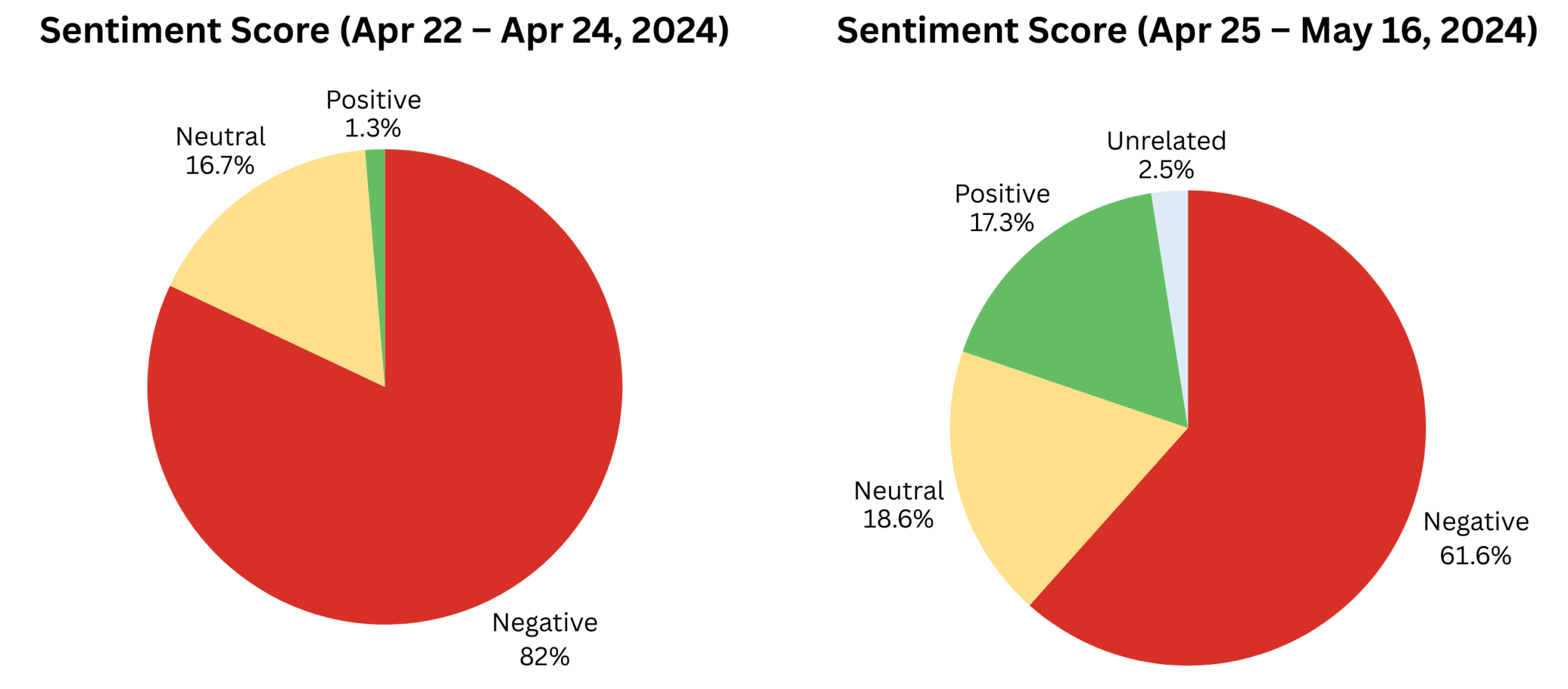
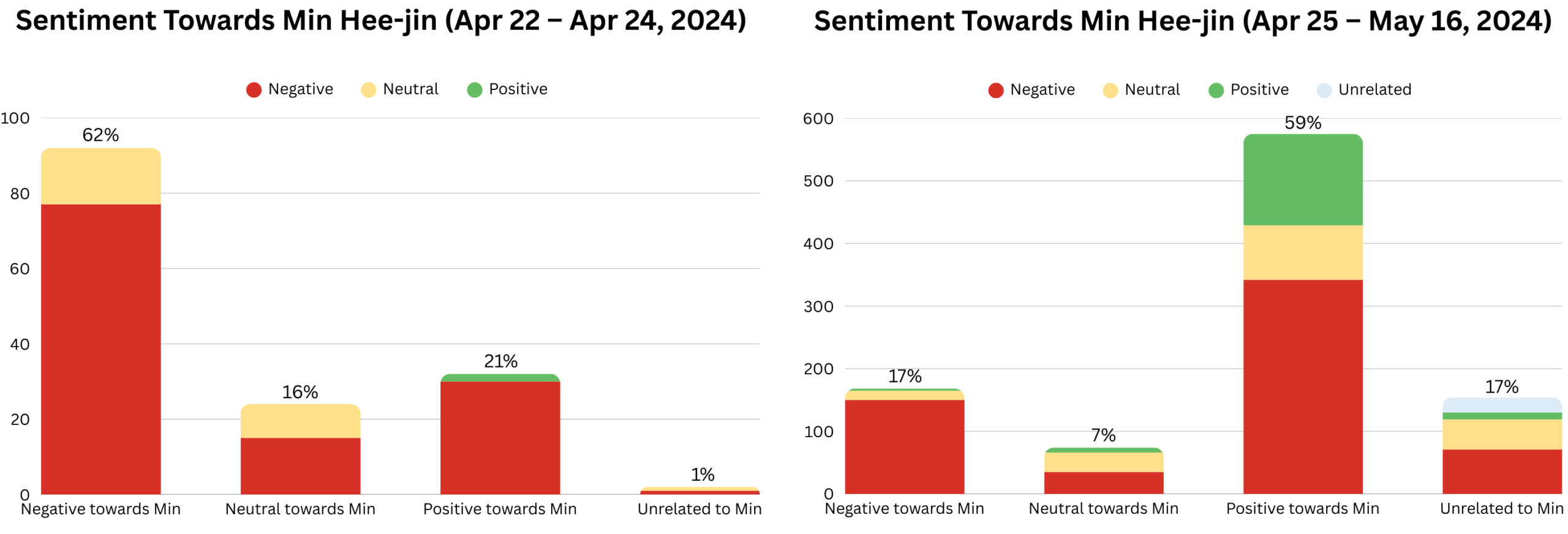
Figures 1 and 2illustrate the dramatic shift in public sentiment surrounding Min’s April 25 conference. Before the event (April 22–24), sentiment toward Min was overwhelmingly negative: 82% of comments were negative (see Figure 1) and 62% of those specifically targeted her (see Figure 2). Common accusations included “Min betraying HYBE”and“Min stealing NewJeans.” Notably, these reactions were largely speculative and not accompanied by concrete evidence, reflecting how uncertainty enables rumor formation in emotionally charged misinformation contexts (Starbird et al., 2019). Many commenters echoed phrases like “I knew it!” and cited their impressions of Min’s past behavior or ambition as justification, relying on preconceived notions rather than verified facts about the current situation.
After the press conference (April 25–May 16), public discourse shifted sharply. Positive comments rose to 17.3%, and negative comments dropped to 61.6% (see Figure 1). Crucially, most of the negativity was redirected at HYBE, while 87% of positive comments directly supported Min (see Figure 2), describing her as a “true artist,” a“visionary,” and someone “fighting alone against a corrupted system.” One comment noted: “She was at rock bottom, but in two hours, she turned a press conference into a fan meeting and convinced the nation—this is GOAT-level.” This transformation, from betrayer to “Mom of NewJeans,” reflects the power of moral, emotional, and identity-based language over facts in times of uncertainty.
Emotional persuasion and rhetorical power in Min Hee-jin’s press conference
While the quantitative shift is clear, qualitative analysis reveals the emotional and rhetorical strategies driving it. Table 1 identifies four recurring themes in positive comments, and these themes reflect how commenters interpreted the press conference and why they found it persuasive.
| Key themes in positive comments | Impact on public opinion |
| Genuine emotion | Her visible emotions and unpolished appearance were interpreted as sincerity, reshaping her image from manipulative to authentic. |
| Logical, articulate speech | Her reasoned delivery balanced emotion with logic, prompting audiences to reassess her credibility. |
| Courage against HYBE | Her public confrontation of corporate authority symbolized defiance and moral integrity, strengthening sympathy for her position. |
| Artistic integrity and identification | References to creative passion and overwork resonated with audiences who viewed her as relatable and hardworking. |
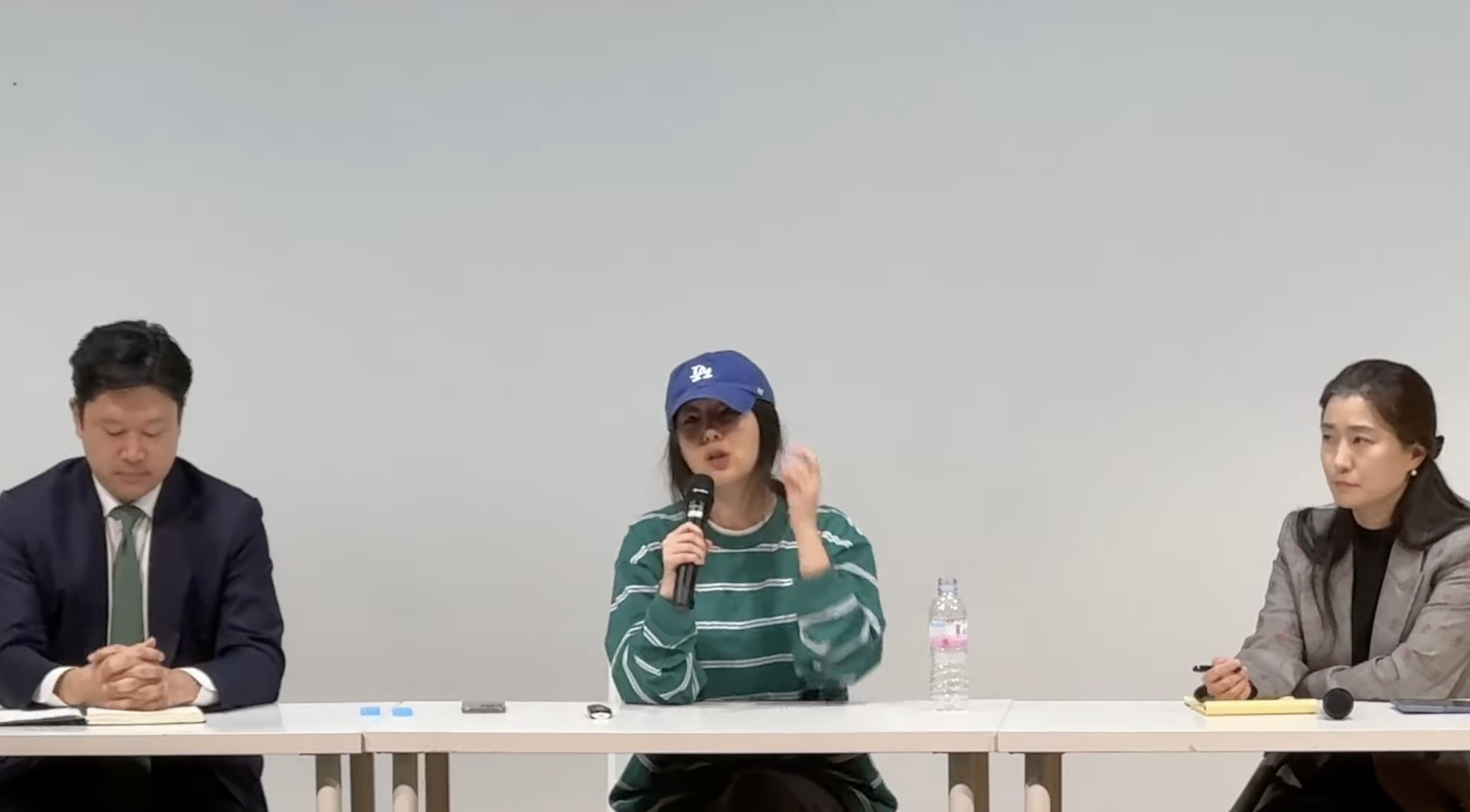
Genuine emotion. Commenters frequently cited Min’s visible frustration, tears, and vulnerability as evidence of sincerity, interpreting them as signs she was being truthful, aligning with research on emotional appeals in other communication (Brader, 2006; Kim & Cameron, 2011). One wrote, “Even if this was a performance, you can’t fake that level of naturalness.” The public largely received her emotional expression as authentic rather than performative, fostering trust even among previous skeptics (see Figure 3).
Logical and articulate delivery. Despite the emotional weight of the event, many commenters noted that Min maintained a reasoned and structured tone throughout. One comment noted, “She crushed them with facts, not emotions,” while another said, “Look at the video title. It makes it seem like she just cried and ranted for two hours, but actually she explained everything so logically.”This rhetorical clarity led some viewers to reassess earlier assumptions, framing her not just as an emotional figure but as someone capable of presenting a coherent argument.
Courage and defiance. Her willingness to challenge HYBE was perceived as symbolic resistance. Several commenters admired what they saw as her bravery: “The egg actually crushed the rock,” one wrote, while another stated, “A subsidiary CEO standing up against the head of the parent company… This takes courage!” Whether or not it involved real risk, the perception of courage reshaped how she was viewed.
Artistic integrity and identification. Audiences also highlighted her passion for NewJeans and her work ethic. Min was frequently described as someone deeply invested in the creative development of the group and in broader artistic principles. One comment noted, “Hearing her talk about NewJeans’ future made me focus more on her claims because she’s the one who actually created them.” Others connected with her remarks about living on food delivery app Baemin and constant overwork: “How can anyone report someone who just worked so hard? She just ordered from Baemin and supported a group (NewJeans).” These references to exhaustion and everyday labor strengthened identification with her as an overworked creator rather than a corporate insider.
This framing may have resonated with broader frustrations about the perceived commercialization of K-pop and the erosion of creative integrity (Uribe, 2024; Valge, 2019). As Min appeared to embody sincerity, artistic labor, and resistance to corporate control, HYBE was increasingly portrayed as profit-driven and detached from creativity. Together, these interpretations show that credibility hinged less on verifiable information than on authenticity and shared values, which in turn fuels both trust in individuals and skepticism toward institutions.
The rise of conspiracy and speculation
Alongside the shift in sentiment, the dispute also gave rise to a wave of conspiratorial and speculative narratives. The most prominent was the “HYBE and Dahn World” theory, which appeared in approximately 9.9% comments post-conference, despite being entirely absent beforehand. It claimed that HYBE had ties to a religious cult, citing supposed clues such as hand gestures in choreography, visual motifs in music videos resembling religious iconography, and alleged symbolic language used in branding. Other speculative themes included “HYBE’s political motives” and “ILLIT (a rival girl group) copying NewJeans,” often drawing on side-by-side video comparisons, similar outfit designs, or shared production styles.
These narratives were identified through thematic coding of randomly sampled comments and were co-constructed within the comments section by participating users. Users drew connections between disparate elements: visual cues from previous music videos like “OMG,” past interviews, ambiguous lyrics (e.g., the use of “Jiwon” in the song “ETA,” which some claimed was referring to Jiwon Park, the former CEO of HYBE), and subtle patterns in interactions among the artists. While factually unverified, this collective sensemaking reflects participatory misinformation dynamics (Starbird et al., 2019; Starbird et al., 2023), in which participants reconcile emotional responses with a perceived lack of transparency from HYBE.
In such contexts, determining factual status is often impossible: when competing parties advance conflicting “truths,” audiences are left to interpret events through emotional and rhetorical cues, using perceived sincerity and authenticity as proxies for credibility. This condition of contested truth is vital to misinformation studies, as it enables unverified claims and rumors to spread without factual resolution. Accordingly, contestation over truth does not negate facticity, but instead causes factual and non-factual information to circulate and be consumed in similar ways, complicating our ability to discern what is actually true. Similar to what Lee et al. (2022) observed in the BTS ARMY fandom, fans’ emotional investment and shared community identity can intensify collective information work, both amplifying and attempting to manage rumors and misinformation within participatory networks. This aligns with Jin (2016), who shows that K-pop fandoms’ affective and interpretive labor often turns uncertainty into shared meaning and emotionally grounded narratives.
This participatory process extended beyond comment sections into wider public attention. Google Trends data (n.d.-a; n.d.-b; see Appendix B) show a sharp surge in searches for “단월드 (Dahn World)” in South Korea following Min’s conference. The top and rising related queries in 2024 included “HYBE,” “Bang Si-hyuk,” “NewJeans,” and “ILLIT”—a pattern absent in 2023, when searches centered on yoga and meditation. This shift suggests that speculative associations first discussed in online comments quickly diffused into mainstream discourse.
The speed of this diffusion underscores the volatility of online discourses and the dynamics of participatory misinformation (Martel et al., 2020; Starbird, 2017): In uncertain contexts, communities construct and amplify unverified narratives, filling gaps left by institutional silence or distrust.
Methods
We collected 36,297 comments from Korean-language YouTube videos addressing the dispute between HYBE and Min Hee-Jin. From this dataset, we used Python to randomly sample approximately 50 comments per day, yielding a final sample of 1,130. This sample size was chosen to balance interpretive depth with analytic scale. YouTube was selected for its central role in distributing key content, including Min’s two-hour press conference, and capturing public reaction. While platforms like X (formerly Twitter) have historically served as hubs for pop culture discourse, recent platform changes and diminished user trust have reduced their visibility and influence in this context. TikTok, though globally significant, was only recently legitimized in Korea through K-pop fandom and continues to have a growing but demographically skewed user base (Abidin & Lee, 2023).
Data collection took place between April 22 and May 16, 2024, using the YouTube Data API. We collected comments from 23 Korean-language videos relevant to the dispute, identified using targeted search terms tied to key figures and themes (e.g., “Min Hee-jin Press Conference,” “HYBE Accusation on Min Hee-jin”). These included full press conference footage and news coverage from major broadcasters in Korea. See Appendix C for full selection criteria. Metadata, links for all collected videos, and comments are available in the supplemental materials.
Sentiment analysis
We initially conducted a quantitative sentiment analysis,2Models included pre-trained Korean-language models (KoBERT, KcBERT) and rule-based approaches using KoNLPy paired with VADER and TextBlob. but the tools consistently misclassified sarcasm, indirect criticism, and emotionally coded language as “neutral.” Neutral sentiment appeared to dominate—63.2% before and 75.3% after the press conference—yet manual review suggested otherwise.
Given these limitations, we adopted a qualitative, aspect-based sentiment analysis approach (Liu, 2012; Schouten & Frasincar, 2016) to better capture context and nuance. Using a random sample of 1,130 comments, all three coders used ATLAS.ti software to annotate each comment for general sentiment (positive, negative, or neutral) and directional sentiment (e.g., “positive toward Min,” “negative toward Min,” “neutral toward Min”). The first author coded the entire sample, and two additional inter-coders independently co-coded 20% of the dataset to assess consistency. All coders worked from a shared codebook and engaged in multiple rounds of comparison and consensus-building. The intercoder agreement rate reached 95.2%.
Qualitative thematic analysis
In addition to sentiment, we conducted a thematic analysis following Braun & Clarke’s (2006) framework. Our goal was to identify recurring narratives, emotional framings, and rhetorical strategies that shaped public interpretation of the dispute—particularly those related to misperception, speculation, and trust. The analysis was grounded in a hybrid approach: while initial coding was inductive, theme development was guided by our research questions about misinformation, emotional resonance, and shifts in audience perception.
The coding framework was developed by the lead author in collaboration with two-trained inter-coders, all fluent in Korean and English. Coders completed four phases: (1) initial open coding to identify recurring concepts, (2) intercoder reliability checks using a shared codebook, (3) collaborative comparison and refinement of emerging categories, and (4) final identification and definition of dominant themes. A full list of identified themes is available in the supplemental materials.
Limitations
The timeframe, from April 22 to May 16, 2024, reflects an early phase of the ongoing HYBE-Min Hee-jin controversy. As the situation developed, new developments could have reshaped the narrative after we completed data collection. The findings should be understood as a snapshot of an unfolding event. Future research could extend this analysis to capture longer-term shifts.
Although qualitative coding followed shared protocols and achieved 95.2% intercoder agreement, interpretations involve subjectivity. Comments were nested within users and videos, but because our focus was on comment-level patterns, we did not account for this dependence. Additionally, while gender and feminist framings were present in audience reactions, especially around emotion and power, they fall outside the scope of this paper.
Finally, our analysis of rhetorical and emotional strategies relied on audience perceptions rather than direct coding of Min’s press conference itself. Future research should attend to the official comments made by Min and associated actors to aid in a holistic understanding of what drove audience perceptions and shifts in discourse.
Despite these limitations, this approach provided a nuanced understanding of how emotion, sentiment, and narrative evolved across a high-profile cultural controversy. Combining sentiment classification with thematic interpretation showed not just what people felt, but how they expressed and shared it.
Topics
Bibliography
Abidin, C. & Lee, J. (2023). K-pop TikTok: TikTok’s expansion into South Korea, TikTok Stage, and platformed glocalization. Media International Australia, 188(1). https://doi.org/10.1177/1329878X231186445
Bang Si-hyuk. (2025, September 23). Wikipedia. https://en.wikipedia.org/wiki/Bang_Si-hyuk
Brader, T. (2006). Campaigning for hearts and minds: How emotional appeals in political ads work. The University of Chicago Press.
Braun, V., & Clarke, V. (2006). Using thematic analysis in psychology. Qualitative Research in Psychology, 3(2), 77–101. https://doi.org/10.1191/1478088706qp063oa
Berger, J. & Milkman, K. L. (2012). What makes online content viral? Journal of Marketing Research, 49(2), 192–205. https://psycnet.apa.org/doi/10.1509/jmr.10.0353
Brady, W. J., Wills, J. A., Jost, J. T., Tucker, J. A., & Van Bavel J. J. (2017). Emotion shapes the diffusion of moralized content in social networks. Psychological and Cognitive Sciences, 114(28), 7313–7318. https://doi.org/10.1073/pnas.1618923114
Cho, J. (2024, April 26). [종합] 하이브, ‘민희진의 난’에 조목조목 반박.. 경영권 탈취→뉴진스 볼모설까지(전문) [Comprehensive] HYBE refutes ‘Min Hee-jin’s Rebellion’ point by point. From management takeover allegations to claims of NewJeans being held as hostages (Full Statement)]. 조선일보 [The Chosun Ilbo]. https://www.chosun.com/entertainments/enter_general/2024/04/26/Y26AAGHXHE2Z2RHNYRVSNQEPBY/
Dillard, J. P. & Seo, K. (2012). Affect and persuasion. In J. P. Dillard & L. Shen (Eds.), The SAGE handbook of persuasion: Developments in theory and practice (pp. 150–166). SAGE Publications. http://dx.doi.org/10.4135/9781452218410.n10
Google Trends. (n.d.-a). 단월드 [Dahn World]. Retrieved October 28, 2025, from https://trends.google.com/trends/explore?date=2024-01-01%202024-12-31&geo=KR&q=%EB%8B%A8%EC%9B%94%EB%93%9C&hl=en
Google Trends. (n.d.-b). 단월드 [Dahn World]. Retrieved October 28, 2025, from https://trends.google.com/trends/explore?date=2023-01-01%202023-12-31&geo=KR&q=%EB%8B%A8%EC%9B%94%EB%93%9C&hl=en
Grass, M. (2021, May 26). What is participatory disinformation? Center for an Informed Public, University of Washington. https://www.cip.uw.edu/2021/05/26/participatory-disinformation-kate-starbird/
Hybe. (2025, September 13). Wikipedia. https://en.wikipedia.org/wiki/Hybe
Illit. (2025, September 14). Wikipedia. https://en.wikipedia.org/wiki/Illit
Jeong, S. (2024, May 4). 성차별과 갑질로 막 나가는 ‘개저씨’, 요즘도 있습니까? [Sexism and power abuse by ‘gaejeossi’, do they still exist these days?]. 조선일보 [The Chosun Ilbo]. https://www.chosun.com/national/weekend/2024/05/04/4F5ACBDQ7BGVBKVVOZO3GO5ZAU/
Jin, D. Y. (2016). New Korean wave: Transnational cultural power in the age of social media (1st ed.). University of Illinois Press. https://doi.org/10.5406/illinois/9780252039973.001.0001
Kim, D. (2024, April 26). 민희진 폭로에…하이브, 4천억 더 빠졌다 [After Min Hee-jin’s revelations… HYBE loses another 400 billion won]. 매일경제 [Maeil Business Newspaper]. https://www.mk.co.kr/news/stock/11001087
Kim, H. J. & Cameron, G. T. (2011). Emotions matter in crisis: The role of anger and sadness in the publics’ response to crisis news framing and corporate crisis response. Communication Research, 38(6), 826–855. https://doi.org/10.1177/0093650210385813
Koreaboo. (2024, April 26). Full translation of HYBE’s statement in response to ADOR Min Hee Jin’s press conference. Koreaboo. https://www.koreaboo.com/news/full-translation-hybe-statement-in-ador-min-hee-jin-press-conference
Lazer, D. M. J., Baum, M. A., Baum, Y. B., Berinsky, A. J., Greenhill, K. M., Menczer, F., Metzger, M. J., Nyhan, B., Pennycook, G., Rothschild, D., Schudson, M., Sloman, S. A., Sunstein, C. R., Thorson, E. A., Watts, D. J., & Zittrain, J. L. (2018). The science of fake news. Science, 359(6380), 1094–1096. https://doi.org/10.1126/science.aao2998
Lee, J. H., Santero, N., Bhattacharya, A., May, E., & Spiro, E. S. (2022). Community-based strategies for combating misinformation: Learning from a popular culture fandom. Harvard Kennedy School (HKS) Misinformation Review, 3(5). https://doi.org/10.37016/mr-2020-105
Liu, B. (2012). Sentiment analysis and opinion mining (Synthesis Lectures on Human Language Technologies, Vol. 5, pp. 1–167). Springer Cham. https://dx.doi.org/10.2200/s00416ed1v01y201204hlt016
Lühring, J., Shetty, A., Koschmieder, C., Garcia, D., Waldherr, A., & Metzler, H. (2024). Emotions in misinformation studies: Distinguishing affective state from emotional response and misinformation recognition from acceptance. Cognitive Research: Principles and Implications, 9(1), 82. https://doi.org/10.1186/s41235-024-00607-0
Martel, C., Pennycook, G., & Rand, D. G. (2020). Reliance on emotion promotes belief in fake news. Cognitive Research: Principles and Implications, 5(47). https://doi.org/10.1186/s41235-020-00252-3
Min Hee-jin. (2025, September 10). Wikipedia. https://en.wikipedia.org/wiki/Min_Hee-jin
NewJeans. (2025, September 11). Wikipedia. https://en.wikipedia.org/wiki/NewJeans
Papacharissi, Z. (2014). Affective publics: Sentiment, technology, and politics. Oxford University Press. https://doi.org/10.1093/acprof:oso/9780199999736.001.0001
Schouten, K., & Frasincar, F. (2016). Survey on aspect-level sentiment analysis. IEEE Transactions on Knowledge and Data Engineering, 28(3), 813–830. https://doi.org/10.1109/TKDE.2015.2485209
Starbird, K. (2017). Examining the alternative media ecosystem through the production of alternative narratives of mass shooting events on Twitter. Proceedings of the Eleventh International AAAI Conference on Web and Social Media, 11(1), 230–239. https://doi.org/10.1609/icwsm.v11i1.14878
Starbird, K., Arif, A., & Wilson, T. (2019). Disinformation as collaborative work: Surfacing the participatory nature of strategic information operations. Proceedings of the ACM on Human-Computer Interaction, 3(CSCW), 1–26. https://doi.org/10.1145/3359229
Starbird, K., DiResta, R., & DeButts, M. (2023). Influence and improvisation: Participatory disinformation during the 2020 US Election. Social Media + Society, 9(2). https://doi.org/10.1177/20563051231177943
TV10. (2024). Min Hee Jin Press Conference 20240425 [Photograph]. Wikimedia Commons. https://commons.wikimedia.org/wiki/File:Min_Hee_Jin_Press_Conference_20240425.png

Uribe, Y. T. (2024, September 17). Idolized and controlled: The reality behind K-pop’s shiny surface. The Link. https://thelinknewspaper.ca/article/idolized-and-controlled-the-reality-behind-k-pops-shiny-surface
Valge, C., & Hinsberg, M. (2019, October 2). The capitalist control of K-pop: The idol as a product. International Centre for Defense and Security. https://icds.ee/en/the-capitalist-control-of-k-pop-the-idol-as-a-product/
Vosoughi, S., Roy, D., & Aral, S. (2018). The spread of true and false news online. Science, 359(6380), 1146–1151. https://doi.org/10.1126/science.aap9559
Wardle, C., & Derakhshan, H. (2017). Information disorder: Toward an interdisciplinary framework for research and Policymaking. Council of Europe. https://rm.coe.int/information-disorder-report-november-2017/1680764666
Woo, H. (2011). Global project of Korean meditation enterprises and the Western response: Focused on activities of Dahn World and Maum Suryon. Journal of the Korean Academy of New Religions, 25(25), 25–60. https://doi.org/10.22245%2Fjkanr.2011.25.25.25
Funding
No funding has been received to conduct this research.
Competing Interests
The authors declare no competing interests.
Ethics
This study did not involve human subjects, clinical trials, or animal experiments requiring institutional review board (IRB) approval. All data analyzed consisted of publicly available online comments. No personally identifiable information was collected or analyzed. As such, informed consent was not required. This research did not report or classify ethnicity or gender of participants.
Copyright
This is an open access article distributed under the terms of the Creative Commons Attribution License, which permits unrestricted use, distribution, and reproduction in any medium, provided that the original author and source are properly credited.
Data Availability
All materials needed to replicate this study are available via the Harvard Dataverse: https://doi.org/10.7910/DVN/YRSCAK
Acknowledgements
We would like to thank Seoyoung Bae and Yerim Shin for their invaluable contributions as intercoder analysts.