
Explore All Articles
All Articles
Article Topic
Elections
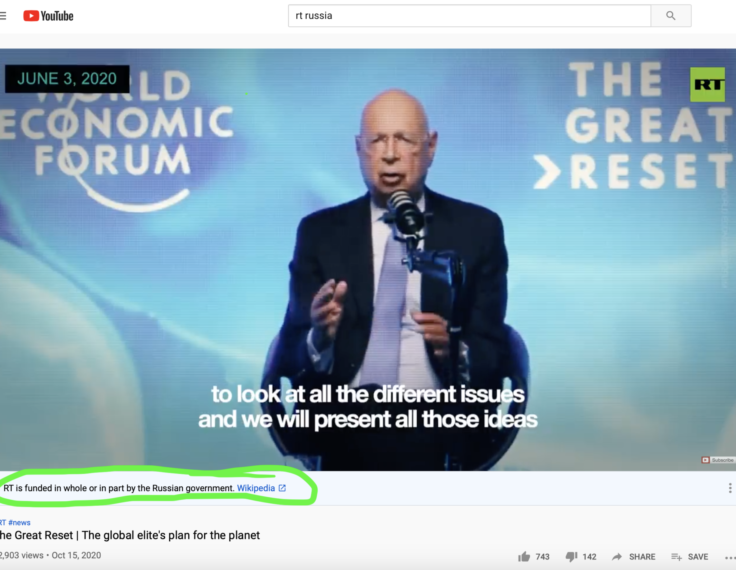
State media warning labels can counteract the effects of foreign misinformation
Jack Nassetta and Kimberly Gross
Platforms are increasingly using transparency, whether it be in the form of political advertising disclosures or a record of page name changes, to combat disinformation campaigns. In the case of state-controlled media outlets on YouTube, Facebook, and Twitter this has taken the form of labeling their connection to a state.

All disinformation is local: A reflection on the need and possibility of measuring impact
Irene Pasquetto
Volume 1, Issue 6 Editorial
By Irene Pasquetto Image by siora photography on unsplashThe title “All disinformation is local” was inspired by a tweet of Joan Donovan, on September 29th 2020
On September 1st, the leadership of the HKS Misinformation Review officially passed to Dr.

COVID-19
The weaponization of web archives: Data craft and COVID-19 publics
Amelia Acker and Mitch Chaiet
An unprecedented volume of harmful health misinformation linked to the coronavirus pandemic has led to the appearance of misinformation tactics that leverage web archives in order to evade content moderation on social media platforms. Here we present newly identified manipulation techniques designed to maximize the value, longevity, and spread of harmful and non-factual content across social media using provenance information from web archives and social media analytics.

COVID-19
Pandemics & propaganda: How Chinese state media creates and propagates CCP coronavirus narratives
Vanessa Molter and Renee DiResta
To gain insight into how Chinese state media is communicating about the coronavirus pandemic to the outside world, we analyzed a collection of posts from their English-language presence on Facebook. We observed three recurring behaviors: sharing positive stories and promoting the Chinese Communist Party’s (CCP) pandemic response, rewriting recent history in a manner favorable to the CCP as the coronavirus pandemic evolved, and using targeted ads to spread preferred messages.
COVID-19
Feeling “disinformed” lowers compliance with COVID-19 guidelines: Evidence from the US, UK, Netherlands, and Germany
Michael Hameleers, Toni G. L. A. van der Meer and Anna Brosius
This study indicates that, during the first phase of the coronavirus (SARS-CoV-2) pandemic in 2020, citizens from the US, UK, Netherlands, and Germany experienced relatively high levels of mis- and disinformation in their general information environment. We asked respondents to indicate the extent to which they experienced that information on coronavirus (SARS-CoV-2 and the disease it causes, COVID-19) was simply inaccurate (misinformation) or intentionally misleading (disinformation).
COVID-19
Leveraging volunteer fact checking to identify misinformation about COVID-19 in social media
Hyunuk Kim and Dylan Walker
Identifying emerging health misinformation is a challenge because its manner and type are often unknown. However, many social media users correct misinformation when they encounter it. From this intuition, we implemented a strategy that detects emerging health misinformation by tracking replies that seem to provide accurate information.

COVID-19
Signs of a new world order: Italy as the COVID-19 disinformation battlefield
Costanza Sciubba Caniglia
When Italy became the western center of the COVID-19 outbreak, it also became the focus of a series of states-sponsored coordinated disinformation campaigns. From early March through May 2020, disinformation operations in the country have increased noticeably, showing evidence of evolving strategies from multiple state actors geared towards reshaping the narrative of the global COVID-19 crisis and pushing forward geopolitical interests.
COVID-19
A dangerous misinfodemic spreads alongside the SARS-COV-2 pandemic
Meghan McGinty and Nat Gyenes
Special Issue on COVID-19 & Misinfodemics, Guest-Editors’ Editorial.
By Meghan McGintyNat Gyenes Image by Brian McGowan on UNSPLASHOn January 7th, 2020, Chinese authorities identified a new type of coronavirus, which was subsequently named severe acute respiratory syndrome coronavirus 2 (SARS-CoV-2).1https://www.who.int/docs/default-source/coronaviruse/situation-reports/20200121-sitrep-1-2019-ncov.pdf?sfvrsn=20a99c10_4
COVID-19
Why do people believe COVID-19 conspiracy theories?
Joseph E. Uscinski, Adam M. Enders, Casey Klofstad, Michelle Seelig, John Funchion, Caleb Everett, Stefan Wuchty, Kamal Premaratne and Manohar Murthi
As conspiracy theories about COVID-19 take root in the United States, understanding the psychological foundations of conspiracy beliefs is increasingly critical. Our research shows that beliefs in two popular variants of COVID-19 conspiracy theory are the joint product of the psychological predispositions 1) to reject information coming from experts and other authority figures and 2) to view major events as the product of conspiracies, as well as partisan and ideological motivations.