
Explore All Articles
All Articles
Article Topic
The different forms of COVID-19 misinformation and their consequences
Adam M. Enders, Joseph E. Uscinski, Casey Klofstad and Justin Stoler
As the COVID-19 pandemic progresses, an understanding of the structure and organization of beliefs in pandemic conspiracy theories and misinformation becomes increasingly critical for addressing the threat posed by these dubious ideas. In polling Americans about beliefs in 11 such ideas, we observed clear groupings of beliefs that correspond with different individual-level characteristics (e.g.,

Overcoming resistance to COVID-19 vaccine adoption: How affective dispositions shape views of science and medicine
John E. Newhagen and Erik P. Bucy
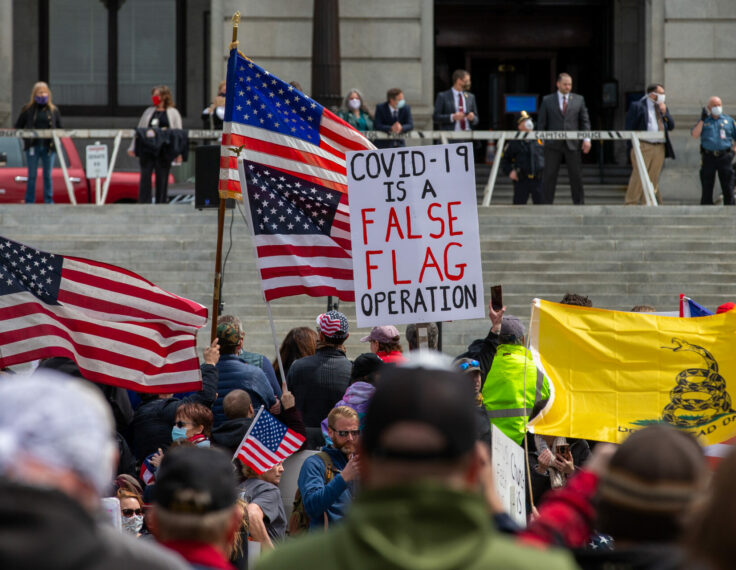
Health experts worry that a COVID-19 vaccine boycott could inhibit reaching “herd immunity,” and their concerns have only grown as the pandemic has spread. Concern has largely focused on anti-vaccine protestors, who captured headlines as they stood side by side with Tea Party activists and armed militia groups demonstrating against the quarantine in April and May of this year.

COVID-19
The Twitter origins and evolution of the COVID-19 “plandemic” conspiracy theory
Matthew D. Kearney, Shawn C. Chiang and Philip M. Massey
Tweets about “plandemic” (e.g., #plandemic)—the notion that the COVID-19 pandemic was planned or fraudulent—helped to spread several distinct conspiracy theories related to COVID-19. But the term’s catchy nature attracted attention from anti-vaccine activist filmmakers who ultimately created Plandemic the 26-minute documentary.

COVID-19
Not just conspiracy theories: Vaccine opponents and proponents add to the COVID-19 ‘infodemic’ on Twitter
Amelia M. Jamison, David A. Broniatowski, Mark Dredze, Anu Sangraula, Michael C. Smith and Sandra C. Quinn
In February 2020, the World Health Organization announced an ‘infodemic’—a deluge of both accurate and inaccurate health information—that accompanied the global pandemic of COVID-19 as a major challenge to effective health communication. We assessed content from the most active vaccine accounts on Twitter to understand how existing online communities contributed to the ‘infodemic’ during the early stages of the pandemic.

COVID-19
The spread of COVID-19 conspiracy theories on social media and the effect of content moderation
Orestis Papakyriakopoulos, Juan Carlos Medina Serrano and Simon Hegelich
We investigate the diffusion of conspiracy theories related to the origin of COVID-19 on social media. By analyzing third-party content on four social media platforms, we show that: (a) In contrast to conventional wisdom, mainstream sources contribute overall more to conspiracy theories diffusion than alternative and other sources; and (b) platforms’ content moderation practices are able to mitigate the spread of conspiracy theories.

COVID-19
Pandemics & propaganda: How Chinese state media creates and propagates CCP coronavirus narratives
Vanessa Molter and Renee DiResta
To gain insight into how Chinese state media is communicating about the coronavirus pandemic to the outside world, we analyzed a collection of posts from their English-language presence on Facebook. We observed three recurring behaviors: sharing positive stories and promoting the Chinese Communist Party’s (CCP) pandemic response, rewriting recent history in a manner favorable to the CCP as the coronavirus pandemic evolved, and using targeted ads to spread preferred messages.

COVID-19
Why do people believe COVID-19 conspiracy theories?
Joseph E. Uscinski, Adam M. Enders, Casey Klofstad, Michelle Seelig, John Funchion, Caleb Everett, Stefan Wuchty, Kamal Premaratne and Manohar Murthi
As conspiracy theories about COVID-19 take root in the United States, understanding the psychological foundations of conspiracy beliefs is increasingly critical. Our research shows that beliefs in two popular variants of COVID-19 conspiracy theory are the joint product of the psychological predispositions 1) to reject information coming from experts and other authority figures and 2) to view major events as the product of conspiracies, as well as partisan and ideological motivations.